

Research Personnel
First Section Exit and Entry
1. What documentation must foreign researchers obtain to work in China?
Pursuant to the Implementation Measures for Foreign Talent Visas jointly issued by the State Administration of Foreign Experts Affairs, the Ministry of Foreign Affairs of the People"s Republic of China, and the Ministry of Public Security of the People"s Republic of China, foreign researchers may complete relevant procedures for working in China through the following process:
I. Visa Application
A. Confirming Visa Type
Pursuant to the Implementation Measures for Foreign Talent Visas, foreign high-level talents meeting national requirements or those qualifying as urgently needed specialised professionals shall apply for an R visa; foreign young scientific and technological talents meeting the conditions and requirements stipulated by the relevant competent authorities of the Chinese government shall apply for a K visa; other applicants seeking employment within China shall apply for a Z visa.
B. Online Registration and Application
Employers must register in advance via the Service system for foreigners working in China.
For overseas applications, the inviting organisation must submit the application through the system while concurrently submitting materials to the Chinese embassy or consulate abroad. For domestic applications, foreign talents entering China on other visas may directly apply for a work permit from the administrative department where the employer is located and concurrently apply for an R visa.
II. Work Permit Processing
A. Preparation of Application Materials
Upload the following materials via the system:
1.Employment contract (Chinese version, signed and stamped by both parties)
2.Academic qualifications and Chinese translations
3.Certificate of no criminal record (notarised and authenticated)
4.Recent passport-style electronic photograph (plain white background)
B. Huairou District Application Service
Applications may be submitted via two channels:
1.Online
Submit via the Service system for foreigners working in China and await preliminary review.
2.Offline
Visit the Huairou Science City Government Service E-Station and Yanqi International Talent Service Hub (No. 53 Yanqi Avenue, Huairou District, Beijing) to process new applications, amendments, cancellations, etc. Enquiries: 010-60687447.
Upon approval, collect the Foreign National Work Permit Notification. Enter China using this notification alongside your visa.
III. Application for Work-Related Residence Permits
A. Application Timeline and Materials
Within 30 days of entry, submit your passport, visa, Foreigner"s Work Permit, and employer"s certification to the Entry-Exit Reception Hall of the Huairou Branch of the Beijing Municipal Public Security Bureau.
B. Expedited Service Channel
Through the Huairou District International Talent One-Stop Service Platform, the dual permit processing service enables simultaneous completion of work and residence permits, reducing processing time to 5 working days.
IV. Enquiries and Assistance
1.Huairou Science City Government Service E-Station and Yanqi International Talent Service Hub
Enquiry Hotline: 010-60687447;
2.Beijing Overseas Talents Center
Enquiry Hotline: 010-60640800;
3.Huairou District Foreign Nationals Working in China Service Office, Beijing
Office Telephone: 010-69685135.
Relevant Documents/Websites | Download Address |
Implementation Measures for Foreign Talent Visas | |
Service Guide to the Foreigner"s Work Permit in China (for Trial Implementation) | https://fuwu.most.gov.cn/r/cms/zwpt/web/pdf/wgrlhzq/20170418182639_469.pdf |
Service System for Foreigners Working in China | |
Labor Contract Law of the People"s Republic of China (2012 Amendment) | https://www.mohrss.gov.cn/xxgk2020/fdzdgknr/zcfg/fl/202011/t20201102_394622.html |
2. What requirements must foreign researchers meet to apply for an R visa?
According to the Implementation Measures for Foreign Talent Visas jointly issued by the State Administration of Foreign Experts Affairs, the Ministry of Foreign Affairs of the People"s Republic of China, and the Ministry of Public Security of the People"s Republic of China, foreign researchers applying for an R visa must meet the following requirements, as summarised below:
I. Eligibility Criteria
A. Talent Standard Requirements
Applicants must meet the criteria of being highly skilled, specialised, and in short supply, falling under the categories of scientists, leading scientific and technological talents, international entrepreneurs, specialised professionals, or highly skilled personnel required for national economic and social development.
B. Application Entity and Process Requirements
Applications must be submitted online by the employing organisation to the provincial-level foreign affairs management department. Upon approval, the R visa shall be issued by the Chinese embassy or consulate abroad.
II. Documentation Requirements
A. Basic Materials and Specific Requirements
The following materials must be prepared (all must be authentic and valid; Chinese translations must be provided where necessary):
Basic Materials | Regulatory Requirements |
Visa Application Form and Photograph | Complete one copy of the Visa Application Form for the People"s Republic of China and affix one recent, full-face, bareheaded colour passport photograph with a light-coloured background.(dimensions must meet embassy requirements, typically 2 inches) |
Valid Passport | Original passport with a validity exceeding 6 months and containing blank visa pages; additionally, provide one photocopy of the passport"s photo data page. |
Printed copy of the Confirmation Letter for Foreign High-Level Talent | / |
High-level Talent Certification | Must meet the criteria for foreign high-level talent or urgently needed specialised professionals as determined by the relevant Chinese government authorities; submit corresponding supporting documentation. |
Academic Qualifications and Degree Certificates | / |
Certificate of No Criminal Record | / |
Medical certificate | / |
Proof of lawful stay or residence | When applying for an R visa in a country other than your country of nationality, you must provide valid proof of lawful stay, residence, work or study in that country, or the original and photocopy of a valid visa. |
Original Chinese passport or original Chinese visa | Applicable to individuals who previously held Chinese nationality and subsequently acquired foreign nationality. |
III. Enquiries and Assistance
1.Huairou Science City Government Service E-Station and Yanqi International Talent Service Hub
Enquiry Hotline: 010-60687447, for document submission and processing status
2.Visa sections of Chinese embassies and consulates abroad
Contact details for relevant embassies/consulates may be found via the Ministry of Foreign Affairs of the People"s Republic of China website. Inquire regarding visa issuance procedures.
3.Beijing Overseas Talents Center
Enquiry Hotline: 010-60640800, for matters concerning R visas and talent recognition procedures
Relevant Documents/Websites | Download/Access Address |
Implementation Measures for Foreign Talent Visas | |
Application Guide for the Foreign High-Level Talent Confirmation Letter | |
Visa Application Form for the People"s Republic of China | https://cs.mfa.gov.cn/wgrlh/lhqz/sblhqz_660598/201308/t20130815_961427.shtml |
Ministry of Foreign Affairs of the People"s Republic of China |
3. What is the procedure for foreign researchers applying for an R visa from abroad, and what are the requirements for renewal or replacement? What documents must be submitted?
Pursuant to the Implementation Measures for Foreign Talent Visas jointly issued by the State Administration of Foreign Experts Affairs, the Ministry of Foreign Affairs of the People"s Republic of China, and the Ministry of Public Security of the People"s Republic of China, the procedures and requirements for applying for, replacing, or renewing (including renewal upon expiry) an R visa for foreign researchers are outlined as follows:
I.Application and Renewal/Replacement Procedures for R Visas
A. Overseas Application Procedure
1.Employer"s online submission
The employing organisation logs into the Service System for Foreigners Working in China to submit the application online, uploading supporting documents such as the invitation letter and high-level talent certification;
2.Provincial-level department review and issuance of confirmation letter
Provincial foreigner work management authorities review the application materials. Upon approval, a Confirmation Letter for Foreign High-Level Talent is generated. The employer forwards this confirmation letter to the foreign applicant;
3.Applicant applies at embassy/consulate
The applicant presents the Confirmation Letter for Foreign High-Level Talent and other required documents to the Chinese embassy or consulate abroad to apply for an R visa. Upon approval by the embassy or consulate, the visa is issued.
B. Visa Replacement Procedure
Applicable to scenarios involving loss, damage, information changes, or expiry renewal. The specific procedures are as follows:
1.Standard replacement (Loss/Damage/Information change)
The applicant submits a Visa application to the Exit-Entry Administration Bureau of the public security organ at their current place of stay or residence. They complete the Visa Application Form and submit relevant supporting documents. Upon approval, the replacement or renewal is completed.
2.Renewal upon expiry (Processed domestically)
Within 30 days prior to the visa"s expiry date, submit the Application Form for Foreigner"s Visa and Documents to the Entry-Exit Reception Hall of the Huairou Branch of the Beijing Municipal Public Security Bureau. Concurrently provide the passport, valid work permit, employer"s certificate, and other required materials. Upon approval by the public security authority, a new R visa will be issued, with the validity period generally not exceeding five years.
II. Documentation Requirements
Application Type | Requirements |
Overseas Application for R Visa | 1.Original passport with a validity of over 6 months and blank visa pages, plus a photocopy of the photo data page; 2.Printed copy of the Confirmation Letter for Foreign High-Level Talent (to be obtained and provided by the employing organisation); 3.An invitation letter issued by the employing organisation (must specify the nature of the research collaboration, duration of stay, etc.); 4.Evidence of high-level talent status (e.g., industry recognition certificates, proof of research achievements, documentation of selection for national-level talent programmes); 5.Academic qualifications and degree certificates (notarised or authenticated); 6.Certificate of no criminal record (notarised or authenticated); 7. Health certificate (issued by Chinese health quarantine authorities or legitimate overseas medical institutions). |
Visa Replacement Materials:Standard Replacement (Loss/Damage/Information Change) | 1. Visa Application Form (1 copy, affixed with a recent, full-face, bareheaded colour passport photograph against a light-coloured background); 2. Original passport and photocopy of the photo data page; 3. Statement of Circumstances (detailing the reason for loss/damage or the nature of the information change); 4. Copy of original visa (if available, to assist with verification); 5. Recent passport photograph.(1 copy, dimensions compliant with passport requirements) |
Visarenewal/replacement documentation: | 1. Original passport and photocopy of the original visa page; 2. Original and photocopy of the Foreigner"s Work Permit; 3. Employment verification letter issued by the employer (must specify current position and employment period, bearing the employer"s official seal); 4. Accommodation registration certificate (declared by the hotel or by the individual/host within 24 hours of entry); 5. One recent, front-facing, bareheaded colour passport photograph against a light-coloured background; 6. Foreign National Visa Application Form, stamped and confirmed by the employing organisation. |
III. Enquiries and Assistance
1.Huairou Science City Government Service E-Station and Yanqi
International Talent Service Hub:
Enquiry Hotline: 010-60687447;
2.Entry-Exit Reception Hall, Huairou Branch of Beijing Municipal Public Security Bureau:
Enquiry Hotline: 010-69685135;
3.Beijing Overseas Talents Center:
Enquiry Hotline: 010-60640800 (for R visa policy coordination and work permit-visa linkage matters);
4.Enquiries at Chinese embassies and consulates abroad:
Contact details for relevant embassies and consulates may be obtained via the Ministry of Foreign Affairs of the People"s Republic of China website for enquiries regarding overseas visa application procedures.
Relevant Document Names | Download Location |
Implementation Measures for Foreign Talent Visas | |
Service system for foreigners working in China | |
Visa Application Form of the People"s Republic of China / Foreign National Visa Document Application Form | https://cs.mfa.gov.cn/wgrlh/lhqz/sblhqz_660598/201308/t20130815_961427.shtml |
Official Website of the Ministry of Foreign Affairs of the People"s Republic of China |
4. How to apply for renewal upon expiry of an R visa?
Pursuant to the Implementation Measures for Foreign Talent Visas jointly issued by the State Administration of Foreign Experts Affairs, the Ministry of Foreign Affairs of the People"s Republic of China, and the Ministry of Public Security of the People"s Republic of China, the procedures, required documentation, and key considerations for renewing expiring R visas for foreign researchers within China are outlined below:
I. Procedures for Renewing an R Visa Upon Expiry Within China
1.Application deadline and submission location
Applications must be submitted to the Entry-Exit Reception Hall of the Huairou Branch of the Beijing Municipal Public Security Bureau within 30 days prior to the expiry date of the current R visa.
2.Documentation submission and form completion
Bring the complete set of application materials and complete the Application Form for Foreigner"s Visa and Documents (requiring confirmation by the employer"s official seal). Submit these in person to the aforementioned authority;
3.Review and renewal
Public security authorities shall verify the authenticity and completeness of the materials. Upon approval, a new R visa shall be issued to the applicant, with the new visa"s validity period generally not exceeding five years.
II. Requirements for Renewal Upon Expiry Within China
The following materials must be prepared (all materials must be authentic and valid; Chinese translations must be provided where necessary; both originals and photocopies must be brought):
Document Name | Specific Requirements |
Passport | Original passport valid for at least six months with blank visa pages, plus one photocopy of the passport photo data page. |
Original R Visa | Photocopy of the original R visa page (if the visa is in an old passport, the original old passport and a photocopy of the corresponding visa page must also be provided). |
Foreign National Work Permit | Original Foreign National Work Permit valid for the duration of employment, plus one photocopy. |
Employer"s Certificate of Employment | Must specify the applicant"s current position, employment period, employer"s contact person and contact details, and bear the employer"s official seal; Should the applicant"s employer or position have changed prior to visa renewal, the Foreigner Work Permit must first be amended via the Foreigner Work Management Service System. Visa renewal may only be applied for once the amendment is complete. |
Accommodation Registration Certificate | Must comply with the requirement to register within 24 hours of entry (hotel accommodation is registered by the hotel; self-owned/rented accommodation is registered by the individual or host). Provide the original certificate. |
Recent passport-sized photograph | One recent, full-face, bareheaded colour passport photograph against a light background.(meeting immigration document standards, typically 2 inches in size) |
Application Form for Foreign National Visa Documents | One copy, completed truthfully with employer"s signature and company seal. |
III. Enquiries and Assistance
1.Entry-Exit Reception Hall, Huairou Branch of Beijing Municipal Public Security Bureau
Enquiry Hotline: 010-69685135;
2.Huairou Science City Government Service E-Station and Yanqi International Talent Service Hub
Enquiry Hotline: 010-60687447 (No. 53 Yanqi Avenue, Huairou District, Beijing);
3.Beijing Overseas Talents Center
Enquiry Hotline: 010-60640800.
Relevant Documents/Websites | Download/Access Address |
Implementation Measures for Foreign Talent Visas | |
Application Form for Foreign Nationals" Visa Documents | https://cs.mfa.gov.cn/wgrlh/lhqz/sblhqz_660598/201308/t20130815_961427.shtml |
5. How to apply for a replacement or renewal of a lost, damaged, or stolen R visa?
Pursuant to the Implementation Measures for Foreign Talent Visas jointly issued by the State Administration of Foreign Experts Affairs, the Ministry of Foreign Affairs of the People"s Republic of China, and the Ministry of Public Security of the People"s Republic of China, the procedures, required materials, and key considerations for foreign researchers to apply for a replacement R visa following loss are outlined below:
I. Procedure for Reissuing a Lost R Visa
1.Reporting the loss (Primary step)
Upon losing the visa, immediately report the loss to the local public security authority (police station in the place of residence or where the loss occurred), detailing the circumstances. Upon verification, the authority will issue a Certificate of Loss (retain the original as the core document for reissuance).
2.Submit replacement application
Present the complete set of application materials at the Entry-Exit Reception Hall of the Huairou Branch of the Beijing Municipal Public Security Bureau to submit the replacement application. Complete the Application Form for Foreigner"s Visa and Documents on-site (this form may be downloaded and completed in advance online, or collected at the venue).
3.Verification and issuance
The public security authorities shall verify the authenticity of the materials and the circumstances of the loss. Upon approval, a new R visa shall be issued to the applicant, with a declaration that the original lost visa is invalidated (the validity period of the new visa shall be based on the remaining validity of the original visa or re-assessed according to policy, generally not exceeding five years).
II. Requirements for Replacement Materials
The following materials must be prepared (all materials must be authentic and valid; Chinese translations must be provided where necessary; both originals and photocopies must be presented):
Document Name | Specific Requirements |
Passport | Original passport valid for at least six months with blank visa pages, plus one photocopy of the passport photo data page.(if the passport is also lost, it must be replaced first) |
Certificate of Loss | Original Certificate of Loss for the visa issued by the local public security authority.(must specify key details including date and location of loss, visa type, and visa number) |
Statement of Circumstances | To be written by the applicant, detailing the specific time, location, and circumstances of the visa loss, along with current employment details in China (including employer and position). Must be signed and confirmed by the applicant. |
Employer"s Certificate of Employment | Issued by the employer, stating the applicant"s name, position, employment period, company contact person and contact details, explicitly stating agree to assist in processing the visa replacement, and bearing the company"s official seal. |
Proof of Accommodation Registration | Complies with the requirement to register within 24 hours of entry (hotel stays are registered by the hotel; self-owned/rented accommodation is registered by the individual or host). Provide the original certificate.(obtainable from the police station or accommodation provider) |
Recent Passport Photograph | One recent colour passport photograph, front view, bareheaded, against a light-coloured background. |
Application Form for Foreign Nationals" Visa and Documents | 1 copy, to be completed truthfully with personal details, loss circumstances and application matters, signed and stamped by the employing organisation for confirmation. |
Download links for the aforementioned forms | https://www.nia.gov.cn/n741445/n741619/index.html (Official Form Download Section of the National Immigration Administration) |
III. Enquiries and Assistance
1.Entry-Exit Reception Hall, Huairou Branch of Beijing Municipal Public Security Bureau:
Enquiry Hotline: 010-69685135;
2.National Immigration Administration Service Hotline:
Enquiry Hotline: 12367, 24-hour bilingual service addressing national visa replacement policies;
3.Service System for Foreigners Working in China Support:
Enquiry Hotline: 010-84233515 or 010-84233569.
Relevant Documents/Websites | Download/Access Address | Notes |
Implementation Measures for Foreign Talent Visas | Core Policy Document for National-Level R-Type Visa Scheme | |
Government Service Platform of National Immigration Administration | https://s.nia.gov.cn/mps/bszy/wgrcrj/sqwgrqz/201903/t20190313_1006.html | Comprehensive Guide to Visa Replacement Procedures (Including Online Application Portal) |
Beijing Municipal Government Service Platform Immigration Services Page | https://banshi.beijing.gov.cn/pubtask/task/1/110000000000/f0861bcf-a925-401e-b360-8f1513e1e78f.html | Beijing Regional Visa Replacement Application Portal |
National Immigration Administration Fee Schedule | / |
6. How long does it take to process an R visa?
In accordance with relevant policies from the State Administration of Foreign Experts Affairs, the Ministry of Foreign Affairs of the People"s Republic of China, the Ministry of Public Security of the People"s Republic of China, and local regulations of Beijing Municipality, the requirements for foreign researchers applying for or processing an R visa are as follows:
I. Processing Duration
For applications submitted overseas, Chinese embassies and consulates typically issue the visa within 5-10 working days from the date of acceptance. Applicants meeting the criteria for expedited processing may request priority handling, which can be completed within 3-5 working days.
Beijing has introduced streamlined procedures for R visas: applications submitted via the One-Stop Online Service platform may be processed within 5 working days for eligible applicants. Domestic renewals or replacements of R visas take even less time: standard processing requires 7 working days, while urgent cases with supporting documentation may be completed within 3 working days.
II. Expedited Processing Requirements
When applying for expedited processing of an R visa, two additional categories of materials must be submitted:
Firstly, documentation substantiating the urgency of the matter;
Secondly, a statement from the employing organisation clearly outlining the necessity for expedited processing, the applicant"s role in China, and the critical timeline for the urgent matter, bearing the organisation"s official seal.
III. Important Notes
All processing times commence from the date when the application materials are complete and compliant. Incomplete submissions or requests for supplementary information will result in extended processing periods.
To further enhance processing efficiency, the Huairou District International Talent One-Stop Service Platform offers a document pre-review service. Applicants or employers may submit materials via this platform for preliminary assessment, thereby reducing delays caused by documentation issues during on-site processing and shortening the overall processing cycle.
Document Title | Download Address | Remarks |
Implementation Measures for Foreign Talent Visas | Core Policy Document for National-Level R-Type Visa Scheme | |
Entry Point for Beijing Municipal Government Services Platform One-Stop Online Service | Beijing Municipal R Visa Streamlined Application Channel | |
Government Service Platform of National Immigration Administration | Track application progress and download forms |
7. What is a K visa, and what conditions must be met to apply for one?
Pursuant to Decision of the State Council to Amend the Regulation of the People"s Republic of China on the Administration of the Entry and Exit of Foreign Nationals (2025) and Regulation of the People"s Republic of China on the Administration of the Entry and Exit of Foreign Nationals (2025 Revision), the K visa constitutes a newly established ordinary visa category specifically designed for foreign young scientific and technological talents.
I. Definition of the K Visa
The K visa is an entry permit issued by the Government of the People"s Republic of China to foreign young scientific and technological talents. It constitutes a new ordinary visa category introduced effective 1 October 2025, aiming to facilitate the entry of foreign young scientific and technological talents to China for activities such as scientific and technological exchanges, entrepreneurship, and research. This visa addresses existing gaps in the provision of targeted services for young scientific and technological talents under the current visa framework.
II. Eligibility Criteria
Applicants must align with the Foreign Young Scientific and Technological Talent Profile and meet one of the following two criteria, with no mandatory requirement for a domestic employing or inviting organisation:
1. Academic background category
Graduation from a recognised domestic or international university or research institution in a Science, Technology, Engineering, or Mathematics (STEM) discipline, holding a bachelor"s degree or higher qualification;
2. Work experience category
Engaged in teaching or research work within STEM-related disciplines at renowned domestic or international universities or research institutions.
III. Documentation Requirements
In accordance with visa application requirements, the following authentic and valid documents must be prepared, subject to the latest specifications issued by Chinese embassies or consulates abroad:
Material Name | Specific Requirements |
Visa Application Form and Photograph | 1.Complete the Visa Application Form for the People"s Republic of China; 2.Affix one recent, full-face, bareheaded colour passport photograph against a light-coloured background. |
Passport | 1.The passport must remain valid for at least six months beyond the intended visa validity period and contain at least two blank visa pages; 2.Provide one photocopy of the passport"s photo data page. 3.Validity period must meet requirements. |
Relevant Academic/Professional Qualifications | 1.Applicants with academic background: Provide original and photocopied degree certificates (bachelor"s degree or higher) in STEM fields issued by renowned domestic or international universities/research institutions; 2.Applicants with work experience: Provide original and photocopied proof of education/research work in STEM fields issued by renowned domestic or international universities/research institutions. |
Additional supporting documents | 1.Where applicable, provide supplementary documentation of research achievements within the STEM field; 2.Where the applicant is applying from a third country (not their country of nationality), provide original and photocopied proof of lawful stay/residence in that third country. |
IV. Core Features of the K Visa
Compared to the existing 12 categories of ordinary visas, the K visa offers greater flexibility in terms of entry frequency, validity period, and duration of stay. Holders may engage in educational, scientific, cultural exchanges, entrepreneurial activities, and business-related pursuits upon entry. The K visa imposes specific requirements only regarding age and educational background or work experience, without mandating a domestic employer or inviting organisation. The application process is also streamlined for greater convenience.
V. Consultation and Assistance
1.Chinese embassies and consulates abroad
The addresses, contact details, and latest K visa review criteria for embassies and consulates in China can be found on the Chinese Consular Service website. Some embassies and consulates support online appointment booking and preliminary document review.
2.National immigration administration 24-hour service hotline
Enquiry Hotline: 12367 (Chinese and English bilingual service)–provides guidance on K visa policies, permitted activities after entry, and stay extension procedures;
3.Ministry of Science and Technology of the People"s Republic of China / State Administration of Foreign Experts Affairs
Supplementary policies such as recognition criteria for foreign young scientific and technological talents may be consulted via the official websites of the Ministry of Science and Technology of the People"s Republic of China or the State Administration of Foreign Experts Affairs.
VI. Relevant Documents/Websites
Relevant Documents/Websites | Download/Access Address |
Decision of the State Council to Amend the Regulation of the People"s Republic of China on the Administration of the Entry and Exit of Foreign Nationals (2025) | https://www.gov.cn/zhengce/content/202508/content_7036507.htm |
China Consular Service Network | |
Government Service Platform of National Immigration Administration | https://s.nia.gov.cn |
Ministry of Science and Technology of the People"s Republic of China Official Website |
8. Is it necessary for researchers to reapply for visa filing when undertaking short-term overseas exchanges?
In accordance with the Implementation Measures for Foreign Talent Visas jointly issued by the State Administration of Foreign Experts Affairs, the Ministry of Foreign Affairs of the People"s Republic of China, and the Ministry of Public Security of the People"s Republic of China, as well as relevant regulations of Beijing Municipality, the requirements for foreign researchers undertaking short-term overseas exchanges for scientific purposes are summarised as follows:
I. Filing for Short-Term Overseas Exchange
1. Departure not exceeding 30 days
If the Foreigner"s Work Permit remains valid, no separate visa filing is required. However, upon re-entry, the individual must update their accommodation registration with the local police station within 24 hours via their lodging establishment or the host/accommodation provider.
2. Departure exceeding 30 days
An application for extension of the Foreigner"s Work Permit must be submitted in advance to the Huairou Science City Government Service E-Station and Yanqi International Talent Service Hub (No. 53 Yanqi Avenue, Huairou District, Beijing). When submitting the extension application, the visa filing information must be updated concurrently. Departure is permitted only after the extension application has been approved.
II. Documentation Requirements for Record Filing
Type of Filing | Essential Documentation Checklist | Document Requirements |
Short-term Departure (exceeding 30 days) | 1. Statement of purpose for travel issued by the employing organisation (must specify urgency of research tasks); 2. Copy of the research cooperation agreement (bearing the official seal of the employing organisation); 3. Copy of applicant"s passport and valid visa page; 4. Original and photocopy of the Foreigner"s Work Permit. | Foreign-language documents must be accompanied by Chinese translations. The agreement must explicitly state the continuity of research tasks during the period of absence. |
III. Points to Note
1.Risks associated with changes to employment information
Should changes occur to the employer, position, or research project during the period abroad, the holder must immediately reapply for a work permit amendment via the Service System for Foreigners Working in China upon re-entry into China. Concurrently, visa filing information must be updated. Failure to do so may result in being deemed to be engaged in illegal employment, potentially leading to fines or restrictions on residence.
2.Validity of documentation
All filing materials must be valid at the time of application. Expired documents require reissuance and notarisation/legalisation.
IV. Enquiries and Assistance
1.Huairou Science City Government Service E-Station and Yanqi International Talent Service Hub (No. 53 Yanqi Avenue, Huairou District, Beijing):
Enquiry Hotline: 010-60687447;
2.Exit-Entry Reception Hall, Huairou Branch of Beijing Municipal Public Security Bureau:
Enquiry Hotline: 010-69685135 (for collection of exit filing forms and frequent entry-exit policies);
3.Service System for Foreigners Working in China:
Enquiry Hotline: 010-84233515 or 010-84233569, for assistance with online filing procedures.
Relevant Document Name | Download Address | Remarks |
Implementation Measures for Foreign Talent Visas | Policy Basis Documents | |
Service System for Foreigners Working in China | Work Permit Extension Application Portal | |
National Immigration Administration Form Download Zone | Including the Application Form for Foreign Nationals" Visa and Documents and other standard forms | |
Beijing Municipal Public Security Bureau Exit-Entry Services | Enables enquiry into specific local filing requirements |
9. Will foreign researchers frequently entering and exiting the country for scientific collaborations be deemed to be engaged in illegal employment?
I. Determination of Illegal Employment
Pursuant to Article 43 of the Exit and Entry Administration Law of the People"s Republic of China:
Under any of the following circumstances, a foreign national is working illegally:
(1)Working within China without obtaining a work permit and a residence permit of the work type as required;
(2)Working within China beyond the scope specified in a work permit; or.
(3)Working within China beyond the prescribed scope of jobs or period in violation of rules for the administration of work-study foreign students, if the foreign national is a foreign student.
It follows that frequent cross-border travel for research collaboration does not inherently constitute illegal employment, provided such activities comply with Chinese laws and regulations.
Pursuant to the Exit and Entry Administration Law of the People"s Republic of China, foreigners working within China must obtain both a work permit and a work-related residence permit. Should scientific collaboration involve substantive work activities without the requisite work permit, it may be deemed illegal employment.
II. Frequent Cross-Border Travel
Under the Exit and Entry Administration Law of the People"s Republic of China, foreign researchers requiring frequent cross-border travel must complete prior approval for work permits. The Chinese collaborating institution must submit an application through the Service System for Foreigners Working in China to the Beijing Municipal Science and Technology Commission to obtain a Foreigners" Work Permit Notification. Foreign researchers may then apply for a Z visa at Chinese embassies or consulates abroad using this document.
Upon entry with a Z visa, the collaborating institution must assist the researcher in applying for a work-type residence permit at the Exit-Entry Administration Bureau of the Beijing Municipal Public Security Bureau within 30 days. This permit serves as the legal authorisation for foreign researchers to work lawfully in China and facilitates multiple entries and exits within its validity period.
Additionally, foreign nationals must register their temporary accommodation with the local police station within 24 hours of each entry, presenting their passport and rental agreement.
III. Points to Note
1.Risks associated with changes in employment information
Should changes occur to the employing organisation, position, or research project during periods abroad, the foreign national must immediately reapply for a work permit amendment via the Service System for Foreigners Working in China upon re-entry. Concurrently, visa filing information must be updated. Failure to do so may result in classification as illegal employment, potentially leading to fines or residency restrictions.
2.Application for multiple-entry convenience
Frequent travelers may explicitly request a 5-10 year multiple-entry visa when initially applying for or renewing an R visa at embassies/consulates or domestic immigration authorities. Submission of a long-term scientific cooperation plan as supporting documentation is required to reduce repetitive filing procedures.
3.Validity of supporting documents
All filing materials must be valid at the time of application. Expired documents require reissuance and notarisation/legalisation.
IV. Consultation and Assistance
1.Entry-Exit Reception Hall, Huairou Branch of Beijing Municipal Public Security Bureau:
Enquiry Hotline: 010-69685135;
2.Service System for Foreigners Working in China:
Enquiry Hotline: 010-84233515 or 010-84233569 (for online filing procedure enquiries).
Relevant Document Name | Download Address | Remarks |
Implementation Measures for Foreign Talent Visas | Policy Basis Documents | |
Service System for Foreigners Working in China | Work Permit Extension Application Portal | |
National Immigration Administration Form Download Zone | Including the Application Form for Foreign Nationals" Visa and Documents and other standard forms | |
Exit and Entry Administration Law of the People"s Republic of China | https://www.nia.gov.cn/n741440/n741547/c1013311/content.html | / |
10. How do foreign researchers apply for residence permits?
In accordance with the Implementation Measures for Foreign Talent Visas jointly issued by the State Administration of Foreign Experts Affairs, the Ministry of Foreign Affairs of the People"s Republic of China, and the Ministry of Public Security of the People"s Republic of China, as well as relevant provisions of the Exit and Entry Administration Law of the People"s Republic of China, the requirements for foreign researchers to apply for a work-related residence permit in China (hereinafter referred to as the Residence Permit) are outlined as follows:
I. Residence Permit Application Process
Foreign researchers must complete residence permit applications within 30 days of entry. The core process comprises three steps: Document Preparation - Application Submission - Review and Certificate Collection. Huairou District offers dedicated facilitation services as detailed below:
1.Document preparation
Employers shall assist applicants in compiling the complete set of materials (including online submission information). Preliminary document review may be conducted via the Huairou District International Talent One-Stop Service Platform to minimise the need for on-site corrections.
2.Application submission
In-person submission: Present materials at the Entry-Exit Reception Hall of the Huairou Branch of the Beijing Municipal Public Security Bureau, complete the Application Form for Foreigner Visa and Documents on-site, and submit materials.
Online submission: Upload materials via the Government Service Platform of National Immigration Administration or the “移民局 12367” app, then attend in person for original document verification after making an online appointment.
3.Review and collection
Public security authorities will verify the authenticity of documents and the applicant"s lawful employment status in China. Standard processing takes 7 working days. Applications processed through Huairou District"s One-Stop Service Platform for concurrent Work Permit + Residence Permit applications may be completed within 5 working days. Upon approval, applicants may collect the residence permit in person with the receipt or opt for postal delivery.
II. Documentation Requirements for Residence Permit Applications
Document Category | Specific Documents | Document Requirements |
Basic Identity Documents | 1.Valid passport 2.Recent front-facing colour passport photograph with bare head against light background 3.Application Form for Foreign Nationals" Visa Documents | The passport must remain valid for at least six months beyond the intended duration of the residence permit. The applicant"s name must be written on the reverse of the photograph. |
Employment-Related Documents | 1.Original and photocopy of valid Foreign National Work Permit 2.Employment verification letter issued by the employer | The employment certificate must specify the applicant"s position, employment period, employer"s contact person and contact details, and bear the employer"s official seal; High-level talents may submit a Confirmation Letter for Foreign High-end Talents in lieu of certain supporting documents. |
Residence Basis Materials | 1.Proof of accommodation registration 2.Health certificate (required for first-time residence permit applications with a stay exceeding 6 months) | Accommodation registration must be completed within 24 hours of entry (hotels declare for lodgings; applicants or hosts declare for self-owned/rented residences); Health certificates must be issued by Chinese health quarantine authorities or accredited overseas medical institutions. |
Supplementary Documents for Special Circumstances | 1.Former Chinese nationals: Copy of original Chinese passport or original Chinese visa 2.Accompanying family members: Proof of kinship | Proof of kinship must be notarised or authenticated. Applications for residence permits for accompanying family members must be submitted concurrently with the principal applicant"s documentation. |
III. Enquiries and Assistance
1.Entry-Exit Reception Hall, Huairou Branch of Beijing Municipal Public Security Bureau:
Enquiry Hotline:010-69685135(for document lists, processing timelines, and joint application policies)
2.Huairou Science City Government Service E-Station and Yanqi International Talent Service Hub:
Enquiry Hotline: 010-60687447, assists with document pre-review, work permit and residence permit joint processing coordination, etc.;
3.National Immigration Administration:
Enquiry Hotline: 12367, 24-hour bilingual service addressing national residence permit policies;
4.Service System for Foreigners Working in China:
Enquiry Hotline: 010-84233515 or 010-84233569.
Relevant Documents | Download address | Notes |
Implementation Measures for Foreign Talent Visas | One of the policy bases for residence permit processing | |
Application Form for Foreign Nationals" Visa and Documents | National Immigration Administration Official Website Form Download Section | |
Government Service Platform of National Immigration Administration | https://s.nia.gov.cn | Online Application, Appointment Booking and Progress Tracking Platform |
11. What are the remedial measures and penalty standards for overstaying after a residence permit expires?
Pursuant to Exit and Entry Administration Law of the People"s Republic of China and relevant regulations of Beijing public security authorities on exit-entry management, the remedial procedures, documentation requirements, and penalty standards for foreign nationals whose residence permits have expired are summarised as follows:
I. Remedial Process for Overstaying Residence Permits
A. Remedial Measures for Overstaying
1.Overstay not exceeding 10 days
An immediate written explanation must be submitted to the Entry-Exit Reception Hall of the Huairou Branch of the Beijing Municipal Public Security Bureau, accompanied by required documents to apply for an extension. Online appointments may be made in advance via the Beijing Municipal Public Security Bureau Online Entry-Exit Services Platform to reduce on-site queuing time. The specific process includes:
Complete the Application Form for Foreigners" Visa and Documents online;
Submit materials in person at the scheduled appointment time. Upon approval, the extension endorsement will be completed within 3-5 working days.
2.Overstay exceeding 10 days
First undergo administrative penalties imposed by public security authorities (specific standards below), then reapply for a visa or residence permit using the Administrative Penalty Decision Notice. Progress of the penalty process may be tracked via the Government Service Platform of National Immigration Administration.
B. Departure Procedures
If extension cannot be obtained, departure preparations must be completed within 15 days:
1.Proceed to the Exit-Entry Administration Bureau of the public security organ that issued your original residence permit to complete departure registration formalities;
2.Purchase departure flight tickets using the filing receipt and retain the booking documentation;
3.Upon departure, present your passport, proof of fine payment, and departure flight ticket to the border inspection authorities to complete exit verification.
II. Documentation Requirements
Procedure | Essential Documentation Checklist | Method of Obtaining/Downloading Materials |
Application for Extension | 1. Application Form for Foreign Nationals" Visa and Documents; 2. Original/copy of valid passport and original residence permit; 3. Statement of reasons for extension issued by the employer (with official seal); 4. Supporting documentation substantiating the reasonableness of the overstay (e.g., medical certificates for sudden illness). | Application form downloads: https://www.nia.gov.cn/n741445/n741619/index.html (National Immigration Administration official website) |
Departure Procedures | 1.Original passport and original residence permit; 2.Fine payment receipt issued by the public security authorities; 3.Departure flight booking confirmation. (must display departure date and flight details) |
III. Penalty Standards and Legal Basis
Pursuant to Article 78 of the Exit and Entry Administration Law of the People"s Republic of China:
A foreign national who illegally resides in China shall be warned; and if circumstances are serious, shall be fined 500 yuan for each day of illegal residence but not more than 10,000 yuan in total or be detained for not less than five days but not more than 15 days.
Where a foreign national under 16 illegally resides in China because his or her guardian or any other person assuming guardianship fails to the perform a guardian"s obligations, the guardian or other person assuming guardianship shall be warned and may be fined not more than 1,000 yuan concurrently.
IV. Consultation and Assistance
1.Entry-Exit Reception Hall, Huairou Branch of Beijing Municipal Public Security Bureau:
Enquiry Hotline: 010-69685135 (on-site processing guidance, document supplementation enquiries);
2.National Immigration Administration 24-hour Service Hotline:
Enquiry Hotline: 12367 (policy interpretation, complaints and suggestions);
3.Beijing Municipal Public Security Bureau Online Immigration Enquiry:
Access relevant information via the “Ping An Beijing” WeChat Official Account→Online “Beijing Municipal Public Security Bureau”→“Entry-Exit Services” module.
Relevant Documents/Websites | Download/Access Address |
Exit and Entry Administration Law of the People"s Republic of China | http://www.npc.gov.cn/zgrdw/huiyi/lfzt/crjglflfzt/2012-11/08/content_1872395.htm |
Residence Permit Policy Enquiry | https://www.nia.gov.cn/News/news/content.jsp?id=1356308 (National Immigration Administration Residence Permit Service Guide) |
Beijing Municipal Public Security Bureau Online Platform for Exit-Entry Services | |
Government Service Platform of National Immigration Administration | https://s.nia.gov.cn |
12. What conditions must foreign researchers in Beijing fulfil to apply for permanent residence in China?
Pursuant to relevant provisions of the Measures for the Administration of Examination and Approval of Foreigners" Permanent Residence in China and the Exit and Entry Administration Law of the People"s Republic of China, applicants must satisfy fundamental requirements (compliance with Chinese law, good health, and no criminal record). Applications for permanent residence in Beijing are categorised into five principal types: employment-based, investment-based, special contribution-based, family reunion-based, and replacement/renewal-based (all duration references denote continuous periods prior to the application date):
I. Investment Category
Foreign nationals who have invested a cumulative total of US$2 million or more in Beijing as natural persons, with stable investment status at the time of application and for the preceding three consecutive years, and possess a sound tax payment record; or who have made direct personal investments totaling US$500,000 or more (actual paid-up registered capital) in industries listed in the Catalogue of Industries for Guiding Foreign Investment issued by the state, and have established a foreign-invested enterprise in Beijing for three consecutive years. provided the applicant"s name is specified in the investor section of the Foreign Investment Enterprise Approval Certificate, may apply for permanent residence.
II. Employment Category
1.Employees of four categories of enterprises
Foreign nationals holding positions at or above Deputy General Manager or Deputy Plant Manager in Beijing-based high-tech enterprises, encouraged foreign-invested enterprises, foreign-invested advanced technology enterprises, or foreign-invested export enterprises; or holding associate senior professional titles such as Associate Professor or Associate Researcher, or equivalent positions; who have continuously held such positions for at least four years prior to and at the time of application; have resided in China for a cumulative period of no less than three years within the four-year period; and possess a good tax record, may apply for permanent residence.
Spouses and unmarried children under 18 years of age of personnel employed in the aforementioned enterprises may apply for permanent residence alongside the principal applicant.
2.Personnel executing national key projects
Individuals holding positions at enterprises and institutions affiliated with departments of the State Council or provincial-level people"s governments, executing national key engineering projects or major scientific research projects, as well as those serving in the following seven categories of research institutions:national laboratories, national key laboratories, national engineering laboratories, national engineering research centres, National Enterprise Technology Centres, National Engineering Technology Research Centres, and foreign-invested R&D centres, holding positions at or above Deputy General Manager or Deputy Plant Manager, or possessing associate senior professional titles such as Associate Professor or Associate Researcher, or enjoying equivalent treatment, may apply for permanent residence provided they have held their position continuously for at least four years prior to and at the time of application, have resided in China for a cumulative period of no less than three years within those four years, and possess a good tax record.
Spouses and unmarried children under 18 years of age of personnel employed on national key projects may apply for permanent residence alongside the employed personnel.
3.Key higher education institutions
Individuals holding positions as Professor, Associate Professor, or equivalent at key higher education institutions in Beijing may apply for permanent residence provided they have held such positions continuously for at least four years prior to and on the date of application, have resided in China for a cumulative period of no less than three years within those four years, and possess a good tax record.
Spouses and unmarried children under 18 years of age of personnel employed at key universities may apply for permanent residence alongside the principal applicant.
4.Foreign members of Zhongguancun start-up teams and foreign technical personnel selected by Zhongguancun enterprises
Foreign members of Zhongguancun start-up teams and foreign technical personnel selected by Zhongguancun enterprises who attain 70 points under the Zhongguancun Foreign Talent Points Assessment Scheme may apply for permanent residence in China upon recognition by the Zhongguancun Administrative Committee and issuance of a recommendation letter.
The spouses and unmarried children under the age of 18 of foreign members of Zhongguancun start-up teams and foreign technical personnel selected by Zhongguancun enterprises may apply for permanent residence alongside the employed individual.
5.Foreign Chinese doctoral holders
Foreign Chinese nationals holding doctoral degrees or higher qualifications who possess work-related residence permits and are employed in Beijing may apply for permanent residence.
Spouses and unmarried children under 18 years of age of foreign Chinese doctoral holders working in Beijing may apply for permanent residence alongside the employed individual.
6.Foreign Chinese nationals in Zhongguancun
Foreign Chinese nationals who, at the time of application and for the period preceding the application, have held a work-related residence permit and worked continuously for four years at a Zhongguancun enterprise, with an annual cumulative period of actual residence within China of no less than six months, may apply for permanent residence as a foreign national.
Spouses and unmarried children under 18 years of age of foreign nationals working in Zhongguancun may apply for permanent residence alongside the employed individual.
7.Annual salary income and personal income tax paid in Beijing reaching specified standards
Foreign nationals who have worked continuously in Beijing for 4 years, with cumulative actual residence within China of no less than 6 months per year during that period; whose annual wage income (pre-tax) has exceeded RMB 500,000 for 4 consecutive years at the time of application and prior to the application date; and who have paid annual personal income tax of no less than RMB 100,000 per year; may apply for a Foreigner Permanent Residence Permit upon recommendation from their current employer.
Spouses and unmarried children under 18 years of age of such employees, provided their annual salary income and annual personal income tax paid in Beijing meet the specified standards, may apply for permanent residence alongside the employed individual.
8.Foreign professionals holding work residence permits annotated talent in Beijing
Foreign high-level talents recognised by Beijing"s talent authorities, or senior professional talents employed and sponsored by enterprises approved by Beijing"s science and technology innovation authorities, who hold a work residence permit annotated talent and have worked continuously in Beijing for three years prior to and at the time of application, may apply for a Foreigner Permanent Residence Permit upon recommendation by their employer.
The spouse and unmarried children under 18 years of age of foreign talents holding work residence permits annotated talent in Beijing may apply for permanent residence alongside the employed individual.
9.Foreign innovative and entrepreneurial talents under Beijing"s comprehensive pilot programme for expanding service sector opening-up
Foreign innovation and entrepreneurship talents in Beijing"s comprehensive pilot programme for expanding service sector opening-up who attain 70 points under the city"s foreign talent points-based assessment system may apply for permanent residence in China upon recognition and issuance of a recommendation letter by the Office of the Leading Group for Beijing"s Comprehensive Pilot Programme for Expanding Service Sector Opening-up.
Spouses and unmarried children under the age of 18 of foreign innovative and entrepreneurial talents participating in the Beijing Pilot Programme for Expanding Opening-up in the Service Sector may apply for permanent residence alongside the principal applicant.
10.Foreign Chinese nationals in the Beijing pilot programme for expanding opening-up in the service sector
Foreign Chinese nationals who, at the time of application and prior to the application date, have held a work-related residence permit and worked continuously for four years at an enterprise within the Beijing Pilot Scheme for Expanding the Opening-up of the Service Industry, with an annual cumulative actual residence in China of no less than six months, may apply for permanent residence for foreign nationals.
Spouses and unmarried children under 18 years of age of foreign Chinese nationals employed in Beijing"s comprehensive pilot programme for expanding service sector opening-up may apply for permanent residence alongside the employed individual.
III. Special Contribution Category
Individuals who have made significant/outstanding contributions to China"s scientific and technological development or research fields, or who are scientific research talents of special national need (e.g., core members of national-level research projects, participants in major technological breakthroughs, etc.).
IV. Family Reunification Category
1.Spouses of Chinese citizens or foreigners who have obtained permanent residence status in China, provided the marriage has lasted for at least five years, the spouse has resided continuously in China for at least five years, has resided in China for no less than nine months each year, and possesses stable livelihood support and accommodation;
2.Unmarried children under 18 years of age seeking to join their parents;
3.Individuals without immediate family members overseas seeking to join immediate family members within China, who are aged 60 or above, have resided continuously in China for five years, have resided in China for no less than nine months each year, and possess stable livelihood support and accommodation.
Relevant Materials/Website | Download/Access Address |
Application for Permanent Residence in China by Foreign Talents | https://hsc.beijing.gov.cn/hsc/kxc/rcfw/5fc7c35e70cd476ca12b/index.shtml |
Interpretation of 20 Entry-Exit Policy Measures by the Ministry of Public Security to Support Beijing"s Innovative Development | https://www.beijing.gov.cn/zhengce/zcjd/201905/t20190523_77466.html |
13. How to apply for permanent residence in China?
I. Specific Application Steps
1.Preparation of materials
Organise a complete set of documents according to the application category (foreign-language materials must be accompanied by Chinese translations; key documents such as academic qualifications and research achievements require notarisation or certification). Consult the Huairou District International Talent One-Stop Service Platform in advance regarding document pre-review requirements to minimise the need for on-site corrections.
2.Submit application
Present original documents and photocopies at the Entry-Exit Reception Hall of the Huairou Branch of the Beijing Municipal Public Security Bureau to submit your application. Complete the Application for Permanent Residence in China by Foreign Talents on-site.
3.Multi-tiered review process
After initial review by the Huairou District Exit-Entry Administration, materials are submitted to the Exit-Entry Administration Bureau of the Beijing Municipal Public Security Bureau for re-examination, with final approval granted by the National Immigration Administration.
4.Collecting the document
Progress may be tracked via the Government Service Platform of National Immigration Administration.Upon approval, applicants may collect their Foreigner Permanent Residence Identity Card from the original immigration office using the receipt, or opt for postal delivery.
II. Application Documentation Requirements
Documents must be prepared according to the application category, ensuring authenticity and validity with the official seal of the corresponding authority affixed. The specific list is as follows:
pplication Category | Essential Documentation Checklist | Specific Requirements for Materials |
Employment Category (Research) | 1. Application Form for Permanent Residence in China for Foreign Nationals 2. Copy of valid passport and visa/residence permit 3. Proof of Employment 4. Original and photocopy of the Foreigner"s Work Permit 5. Tax records for the past four years 6. Proof of research achievements 7. Medical certificate | The employment certificate must specify the position held, duration of employment, and remuneration package, and bear the employer"s official seal; Tax records must be issued and stamped by the tax authorities; Proof of research achievements shall include publications, patent certificates, project completion reports, etc.; Health certificates must be issued by health quarantine authorities within China. |
Special Contribution Category (Research) | 1. Application Form for Permanent Residence in China for Foreign Nationals 2. Copy of valid passport and visa/residence permit 3. Recommendation letter issued by provincial/ministerial-level or higher government authorities 4. Award certificates (national/provincial-ministerial level scientific research awards) 5. Research project cooperation agreement/evidence of achievements 6. Health certificate | The letter of recommendation must explicitly state the applicant"s exceptional contributions and national necessity, signed by the responsible official of the recommending organisation and bearing the official seal; Overseas award certificates must be authenticated by Chinese embassies or consulates abroad; domestic awards require supporting documentation from the awarding body. |
III. Enquiries and Assistance
1.Entry-Exit Reception Hall, Huairou Branch of Beijing Municipal Public Security Bureau
Enquiry Hotline: 010-69685135 (for application progress updates and supplementary documentation requirements);
2.Huairou Science City Government Service E-Station and Yanqi International Talent Service Hub
Enquiry Hotline: 010-60687447, Assistance with document pre-review and policy interpretation;
3.National Immigration Administration Service Hotline
Enquiry Hotline: 12367, 24-hour bilingual service addressing national permanent residence approval policies;
4.Entry-Exit Reception Hall, Huairou Branch of Beijing Municipal Public Security Bureau:
Enquiry Hotline: 010-69685135, for progress tracking and policy consultation;
5.General Administration of Customs (Beijing) International Travel Health Centre
Hepingli Headquarters:
Entry-Exit Medical Examinations, Yellow Fever Vaccination Services: 010-64274239 or 010-82003383;
Immigration Visa Medical Examinations:010-82005029 (please telephone in advance);
Haidian Outpatient Department;
Entry-Exit Medical Examination Services: 010-82403675.
6.Huairou District Health Commission
Enquiry Hotline: 010-89683651.
Relevant Materials/Website | Download/Access Address | Remarks |
Measures for the Administration of Examination and Approval of Foreigners" Permanent Residence in China | Core policy reference document, clarifying application criteria and procedures | |
Application Form for Permanent Residence in China for Foreign Nationals | National Immigration Administration Official Website – Official Forms Download Section | |
Government Service Platform of National Immigration Administration | https://s.nia.gov.cn | Application Progress Inquiry and Approval Policy Guidance Platform |
Beijing Municipal Tax Authority Tax Payment Record Inquiry Portal | Employer Assistance for Querying and Printing Tax Records from the Past Four Years |
14. In which aspects do holders of Permanent Residence ID Cards enjoy national treatment in Huairou?
Pursuant to Measures for the Administration of Examination and Approval of Foreigners" Permanent Residence in China and Huairou District"s special policies for foreign talent services, the conveniences, procedures, and relevant requirements for foreign researchers holding a Foreigner Permanent Residence Identity Card in China are summarised as follows:
I. Core Conveniences and Application Procedures
A. Establishing Technology-Based Enterprises
1.Registration process
The Foreigner Permanent Residence Identity Card may be directly presented as proof of identity to register a technology-based enterprise via the Beijing Enterprise Service e-Window platform or the Huairou District Government Service Centre. No additional notarised foreign identity documents are required, and the registration process is identical to that for Chinese citizens.
2.Policy support
Tax Incentives: Eligible for high-tech enterprise tax reductions (corporate income tax levied at 15%) and additional deductions for R&D expenditure, mirroring tax policies for enterprises established by Chinese citizens.
Start-up Subsidies: Huairou District operates the Foreign Talent Innovation and Entrepreneurship Support Fund. Eligible foreign researchers may apply for start-up subsidies of up to RMB 500,000, subject to submission of a business plan, proof of research achievements, and other required documentation.
B. Property Purchase and Children"s Education
1.Property purchase process
No social insurance or individual income tax payment certificates are required to purchase one residential property (including new-build and second-hand housing) for self-occupation in Huairou District.
Procedure: After selecting a property, submit required documents to the property transaction window at the Huairou District Housing and Urban-Rural Development Commission for online contract filing. Review is completed within 1-3 working days.Upon approval, proceed with real estate registration (approximately 7 working days).
2.Children"s education process
Children may apply for enrolment in public primary and secondary schools within Huairou District, enjoying the same admission policies as local registered students (exemption from entrance examinations and admission based on proximity to residence).
Procedure: During the annual compulsory education enrolment period (typically May-June), guardians must submit applications with required documents to the Basic Education Section of the Huairou District Education Commission or the relevant school. Upon approval, enrolment formalities may proceed.
C. Healthcare And Social Security Services
1.Healthcare coverage
Enrolment Process: Apply for Beijing Basic Medical Insurance through your employer or directly at the Huairou District Medical Security Bureau (Address: No. 86 Kaifang Road, Huairou District).Coverage commences the month following payment.
Access to Healthcare: When seeking treatment at the International Department of Beijing Huairou Hospital (Address: No. 9 Yongtai North Street, Huairou District), present your Foreigner Permanent Residence Identity Card and medical insurance card to receive priority registration, consultation, and hospitalisation services without additional queuing.
2.Social insurance
Contribution Standards: Social insurance contribution bases and rates shall be determined in accordance with the standards applicable to Chinese citizens;
Benefit Entitlement: Upon accumulating 15 years of pension insurance contributions and reaching statutory retirement age, individuals may receive a monthly basic pension in Beijing, equivalent to that of Chinese citizens.
II. Documentation Requirements
Entitlements | Essential Documentation Checklist | Specific Document Requirements |
Establishing a Technology-Based Enterprise | 1.Original and photocopy of the Foreigner"s Permanent Residence Identity Card; 2.Articles of Association (signed by all shareholders, clearly defining the scope of technology-based business operations); 3.Proof of registered capital (bank-issued confirmation of funds in place, no minimum requirement); 4.Proof of scientific research achievements (e.g., patent certificates, academic paper retrieval reports, technical achievement appraisal certificates); 5.Identity documentation of the legal representative (if authorised by proxy, a letter of authorisation must be provided). | The Articles of Association must specify relevant technology-based enterprise activities (e.g., R&D, technical services, etc.); Proof of scientific research achievements must align with the company"s business direction; overseas achievements require notarisation or authentication by Chinese embassies or consulates abroad. |
Purchase of residential property for own occupation | 1.Original and photocopy of the Foreigner"s Permanent Residence Identity Card; 2.Property purchase contract (signed by both parties and registered with the developer or estate agent); 3.Proof of funds (bank-issued deposit certificate for the purchase price, amounting to no less than 30% of the total purchase price); 4.Declaration of purchase eligibility (stating the property is the sole residence for personal use, signed by the applicant) | Funds verification must be issued within one month prior to application; The property purchase contract must comply with Beijing"s commercial property transaction regulations, avoiding the purchase of commercial premises subject to purchase restrictions. |
Children attending state schools | 1.Original and photocopy of the Foreigner"s Permanent Residence Identity Card; 2.Child"s birth certificate (original and certified translation; notarisation required for births overseas); 3.Proof of guardian"s residence in Huairou District (e.g., property purchase contract, tenancy agreement and registration certificate); 4.Recent passport-style photographs of the child (two 1-inch photos). | Proof of residence must demonstrate actual residence within the corresponding school district; rental agreements must be registered with the Huairou District Housing Authority. The translated birth certificate must bear the official stamp of a certified translation agency. |
Enrolment in Basic Medical Insurance | 1.Original and photocopy of the Foreigner"s Permanent Residence Identity Card; 2.Insurance application form (available for collection at Huairou District Medical Insurance Centre or downloadable online); 3.Employer"s certification (required for employed individuals, specifying position and intent to enroll; not required for self-employed persons); 4.Recent passport-sized photograph (one 1-inch photo). | Employed individuals shall be enrolled collectively by their employer; self-employed individuals must apply in person at the Medical Insurance Centre; The insurance application form must truthfully state contact details to receive payment notifications. |
III. Enquiries and Assistance
1.Huairou Science City Government Service E-Station and Yanqi International Talent Service Hub
Enquiry Hotline:010-60687447 (for technology enterprise registration and start-up subsidy applications)
2.Huairou District Housing and Urban-Rural Development Committee
Enquiry Hotline:010-69642455, for property purchase eligibility verification and real estate registration;
3.Huairou District Education Commission
Enquiry Hotline: 010-69624340,for advice on public school enrolment policies and application procedures for children;
4.Huairou District Medical Security Bureau
Enquiry Hotline:010-89681953 or 010-89687892, for enquiries regarding medical insurance enrolment and medical expense reimbursement.
Document Title | Download Address | Remarks |
Measures for the Administration of Examination and Approval of Foreigners" Permanent Residence in China | Core Policy Basis for Permanent Residence Rights | |
Trial Measures Concerning Foreign Talents Holding Permanent Residence Identity Cards Establishing Technology-Based Enterprises | https://www.ncsti.gov.cn/zcfg/zcwj/202006/t20200605_13630.html | Clarification of Tax Incentives and Subsidy Eligibility Criteria for Start-ups |
Beijing Enterprise Service e-Window Platform | Online Registration Portal for Technology-Based Enterprises | |
Huairou District Foreign Talent Entrepreneurship Support Fund | Start-up Subsidy Application Process and Document Templates Download | |
Beijing Municipal Medical Insurance Public Services | https://ybfw.ybj.beijing.gov.cn//ServiceCatalog?type=%E4%B8%9A%E5%8A%A1%E5%8A%9E%E7%90%86 | Medical Insurance Enrolment Process and Contribution Standards Enquiry |
Second Section Work Permit
15. Procedures for Applying for a Work Permit in China
Pursuant to the Service Guide to the Foreigner"s Work Permit in China (for Trial Implementation) issued by the State Administration of Foreign Experts Affairs, applications for work permits are categorized into two types based on the intended duration of stay:over 90 days (excluding 90 days) and 90 days or less (including 90 days).The application procedures are as follows:
I. The Procedure of Application for Foreigners’ Work Permit in China (working in China above 90 days, not including 90 days) and Application for Extension and Cancellation of the Work Permit for Foreigners Working in China are as Follows:
A. Submit Online
The employers shall enter into the system, fill out the information online and submit all the relevant documents. The intermediates shall fill out the relevant information online, including the company name, the legal registration certificate (including business license or organization code certificate, social insurance registration certificate or the registration certificate of foreign residence representatives’ office, etc.), and the name, individual identity certificate, telephone number of agencies, and then submit the power of attorney and the identity certificate of the agencies.
B. Preliminarily Review Online
The competent department shall make a preliminary review on the documents that have already uploaded by the employers online within five working days as the date of submitting (excluding this date). The department shall make a comprehensive notice to the employers if their documents are not qualified and notice the employers online to submit all the original documents on site if qualified.
C. Handling Process
The competent departments shall decide whether they shall accept the application or not after the preliminary review. The application which is included in our business scope with the comprehensive and qualified documents and meet our requirements shall be accepted with an electrical accepted notification; the one without qualified documents and out of our legal requirements shall be returned at one time to fix it up and shall be accepted after the collection; the one that is out of our business scope shall be rejected with the appropriate reasons with a rejected notification to the applicants or employers by the department within five working days from the date of deciding.
D. Review
The competent departments shall review and make a decision within 10 working days (excluding the date of acceptation) if Foreigner’s Work Permit Notification or Foreigner’s Work Permit shall be approved or not. Foreigner’s Work Permit Notification shall be issued online if approved. The applicants shall apply and collect the work permit after entry within 15 working days with all the following original documents, contract or the work certification, previous work experience certificate, criminal clearance certificate, body check certificate and the highest degree certificate, etc.
E. Decision Making
The competent department shall approve the qualified and capable applicants to get the work permit above 90 days and the employers shall bring all the original documents on site to check within 10 days as the date of approval and collect the foreigner’s work permit. The department shall also reject the unsuitable applicants with a decent reason and notice the applicants or the employers have the right to apply it again or apply for a suit. The decision-making department could simplify the review procedure on hard documents for the work permit extension under the trust record of the employers and the applicants.
II. The Procedure of Application for Foreigners’ Work Permit in China or Invitation Letter for Foreign Experts to China (work in China for 90 days or less) is as Follows:
A. Submit Online
The employers or the intermediates shall submit the application in formation online.
B. Preliminarily Review and Accept Online
The competent department shall make a preliminary review and acceptation on the documents that have already uploaded by the employers online within five working days as the date of submitting (excluding this date). The department shall make a comprehensive notice to the employers if their documents are not qualified and accept the one that is qualified and issue the acceptation notice online.
C. Review
The competent departments shall review and make a decision within 5 working days without submitting paper documents for verification.
D. Decision Making
The competent department shall approve the qualified and capable applicants to get the work permit less than 90 days and issue the notification letter online without checking the paper documents. The department shall also reject the unsuitable applicants with a decent reason and notice the applicants or the employers have the right to apply it again or apply for a suit. The applicant that is qualified to get the invitation letter shall collect it at the issuing authority without submitting paper documents for verification.
III. The Work Permit shall be Approved by the Competent Department for the Applicant that is Qualified to Apply in China Directly without Receiving the Notification Letter Online.
Related Documents | Download Address |
Service Guide to the Foreigner"s Work Permit in China (for Trial Implementation) |
16. What is ‘one-step service’? How to apply?
I. One-step Service for Handling Foreigners’ Applications for the Work Permit and the Residence Permit.
A. Who Can Apply?
All foreigners working in Beijing are entitled to the convenient one-stop application service for the two permits at any of the 15 one-stop service counters across the city.
B. Why to Apply?
According to the Exit and Entry Administration Law of the People’s Republic of China, foreigners who work in China shall obtain work permits and residence permits in accordance with relevant regulations. The one-stop application service allows applicants to submit materials needed for the two permits at the same time, which will then be reviewed simultaneously and the two permits issued together, thus making the application process faster, easier and more efficient. From September 8th 2023, the applicant can collect the two permits together in just five working days.
C. The Service Scope
1. The application for the two permits by holders of the Notification Letter of Foreigner’s Work Permit in China.
2. The application for the two permits by foreigners holding a valid visa/residence permit who are already in the mainland (including the high-end talents (Category A) holding any kind of valid visas/residence permits, foreigners holding reunion visas/residence permits, foreigners who want to transfer to another employer, etc.).
3. The application for the renewal of the two permits.
II. How to Apply?
A. Submit Materials Online:
The application shall be submitted by the employer in the Service System for Foreigners Working in China, Check the box next to the ‘One-Stop Service’ for Both Permits in the System.
B. Hand in Materials on Site:
After the application passed the pre-examination online (one working day for Category A applicants, and three working days for Category B/C ones), you can make an appointment in the Service System for Foreigners Working in China (no appointment needed for Category A), and go to the one-stop service counter according to the appointment letter to submit the paper documents. Besides, there is no need to make another appointment with the Entry-Exit Administration.
C. Collect the Permits:
After the paper documents are reviewed on the site, in principle you will claim the two permits issued by the Entry-Exit Administration at the same time in five working days.
III. Materials Needed to be Submitted on the Site
A. For the Work Permit:
1.The originals and copies of all attachments submitted by the employer in the Service System for Foreigners Working in China. Please check on the official website of Beijing Overseas Talents Center (www.8610hr.cn- Work Permit for Foreigners in China -Application Guide.)
2.Identity documents for the handlers. The applicant needs to provide his/her original passport, the handler registered in the Service System for Foreigners Working in China his/her identity document, and other personnel of the employer the letter of introduction and the original and copy of his/her identity document.
B. For the Residence Permit:
1.The applicant"s valid passport or international travel document;
2.The Application Form for Foreigner Visa Documents filled in with a black ink pen and pasted with a recently-taken 2-inch front color photo of your face with a white background and without any headwear;
3.The applicant"s valid accommodation registration with local police station of his/her place of residence or hotel;
4.An opinion letter issued by the employer agreeing to apply for a residence permit.
IV. For Office Addresses and Contact Numbers for this Service, Please Refer to the Article as Follows
Related Documents | Download Address |
How Can Foreign Talents in Beijing Apply for the "One-Stop Service for Both Permits |
17. What are the criteria for determining foreign high-end talents (Category A)? Which groups are eligible?
I. Foreign High-End Talents (Category A)
Foreign high-end talents refer to scientists, technological leaders, international entrepreneurs, specialists, and other talents who align with the orientation of ‘high-precision, cutting-edge, and scarce’ and market demand, and are needed for China"s economic and social development, as well as those who meet the points-based standard for foreign high-end talents. Foreign high-end talents are not subject to restrictions on age, education, or work experience. Details are as follows according to the ‘Classification Standards for Foreigners Working in China (Trial)’:
II. Specific Requirements for Foreign High-End Talents (Category A)
Foreign high-end talents urgently needed for China"s economic and social development, such as scientists, technological leaders, international entrepreneurs, and specialists who are ‘high-precision, cutting-edge, and scarce,’ and who meet the national priorities and catalog for introducing foreign talents and one of the following conditions, shall be classified as Category A, and are eligible for ‘green channel’ and ‘tolerance for missing materials’ services.
A. Selected for Domestic Talent Introduction Programs
Individuals selected for talent introduction programs recognized by talent management departments at the sub-provincial level or above, approved or filed with the consent of the Organization Department of the CPC Central Committee, the Ministry of Human Resources and Social Security, and the State Administration of Foreign Experts Affairs.
B. Meeting Internationally Recognized Standards for Professional Achievements
1.Nobel Prize winners (in Physics, Chemistry, Physiology or Medicine, Economics).
2.Winners of the following awards: U.S. National Medal of Science, U.S. National Medal of Technology and Innovation; French National Center for Scientific Research Medal of Research; UK Royal Gold Medal; Copley Medal; Turing Award; Fields Medal; Wolf Prize in Mathematics; Abel Prize; Lasker Award; Crafoord Prize; Japan Prize; Kyoto Prize; Shaw Prize; renowned architecture awards; renowned industrial design awards.
3.Academicians of national academies of sciences and engineering academies of various countries.
4.Those who have served as members, fellows, or directors of internationally renowned academic institutions and international scientific and educational organizations, such as the International Organization for Standardization (ISO).
5.Directors or heads of national research institutes or national laboratories of various countries, and senior researchers.
6.Project leaders, chief scientists, or key members of scientific and technological program achievements in various countries.
7.Those who have served as editors-in-chief, deputy editors-in-chief, or senior members of high-level international scientific and technological journals (JCR Zones 1 and 2).
8.Those who have published three papers as first author or corresponding author (including authors with equivalent contributions) in high-level international scientific and technological journals (JCR Zones 1 and 2 in their professional field).
9.Those who have held mid-level or above management positions in overseas high-level universities or have been appointed as professors or associate professors.
10.Those who have held senior management positions or key roles in technology research and development at the headquarters of Fortune 500 companies, or vice president or above management positions in secondary companies or regional headquarters, or heads of technology research and development.
11.Those who have held senior management positions in internationally renowned financial institutions or internationally renowned accounting firms.
12.Principals, vice principals, professors, and associate professors of world-renowned music, art, and art academies.
13.Chief conductors and section players of world-renowned orchestras.
14.Artists who have performed solo recitals in world-renowned opera houses or concert halls.
15.Winners of the highest-level individual awards in renowned literary prizes, renowned film, television, and drama awards, renowned music awards, renowned advertising awards, or grand prizes or first prizes in Category 1 international art competitions, or individual awards for grand prizes in Category 2 competitions, and those who have served as judges for the above awards and competitions.
16.Well-known athletes who have placed in the top eight in the Olympics or the World Cup, World Championships, or other important international events included in the Olympic program in the last two editions, or the top three in the Asian Games or Asian Cup, Asian Championships included in the Asian Games program in the last two editions, or the head coaches or core members of the coaching team responsible for their training.
17.Those who have held ministerial-level or above leadership positions in foreign government agencies, or senior leadership positions in renowned international organizations or non-governmental organizations.
18.Winners of world or national skills competitions, or professionals engaged in training for such competition events; highly skilled talents holding internationally recognized highest-level vocational skill qualification certificates or senior technician vocational skill qualification certificates in China.
C. Foreign Talents Meeting Market-Oriented Encouraged Job Demands
1.Personnel appointed to senior management or technical positions by central enterprises and their secondary subsidiaries, global or regional headquarters of Fortune 500 companies, national high-tech enterprises (recognized by provincial-level or above science and technology departments), and large enterprises.
2.Personnel holding senior management or technical positions working in enterprise engineering research centers (recognized by development and reform departments), engineering laboratories (recognized by development and reform departments), engineering technology research centers (recognized by science and technology departments), enterprise technology centers (recognized by economy and information technology departments), and local technological innovation service platforms (recognized by science and technology departments) that are nationally recognized.
3.Personnel appointed to senior management or technical positions by medium-sized enterprises domestically or internationally, or chairs of the board, legal representatives, general managers, or chief technical experts of small foreign-invested enterprises that align with the encouraged industries in the ‘Catalogue of Industries for Guiding Foreign Investment’ and the items in the ‘Catalogue of Advantageous Industries for Foreign Investment in Central and Western China.’
4.Personnel appointed to senior management positions or as associate professors, associate researchers, or senior lecturers, senior internship instructors, or other associate senior or above professional technical positions in higher education institutions, research institutions, or vocational colleges.
5.Personnel appointed to senior management positions or associate senior or above professional technical positions in domestic Class 3A general hospitals, specialist hospitals at the sub-provincial city level or above, or foreign-invested hospitals.
6.Chief conductors, artistic directors, and principal players appointed by domestic first-class orchestras or other art groups.
7.Personnel holding senior management or technical positions such as editors-in-chief, deputy editors-in-chief, chief announcers, senior hosts, planning supervisors, or layout design supervisors appointed by central and local mainstream media.
8.Key athletes, head coaches, or core members of the coaching team appointed by national or provincial sports teams or clubs.
9.Foreign talents whose average wage income is not less than six times the local average social wage income of the previous year.
D. Innovation and Entrepreneurship Talents
1.Founders of enterprises who contribute with major technological inventions, patents, or other intellectual property rights or proprietary technologies, with stable investment for three consecutive years, cumulative actual investment in the enterprise not less than USD 500,000, and individual shareholding not less than 30%.
2.Chairs of the board, legal representatives, general managers, or chief technical experts of enterprises with annual sales exceeding RMB 10 million or annual tax payment exceeding RMB 1 million for three consecutive years, who contribute with major technological inventions, patents, or other intellectual property rights or proprietary technologies.
3.Personnel appointed to senior management or technical positions by units included in the list of innovative enterprises or sci-tech innovation occupation lists formulated by provincial-level authorities.
E. Outstanding Young Talents
Young talents under 40 years of age engaged in postdoctoral research at high-level universities overseas or in Chinese higher education institutions.
F. Those with a Points-Based Score of 85 Points or Above
Personnel who achieve a points-based score of 85 points or above.
Related Documents | Download Address |
Classification Standards for Foreigners Working in China (Trial) | https://fuwu.most.gov.cn/r/cms/zwpt/web/pdf/wgrlhzq/20180731103648_983.pdf |
18. What are the convenience measures for Category A high-end foreign talents when applying for the work permit for foreigners in China, as well as for extension, cancellation, alteration, and re-issuance?
According to the Service Guide to the Foreigner"s Work Permit in China (for Trial Implementation) issued by the State Administration of Foreign Experts Affairs, the following convenience measures are provided for Category A high-end foreign talents applying for the work permit for foreigners in China, as well as for extension and cancellation:
1.If the online preliminary review by the accepting authority is passed, the application is directly accepted, and an electronic acceptance receipt is issued. Applicants do not need to provide paper materials for verification before entry.
2.If the applicant has been included in relevant domestic talent plans, the entire application process can be completed online without submitting paper documents for verification.
3.For applicants who meet the Criteria for Classification of Foreigners Working in China for Category A high-end foreign talents:
a.those selected for domestic talent programs;
b.those conforming to internationally recognized standards for professional achievements; the proof of work qualifications adopts a pledge system (excluding those who achieve these conditions based on past work experiences).
4.For applicants who meet the Criteria for Classification of Foreigners Working in China for Category A high-end foreign talents:
a.those selected for domestic talent programs;
b.those conforming to internationally recognized standards for professional achievements;
c.those meeting market-oriented demand for encouraged jobs;
d.those who are innovative and entrepreneurial talents, the highest degree (academic qualification) certificate adopts a pledge system.
5.A no criminal record certificate adopts a pledge system.
6.If applicants have already entered China with other visas or valid residence permits, they can apply for the work permit for foreigners in China within the country.
7.For applications for the work permit for foreigners in China, extension, and cancellation, the decision-making authority shall review and make a decision within 5 working days.
8.The maximum duration of a work permit for foreigners in China can be up to 5 years.
Related Documents | Download Address |
Service Guide to the Foreigner"s Work Permit in China (for Trial Implementation) |
19. How is the duration of the work permit for foreign postdoctoral researchers in China calculated?
Young talents under the age of 40 engaged in postdoctoral research at high-level universities overseas or in Chinese higher education institutions are classified as foreign high-end talents (Category A). Pursuant to the convenience measures for foreign high-end talents (Category A), they may be granted a work permit for foreigners in China with a maximum validity of up to 5 years.
Therefore, the specific duration of the work permit for foreign postdoctoral researchers must be calculated based on the actual term specified in the employment contract with their host institution, with a maximum single duration of up to five years.
Relevant Document Titles | Download Address |
Classification Standards for Foreigners Working in China (Trial) | https://fuwu.most.gov.cn/r/cms/zwpt/web/pdf/wgrlhzq/20180731103648_983.pdf |
Service Guide to the Foreigner"s Work Permit in China (for Trial Implementation) |
20. Can foreign talents directly convert their tourist visa (L visa) into a work permit in Huairou after entry? What conditions need to be met?
I. Foreign Talents Holding a Tourist Visa (L Visa) may Directly Convert Their Status to Obtain a Work Permit in Huairou after Entry.
This scenario falls under the category of applying for a work permit for foreigners in China from within the country.
II. The Following Conditions must be Satisfied
According to the Service Guide to the Foreigner"s Work Permit in China (for Trial Implementation), foreign nationals meeting any of the following conditions may apply directly for a work permit for foreigners in China from within the country. They shall submit all application materials required for the Work Permit Notification and the Foreigner"s Work Permit:
1.Foreign high-end talents (Category A) who have already entered China with other types of visas or valid residence permits.
2.Foreigners already working in China who change employers but not their job position or occupation, and whose current work-type residence permit is still valid.
3.Spouses or children of Chinese citizens, or spouses or children of foreigners permanently residing or working in China, who hold valid visas or valid residence permits.
4.Those qualifying under preferential policies relevant to pilot free trade zones or comprehensive innovation reform pilot zones.
5.Employing units that qualify for preferential policies related to regional headquarters of multinational companies in China.
6.Intra-corporate transferees within an enterprise group.
7.Those implementing intergovernmental agreements or arrangements.
8.Representatives of resident institutions in China who have entered legally with a work visa; or those who have obtained a work permit for foreigners in China for a duration of 90 days or less and, within the validity of their stay, are hired legally by a domestic employer.
9.Other circumstances deemed compliant by the approving authority.
Related Documents | Download Address |
Service Guide to the Foreigner"s Work Permit in China (for Trial Implementation) |
21. How many days in advance can an application for extension of a work-type residence permit be submitted? What are the required documents?
According to the Service Guide to the Foreigner"s Work Permit in China (for Trial Implementation), where the employer continues to employ the applicant in the same position (occupation), the application for extension of the work-type residence permit may be submitted no earlier than 30 days in advance. The required documents (list of materials to be submitted) are shown in the chart below:
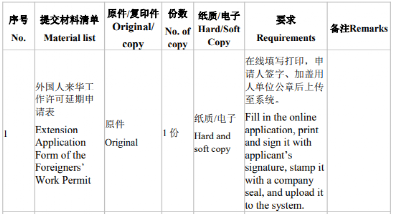
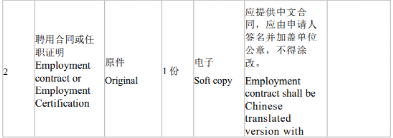
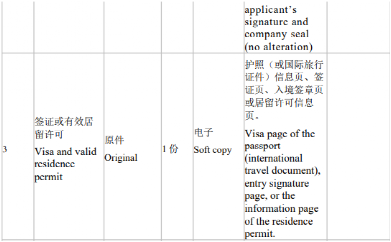
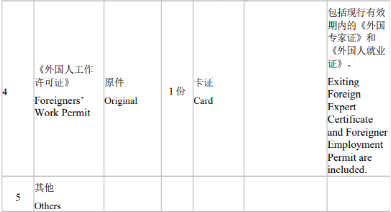
Related Documents | Download Address |
Service Guide to the Foreigner"s Work Permit in China (for Trial Implementation) |
22. Do foreign nationals relocating to work in Huairou District from other cities or other municipal districts of Beijing need to reapply for work and residence permits?
Whether foreign nationals transferring to work in Huairou District from other cities or other districts of Beijing need to reapply for a work permit and a residence permit depends on the specific circumstances.
I. If the Foreign National Remains Employed by the Original Employer and is Only Transferring to Work at a Branch Office or Project Site in Huairou District from Another Location, Reapplying for a Work Permit is not Required, Provided the Following Conditions are Met:
A. The employing unit has a legally registered branch office or physical operational premises in Huairou District.
B. The information on the work permit, including the employer"s name and Unified Social Credit Code, remains unchanged.
C.The job position, title, and core responsibilities remain substantively unchanged.
In this case, the employing unit must, within 10 days, submit a filing for the change of work location to the original work permit issuing authority and update the corresponding information on the work permit. If the individual assumes a new position within the same organization, including a promotion from a professional role to an administrative management position, proof of the position change must be submitted during the permit extension application.
II. If the Foreign National Assumes a New Position (or Changes Occupation), They Must Reapply for a Work Permit for Foreigners in China, and Consequently, Apply for a New Residence Permit.
Related Documents | Download Address |
Service Guide to the Foreigner"s Work Permit in China (for Trial Implementation) |
Third Section Safeguards for Foreign Talents and Their Accompanying Family Members
23. What Convenience Policies Are Available for Family Members of Foreign Nationals Holding Work Permits in China?
I. Family Members May Apply for Family Reunion Visas (S1/S2)
A. S1 Visa:
Applicable to spouses, parents, children under 18 years of age, and parents-in-law visiting for long-term stays (exceeding 180 days). S2 Visa: Applicable to siblings, grandparents, and other family members visiting for short-term stays (not exceeding 180 days).
B.According to the Notice by the General Office of the State Council of Issuing the Action Plan for Steadily Advancing High-level Opening up and Making Greater Efforts to Attract and Utilize Foreign Investment and the Notice on Matters Related to Supporting Foreign Talents" Innovation and Entrepreneurship in Beijing, eligible individuals may apply for other types of visas with relaxed validity periods:
1.Action Plan for Steadily Advancing High-level Opening up and Making Greater Efforts to Attract and Utilize Foreign Investment: ‘the validity period of visa entry for managers and technicians of foreign-funded enterprises and their accompanying spouses and minor children will be relaxed to two years’
2.Notice on Matters Related to Supporting Foreign Talents" Innovation and Entrepreneurship in Beijing: ‘Foreign doctoral graduates invited by innovation and entrepreneurship entities may apply for the Confirmation Letter for Foreign High-Level Talents. After obtaining the confirmation letter, they may apply for a foreign talent (R-category) visa with a maximum validity of 10 years. Their spouses and minor children may also apply for visas of the same duration.’
II. Eligible Family Members May Apply for Permanent Residence
According to the 12 Preferential Policies on Immigration, Exit and Entry to Facilitate the Construction of Free-trade Zones:
1.Foreign high-level talents, individuals with significant outstanding contributions, and foreigners specially needed by the state, upon recommendation by relevant competent national authorities, provincial-level people"s governments, or the administrative departments of national key development zones, may apply to the exit-entry administration authorities of public security organs for permanent residence in China. Their foreign spouses and minor children may apply concurrently.
2.Foreigners working in China who have been employed continuously for 4 years, residing actually in China for no less than 6 months each year, with an annual wage income not less than six times the average annual wage of urban employees in the same region of the previous year, and having paid an annual individual income tax not less than 20% of the standard annual wage income, may apply to the exit-entry administration authorities of public security organs for permanent residence in China. Their foreign spouses and minor children may apply concurrently.
3.Foreign nationals of Chinese origin working in China, who hold a doctoral degree or have worked continuously for 4 years in national key development zones with actual residence in China for no less than 6 months each year, may apply to the exit-entry administration authorities of public security organs for permanent residence in China. Their foreign spouses and minor children may apply concurrently.
Related Documents | Download Address |
Notice by the General Office of the State Council of Issuing the Action Plan for Steadily Advancing High-level Opening up and Making Greater Efforts to Attract and Utilize Foreign Investment | https://www.gov.cn/zhengce/content/202403/content_6940154.htm |
12 Preferential Policies on Immigration, Exit and Entry to Facilitate the Construction of Free-trade Zones | https://www.nia.gov.cn/n741440/n741577/c1076430/content.html |
Notice on Matters Related to Supporting Foreign Talents" Innovation and Entrepreneurship in Beijing | https://fgw.beijing.gov.cn/fgwzwgk/2024zcwj/qtwj/202205/t20220517_3729033.htm |
China Consular Affairs Website: What are the Issuance Criteria and Required Documents for Private Affairs (S1/S2) Visas? | https://cs.mfa.gov.cn/wgrlh/lhqz/cjwdn_660600/201407/t20140718_961506.shtml |
24. What conditions must foreign research personnel coming to Beijing meet to qualify for talent introduction? Under what conditions can the introduction procedures be expedited?
I. What Conditions Must Foreign Research Personnel Coming to Beijing Meet to Qualify for Talent Introduction?
According to Article 2 of the Interim Measures of Beijing Municipality on Encouraging Overseas High-level Talent to Start Business and Work in Beijing, introduced overseas high-level talents should generally hold a doctoral degree obtained overseas, be under 55 years of age, work in Beijing for no less than 6 months annually after introduction, and meet one of the following conditions:
1.Experts or scholars who have held positions equivalent to or higher than associate professor or associate researcher in renowned overseas universities or research institutions.
2.Management or research and development technical talents who have held senior technical positions in internationally renowned enterprises, financial institutions, or well-known law (accounting, auditing) firms, are familiar with business operations and international rules in relevant fields, and possess extensive practical experience.
3.Experts or scholars who have held mid-level or senior management positions in international organizations, foreign government agencies, or renowned non-governmental organizations.
4.Experts, scholars, and engineering technical personnel who have presided over large international scientific research or engineering projects and possess extensive scientific research or engineering technical experience.
5.Professional technical personnel who possess intellectual property rights aligned with Beijing"s key development industries, sectors, and fields or who master core technologies.
6.Outstanding talents required for the development of Beijing"s cultural and creative industries.
7.Excellent postdoctoral researchers with high development potential and professional proficiency.
II.Under What Conditions Can the Introduction Procedures be Expedited?
According to Article 3 of the Measures for the Management of Talent Introduction in Beijing (Trial), a ‘green channel’ for introducing outstanding talents shall be established. The introduction procedures may be expedited for individuals coming to work in Beijing who meet one of the following conditions:
1.Chinese selected experts under the ‘Thousand Talents Plan’ or ‘HaiJv Talents Plan’.
2.Selected individuals under the ‘Ten Thousand Talents Plan’, the ‘High-Level Innovation and Entrepreneurship Talent Plan’, and the Zhongguancun ‘High-Level Talent Gathering Project’.
3.Winners of the National Top Science and Technology Award, principal winners of the second-class award or above of the National Natural Science Award, National Technological Invention Award, or National Science and Technology Progress Award, and principal winners of the first-class award or above of the Municipal Science and Technology Award.
Related Documents | Download Address |
Interim Measures of Beijing Municipality on Encouraging Overseas High-level Talent to Start Business and Work in Beijing | |
Measures for the Management of Talent Introduction in Beijing (Trial) | https://www.beijing.gov.cn/zhengce/zhengcefagui/202304/W020230423519074949254.pdf |
25. Are the spouses of foreign talents holding work permits exempt from academic qualification authentication when applying for an individual work permit?
According to the Service Guide to the Foreigner"s Work Permit in China (for Trial Implementation) issued by the State Administration of Foreign Experts Affairs, foreign nationals who meet any of the following conditions may apply directly for a work permit for foreigners working in China from within the country and shall submit all application materials required for the Work Permit Notification and the Foreigner"s Work Permit: ‘...(3) Foreign spouses or children of Chinese citizens, or spouses or children of foreigners permanently residing or working in China, holding valid visas or valid residence permits...’
Therefore, the spouses of foreign talents holding work permits are exempt from the academic qualification authentication when applying for an individual work permit.
Related Documents | Download Address |
Service Guide to the Foreigner"s Work Permit in China (for Trial Implementation) |
26. What Residence Registration Procedures Are Required for Children Transferring to Public Schools in Huairou?
I. Available School Options
A. Huairou Science City Supporting International Education Project
北京怀柔青苗学校(Beijing Huairou Beanstalk School)
B. Public Schools
Primary and secondary schools and kindergartens officially established with approval from the education administrative department within the Huairou administrative region.
II. Acceptance Conditions
A. Huairou Science City Supporting International Education Project
Enrolls age-appropriate students for primary, junior high, and high school levels nationwide, without nationality restrictions.
B. Public Schools
1. Foreign students seeking to study in Huairou must provide relevant materials proving their parent(s) or guardian(s) work in Huairou.
2. For kindergarten admission, applications must be submitted to kindergartens in the district within the specified time frame. Admission decisions are made by the kindergartens based on factors such as available spots.
3. Foreign students applying for primary or secondary schools in the district must submit applications to the Huairou District Education Commission. After confirmation, the District Education Commission will coordinate and arrange school placements.
III. Contact Information
A. Responsible Departments
Preschool Education Section, Primary Education Section, Secondary Education Section, and Adult & Vocational Education Section of the Huairou District Education Commission.
B. Office Address
Huairou District Education Commission (湖光南街2号院)(No. 2 Yard, Huguang South Street)
C. Consultation Hours
8:30-11:30, 13:30-17:30, Monday to Friday (excluding statutory holidays)
D. Contact Information
a.Preschool Education Section (Kindergarten Admission): 69626908
b.Primary Education Section (Primary School Admission): 69621036
c.Secondary Education Section (Secondary School Admission): 69641149
d.Adult & Vocational Education Section (Private International School Admission): 69625191
Related Documents | Download Address |
I Want to Apply for My Child"s School Enrollment |
27. How to Apply for Residence Registration for a Newborn Child of Foreign Nationals in Huairou?
I. Legal Provisions
According to Article 40(1) of the Exit and Entry Administration Law of the People"s Republic of China: ‘For foreign infants born in China, their parents or agents shall, within 60 days after they are born, on the strength of the birth certificates, go through the formalities for stay or residence registration for them with the exit/entry administrations of public security organs under people’s governments at or above the county level in the places of their parents’ stay or residence.’
The specific interpretation is as follows:
1.The requirement for residence registration applies only to foreign infants born within Chinese territory. Foreign infants born outside China and subsequently entering China are not subject to this requirement.
2.The persons obligated to complete the birth registration are the infant"s parents or their legal agents.
3.The registration must be completed within 60 days after the infant"s birth.
4.Obtaining a birth certificate is the prerequisite procedure. The birth certificate, namely the Birth Medical Certificate, is a medical certificate issued by healthcare institutions or personnel engaged in home deliveries in accordance with regulations of the health administrative department of the State Council, pursuant to the Maternal and Infant Health Care Law. All newborns delivered within the territory of the People"s Republic of China, regardless of nationality, are entitled to receive the uniform Birth Medical Certificate issued by the health administrative department of the State Council.
5.The authority responsible for accepting the birth registration is the exit-entry administration authority of the public security organ under the local people"s government at or above the county level in the place of the parents" stay or residence.
II. Application Process
Therefore, foreign nationals giving birth to a child in Huairou must, within 60 days of the infant"s birth, carry the infant"s Birth Medical Certificate to the Public Security Service Sub-center of Beijing Huairou District Government Affairs Service Center (South Hall): Counters 1-3, 1st Floor, No. 37 Qingchun Road, Huairou District, Beijing(北京市怀柔区青春路37号一层1-3号窗口). Inquiry telephone: (010) 12367. Business hours: Monday to Saturday, 8:30-11:30 AM and 1:30-5:30 PM (excluding statutory holidays).
Furthermore, to facilitate foreign applicants, the Exit-Entry Administration of the Beijing Municipal Public Security Bureau has launched an online residence registration service for foreign newborns. The specific procedure is as follows:
1.The parents or agents of the foreign infant must scan the following documents:
a.The information page of the valid passport or other international travel document of the foreign parent(s).
b.The page containing the valid visa or residence permit of the foreign parent(s).
c.The infant"s Birth Medical Certificate.
2.Send the scanned files to the dedicated internet email address of the Exit-Entry Administration of the Beijing Municipal Public Security Bureau for accepting foreign visa and document applications (Email address: bjgacrj2024@163.com).
3.The Exit-Entry Administration of the Beijing Municipal Public Security Bureau will provide feedback on the review result via email within 7 working days of receiving the email. If the review is passed, the online registration procedure is considered complete.
28. Can a newborn child whose parents hold work-type residence permits apply directly for Chinese permanent residence?
A newborn child whose parents hold work-type residence permits may apply directly for Chinese permanent residence.
According to Article 6 of the Measures for the Administration of Examination and Approval of Foreigners" Permanent Residence in China: ‘Foreigners applying for permanent residence in China must abide by Chinese laws, be in good health and without any criminal record, and must meet at least one of the following requirements... (6) being an unmarried person under 18 years old turning to his parent; or....
Therefore, a newborn child may directly apply for and obtain Chinese permanent residence status when the parents hold work-type residence permits.
Related Documents | Download Address |
Measures for the Administration of Examination and Approval of Foreigners" Permanent Residence in China |
29. What are the requirements and procedures for foreign talents to apply for medical services in Huairou?
I. Target Beneficiaries
Medical services are available to relevant talents working at Huairou Laboratory, Chinese Academy of Sciences research institutes in Huairou, higher education institutions, new-type R&D institutions, and leading innovative enterprises.
II. Service Content
A.The International Medical Department of Huairou Hospital provides outpatient appointment booking, medical consultations, and hospitalization services for deputy senior-level or above talents in the Science City.
B.The International Medical Department of Huairou Hospital offers emergency medical treatment for all talents in the Science City.
C.The International Medical Department accepts health examination appointments for talent teams from the Science City, and provides follow-up medical consultations and chronic disease management services for those who undergo health examinations.
III. Service Location
International Medical Department, Huairou Hospital
IV. Consultation Hours
Monday to Friday 8:00-12:00, 13:30-17:30 (excluding national statutory holidays)
V. Contact Information
International Medical Department, Huairou Hospital: 13621125187
Hospital General Duty: 69644822
Appointment Hotline: 60686896
Related Documents | Download Address |
I Want to Apply for Medical Services |
30. What are the acceptance conditions for foreign talents applying for science and technology awards in Huairou?
I. Acceptance Conditions
A. Outstanding Contribution:
The Zhongguancun Award for Outstanding Contribution aims to reward individuals who have made significant discoveries in scientific research that promote scientific development and social progress, or achieved major breakthroughs in key core technology research and development, creating substantial economic, social, or ecological environmental benefits.
B. Outstanding Youth:
The Zhongguancun Award for Outstanding Youth aims to reward individuals under 40 years of age who have made important discoveries in scientific research that advance the development of related disciplines, or achieved innovative breakthroughs in key core technology research and development, promoting the transformation and industrialization of scientific and technological achievements.
C. International Cooperation:
The Zhongguancun Award for International Cooperation aims to reward foreigners who engage in international scientific and technological exchange and cooperation with individuals and organizations in Beijing, enhancing the internationalization level of scientific and technological innovation and global influence of the city.
D. Natural Sciences:
The Natural Science Award aims to reward individuals and organizations that elucidate natural phenomena, characteristics, and laws in basic and applied basic research, making significant scientific discoveries.
E. Technological Invention:
The Technological Invention Award aims to reward individuals and organizations that make significant technological inventions in the research and development of products, processes, materials, devices, and their systems by applying scientific and technological knowledge.
F. Technological Progress:
The Science and Technology Progress Award aims to reward individuals and organizations that complete and apply innovative scientific and technological achievements, making outstanding contributions to promoting scientific and technological progress and economic and social development.
II. Responsible Department
Social Development Science and Technology Center
III. Processing Time
The application period varies annually. Please check the announcements on the Huairou District Government Information Website for specific dates.
IV. Contact Information
Specific Contact: 010-69631633 Mobile: 1861187202
Related Documents | Download Address |
I Want to Apply for Science and Technology Awards |
31. What is the procedure for foreign talents to enroll in social insurance?
I. Social Insurance Enrollment Procedure
A. Item Name:
Unified Registration and Maintenance of Social Insurance, Employment, and Labor Usage Filing (formerly ‘New Enrollment’ or ‘Adding Personnel’)
B. Processing Time:
Online service platform accepts applications throughout the month
II. Materials to be Uploaded
A. For Foreigners Holding Only a Passport (Without Permanent Residence Status):
1.Work permit document (one of the following: Work Permit for Foreigners Working in China, Employment License for Foreigners, Foreign Expert Certificate, Permanent Correspondent Certificate for Foreign Journalists, or Beijing Work Residence Permit for High-Level Overseas Talents)
2.Biographical page of the passport
B. For Foreigners Possessing a Foreign Permanent Residence ID Card:
Front and back copies of the Permanent Residence ID Card
C. Other Materials as Required by the System
III. Contact Information for Inquiries
A. Service Consultation Hotline: 89687191
B. Social Insurance Policy Consultation Hotline: 12333
Related Documents | Download Address及公众号服务 | |
I Want to Register for Social Insurance |
| |

32. What is the Procedure for Foreign Talents" Children and Dependents to Enroll in Basic Medical Insurance?
I. Required Documentation
A. For spouses and children of foreign talents:
1.Work Permit for Foreigners Working in China (Category A)
2.Identity documents of the applicant
3.Marriage certificate (for spouses)
4.Child"s birth certificate
5.Declaration of No Basic Medical Coverage
B. For permanent residence holders:
1.Passport
2.Foreign Permanent Residence ID Card
3.Declaration of No Basic Medical Coverage
II. Application Location Determination
Determine the beneficiary"s student status:
If the beneficiary is a student: The educational institution handles the insurance enrollment
If the beneficiary is not a student: Enrollment is processed at the social insurance office of the household registration location or place of residence
III. Contact number: 010-89687156
Related Documents | Download Address |
I Want to Register for Health Insurance |
Fourth Section Individual Income Tax
33. Must income from overseas part-time work be declared for tax purposes in China?
Pursuant to Article 1 of the Individual Income Tax Law of the People"s Republic of China, which provides that: “A resident individual is an individual who is domiciled in China or who is not domiciled in China but has stayed in the aggregate for 183 days or more of a tax year in China. A resident individual shall, in accordance with the provisions of this Law, pay individual income tax on his or her income obtained inside and outside China. A nonresident individual is an individual who neither is domiciled in China nor stays in China or who is not domiciled in China but has stayed in the aggregate for less than 183 days of a tax year in China. A nonresident individual shall, in accordance with the provisions of this Law, pay individual income tax on his or her income obtained inside China. [...]”
According to Article 2 of the Individual Income Tax Law of the People"s Republic of China and Article 3 of the Regulation on the Implementation of the Individual Income Tax Law of the People"s Republic of China Republic of China issued by the State Council of the People"s Republic of China, income obtained from the provision of labor services inside China due to holding the posts, being employed or performing contracts, among others shall be considered income from within China, while income obtained from the provision of labor services outside China due to holding the posts, being employed or performing contracts, among others shall be considered income from outside China.
Furthermore, it is noteworthy that Article 4 of the Regulation on the Implementation of the Individual Income Tax Law of the People"s Republic of China, stipulates: “Where the number of years in each of which an individual who does not have a residence in China has stayed for a total of 183 days or more in China is less than 6 years consecutively, he or she may, after filing a report with the tax authority having jurisdiction, be exempt from individual income tax on his or her income derived from outside China paid by overseas entities or individuals; [...]”
For specific tax policies and declaration/payment procedures, individuals may consult:
Beijing Huairou District Taxation Bureau, State Taxation Administration
Tax Service Hotline: 010-12366 (Working Days: 9:30-17:30)
Related Documents | Download Address | |
Individual Income Tax Law of the People"s Republic of China |
| |
Regulation on the Implementation of the Individual Income Tax Law of the People"s Republic of China | https://www.chinatax.gov.cn/n810219/n810744/n3752930/n3752974/c3963364/content.html |
|


34. How is a research grant issued by an international organization treated under tax treaties?
Article 4 of the Individual Income Tax Law of the People"s Republic of China stipulates: “Individual incomes set forth below shall be exempt from individual income tax: (1) prizes in science, education, technology, culture, health, sports and environmental protection awarded by provincial people"s governments, ministries and commissions under the State Council and units of the People"s Liberation Army at or above the army level, as well as by foreign organizations and international organizations [...]”Therefore, research prize issued by international organizations to scientific and technical personnel are exempt from individual income tax in China and do not need to be declared or taxed.
If the country (or region) where the international organization belongs to is a contracting party to a bilateral tax treaty signed by China, then the tax treaty shall be applied (e.g. the Agreement between the Government of the People’s Republic of China and the Government of the Republic of Singapore for the Avoidance of Double Taxation and the Prevention of Fiscal Evasion with Respect to Taxes on Income). Typically, international tax treaties provide exemptions for grants or bonuses for scientific research and teaching income.
If the country (or region) where the international organization belongs to is not a contracting party to any tax treaty signed by China, then international tax treaties cannot be applied. The research prize will be regarded as income derived outside China based on the Regulation on the Implementation of the Individual Income Tax Law of the People"s Republic of China issued by the State Council of the People"s Republic of China, and shall be exempt from tax according to Article 4 of the Individual Income Tax Law of the People"s Republic of China.
In summary, whether a research grant issued by an international organization to scientific and technical personnel can apply a tax treaty depends on the nature of that international organization. However, regardless of the applicability of international tax treaties, research grants issued by international organizations are usually exempt from individual income tax in China and do not need to be declared or taxed.
It is important to note that if the grant is issued with certain attached conditions, it may be regarded as “remuneration for labor service” according to Article 6 of the Regulation on the Implementation of the Individual Income Tax Law of the People"s Republic of China. In such cases, it needs to be declared and taxed according to the relevant tax treaty or domestic laws and regulations. For specific situations, individuals may consult:
Beijing Huairou District Taxation Bureau, State Taxation Administration
Tax Service Hotline: 010-12366 (Working Days: 9:30-17:30)
Related Documents | Download Address | |
Individual Income Tax Law of the People"s Republic of China |
| |
Regulation on the Implementation of the Individual Income Tax Law of the People"s Republic of China, as amended 2018 | https://www.chinatax.gov.cn/n810219/n810744/n3752930/n3752974/c3963364/content.html |
|


35. Can Hong Kong and Macao research personnel working in Beijing enjoy tax preferences?
I. Conditions for Hong Kong and Macao Research Personnel Working in Beijing to Enjoy Tax Preferences
According to Articles 3, 4, and 5 of the Interim Measures for the Administration of Individual Income Tax Subsidies for Overseas High-Level Talents in Beijing jointly issued by the Beijing Municipal Finance Bureau, Beijing Municipal Human Resources Bureau, and Beijing Municipal Taxation Service of the State Taxation Administration, Hong Kong and Macao research personnel (including permanent residents of Hong Kong and Macao, Hong Kong residents admitted under the Hong Kong Admission Scheme (Quality Migrant Admission Scheme, Professionals Admission Scheme, Entrepreneurship Admission Scheme), and mainland residents who have settled in Hong Kong or Macao (and have cancelled their mainland household registration)) working in specific areas of Beijing (including Huairou Science City), as long as they are recognized as “Beijing Overseas High-Level Talent”, can apply for a financial subsidy for the portion of their individual income tax that exceeds 15%, achieving an “effective tax rate cap of 15%".
II.Steps for Hong Kong and Macao Research Personnel to Apply for Tax Preferences in Beijing
A. Determination of Eligibility for Tax Preferences
Applicants should consult the Interim Measures for the Administration of Individual Income Tax Subsidies for Overseas High-Level Talents in Beijing to confirm whether they meet the qualification criteria for enjoying tax preferences.
B. Preparation of Application Materials
Guidelines are updated dynamically Applicants should prepare application materials according to the latest application guidelines released by the Beijing Municipal Human Resources Bureau in conjunction with the Municipal Finance Bureau and the Municipal Taxation Service.
C. Application Period
The subsidy for Beijing Overseas High-Level Talent is processed once a year. The subsidy application for the current year is centrally accepted from July to August of the following year. Applicants submit their subsidy applications to the Beijing Overseas Talents Center. The relevant district organizational department (or designated department) will disburse the subsidy directly to the applicant"s personal bank account.
D. Assistance and Consultation
1.Beijing Overseas Talents Center
Tax Consultation Hotline for Foreign Talent: 12366 (English service provided)
2.Beijing Huairou District Taxation Bureau, State Taxation Administration
Tax Service Hotline: 010-12366 (Working Days: 9:30-17:30)
Related Documents | Download Address |
Interim Measures for the Administration of Individual Income Tax Subsidies for Overseas High-Level Talents in Beijing | https://www.bj-talents.cn/upload/file/20240206/fd821061a272460ca09b8031b88e2052.pdf |
36. How to obtain a Tax Clearance Certificate after terminating employment in China?
According to Article 13 of the Individual Income Tax Law of the People"s Republic of China and the Announcement of the State Administration of Taxation on Matters Concerning the Replacement of the Tax Payment Certificate (Document Style) with the Individual Income Tax "Tax Payment Certificate (Documentary Style)" to "Payment Record" (State Taxation Administration Announcement [2018] No. 55), before departure, foreign personnel should first complete the final settlement of their individual income tax for the year. Subsequently, after completing the annual final settlement through the Personal Online Tax Bureau, they can obtain the "Tax Record" online.
For details, please consult:
Beijing Huairou District Taxation Bureau, State Taxation Administration
Tax Service Hotline: 010-12366 (Working Days: 9:30-17:30)
Related Documents | Download Address | |
Individual Income Tax Law of the People"s Republic of China |
| |
Announcement of the State Administration of Taxation on Matters Concerning the Replacement of the Tax Payment Certificate (in Document Style) with the Tax Payment Record Certificate” (Document Form) to “Tax Payment Record” | https://www.chinatax.gov.cn/chinatax/n810341/n810765/n3359382/201812/c4183165/content.html | |

37. Is income earned by providing consulting services to overseas institutions remotely while in China subject to supplementary tax payment in China? How is the taxable amount calculated?
I. Determination of Tax Resident Status
Article 1 of the Individual Income Tax Law of the People"s Republic of China stipulates: “A resident individual is an individual who is domiciled in China or who is not domiciled in China but has stayed in the aggregate for 183 days or more of a tax year in China. A resident individual shall, in accordance with the provisions of this Law, pay individual income tax on his or her income derived inside and outside China. A nonresident individual is an individual who neither is domiciled in China nor stays in China or who is not domiciled in China but has stayed in the aggregate for less than 183 days of a tax year in China. A nonresident individual shall, in accordance with the provisions of this Law, pay individual income tax on his or her income obtained inside China [...]”
II.Nature of Income Derived from Providing Consulting Services to Overseas Institutions
According to Articles 3 and 6 of the Regulation on the Implementation of the Individual Income Tax Law of the People"s Republic of China issued by the State Council of the People"s Republic of China, income derived from providing consulting services to overseas institutions is considered remuneration for labor service derived from outside China.
According to Article 1 of the Individual Income Tax Law of the People"s Republic of China, a resident individual shall pay individual income tax on this service income, while a non-resident individual does not need to declare or pay tax on this service income.
III. Calculation of Taxable Amount
According to Article 6 of the Individual Income Tax Law of the People"s Republic of China, for income from remuneration for labor services, authorship remuneration, and royalties, the amount of income is the balance of the income after applying a 20% expense deduction, and the taxable income for each payment is this amount of income.
IV. Assistance and Consultation
Beijing Huairou District Taxation Bureau, State Taxation Administration
Tax Service Hotline: 010-12366 (Working Days: 9:30-17:30)
Related Documents | Download Address | |
Individual Income Tax Law of the People"s Republic of China |
| |
Regulation on the Implementation of the Individual Income Tax Law of the People"s Republic of China | https://www.chinatax.gov.cn/n810219/n810744/n3752930/n3752974/c3963364/content.html |
|


38. How should a “Research Contribution Award” received upon termination of employment be declared? Does the separate taxation policy apply?
The tax declaration for a “Research Contribution Award” received upon termination of employment needs to be handled separately based on the nature of the award:
I. Situations where Separate Taxation is Allowed
According to the Announcement of the Ministry of Finance and the State Taxation Administration on Continuing the Implementation of Individual Income Tax Policies Regarding Annual One-off Bonuses (Announcement No. 30 [2023] of the Ministry of Finance and the State Taxation Administration), if a resident individual receives an annual one-off bonus that conforms to the provisions of the Notice of the State Administration of Taxation on Adjusting the Method of Calculating and Levying Individual Income Taxes on Annual One-off Bonuses, etc. Obtained by Individuals (No. 9 [2005] Promulgated by the STA), it shall not be incorporated into the comprehensive income of the current year. Instead, tax shall be calculated separately by dividing the bonus by 12 months, determining the applicable tax rate and quick deduction according to the Schedule of Comprehensive Income Tax Rates after Conversion into Monthly Payments.
It is noteworthy that according to the Announcement of the Ministry of Finance and the State Taxation Administration on Relevant Individual Income Tax Policies Regarding Non-Resident Individuals and Resident Individuals Who Are Not Domiciled in China (Announcement No. 35 [2019] of the Ministry of Finance and the State Taxation Administration), bonuses for several months received by a non-resident individual shall not be consolidated with other wage and salary income of the current month, and shall be averaged over 6 months. No deduction of expenses shall be allowed, and the monthly tax rate table shall be applied to calculate the tax payable. The method of averaging taxation can only be used once per tax year for each non-resident individual.
II. Situations where Tax Exemption is Allowed
According to Item 1, Article 4 of the Individual Income Tax Law of the People"s Republic of China, prizes in science, education, technology, culture, health, sports and environmental protection awarded by provincial people"s governments, ministries and commissions under the State Council and units of the People"s Liberation Army at or above the army level, as well as by foreign organizations and international organizations shall be exempt from individual income tax.
III. Situations where Separate Taxation or Exemption is not Allowed
An internal “Research Contribution Award” established by the employer, if it does not meet the definition of an “annual one-off bonus” in the Announcement of the Ministry of Finance and the State Taxation Administration on Continuing the Implementation of Individual Income Tax Policies Regarding Annual One-off Bonuses (e.g., paid in installments within one year or multiple bonuses), must be incorporated into the wage and salary income of the month for tax calculation.
Compensatory awards received due to early termination of employment for personal reasons shall be subject to cumulative withholding as “wage and salary income” and incorporated into the annual final settlement for comprehensive income.
IV. Consultation and Assistance:
Beijing Huairou District Taxation Bureau, State Taxation Administration
Tax Service Hotline: 010-12366 (Working Days: 9:30-17:30)
Relevant Document | Download Link | |
Individual Income Tax Law of the People"s Republic of China |
| |
Announcement of the Ministry of Finance and the State Taxation Administration on Continuing the Implementation of Individual Income Tax Policies Regarding Annual One-off Bonuses | ||
Announcement of the Ministry of Finance and the State Taxation Administration on Relevant Individual Income Tax Policies Regarding Non-Resident Individuals and Resident Individuals Who Are Not Domiciled in China | https://fgk.chinatax.gov.cn/zcfgk/c102416/c5202332/content.html |
|


39. When purchasing property in Huairou District, can foreign research personnel enjoy the same Deed Tax preferences as local residents?
Foreign personnel can enjoy the same Deed Tax preferential policies as local residents. Article 1 of the Deed Tax Law of the People"s Republic of China stipulates: “Entities and individuals to whom rights in land and buildings are transferred in the territory of the People"s Republic of China are deed tax payers, and shall pay deed tax in accordance with the provisions of this Law.” Foreign taxpayers and Chinese taxpayers alike pay deed tax according to the provisions of the Deed Tax Law of the People"s Republic of China.
Taxpayer may refer to the Beijing Government Service Website"s page for the Huairou District Taxation Bureau"s Deed Tax Declaration Service Guide for real-time policies and the deed tax declaration guide.
For details, please consult:
Beijing Huairou District Taxation Bureau, State Taxation Administration
Tax Service Hotline: 010-12366 (Working Days: 9:30-17:30)
Related Documents | Download Address |
Deed Tax Law of the People"s Republic of China | http://www.npc.gov.cn/c2/c30834/202008/t20200811_307161.html |
Huairou District Taxation Bureau Deed Tax Declaration Service Guide |
Fifth Section Intellectual Property
40. When participating in international research projects, how should the ownership of individual intellectual property rights be determined?
When participating in international research projects, the allocation of individual intellectual property rights shall be determined based on multiple factors. In general, the parties should primarily consider their respective roles and substantive contributions to the project, while taking into account the type of research project, sources and conditions of funding, nature of research outputs, each party’s willingness, capacity, and responsibility to protect intellectual property through legal means, and the potential for commercialization or technology transfer of foreground intellectual property.
I.Distinction Between Official and Non-official Projects
A. The Ownership Regulations of Official Project
Pursuant to the Several Provisions on the Administration of Intellectual Property Rights Resulting from National Research Projects, the competent authorities for science and technology, when issuing project assignments or signing contracts, shall expressly stipulate the State’s rights over research results that concern national security, national interests, or major public interests, and shall designate an institution responsible for managing such results and their intellectual property rights. At the same time, the lawful moral rights, awards, and remuneration of the researchers shall be duly protected.
For scientific and technological achievements resulting from state-funded projects or national science and technology programs, unless they involve national security, national interests, or major public interests, the intellectual property rights shall be granted to the project undertaker (such as a university or enterprise). The undertaker may independently decide to implement, license, assign, or capitalize such rights and obtain corresponding benefits.
According to the Administrative Measures for National Special Projects on International Scientific and Technological Cooperation, the achievements of such projects shall be registered and managed in accordance with the Measures for the Registration of Scientific and Technological Achievements and other relevant provisions. The management, ownership, and distribution of benefits relating to the intellectual property rights shall be governed by the Law of the People"s Republic of China on Scientific and Technological Progress, the Several Provisions on the Administration of Intellectual Property Rights Resulting from National Research Projects issued by the General Office of the State Council, and the Interim Provisions on the Administration of Intellectual Property Rights of International Scientific and Technological Cooperation Projects issued by the Ministry of Science and Technology. Projects involving state secrets shall comply with the Regulations on the Confidentiality of Science and Technology.
B. Unofficial Project Equal Negotiation Agreement
For non-official cooperative research projects, ownership of intellectual property in the project outcomes shall be determined by mutual agreement among the parties on an equal basis. In assessing each party’s contribution, intellectual and creative contributions shall generally carry the greatest weight.
As for academic papers published in connection with the research, the right of authorship shall vest in the individuals who have made the substantive intellectual contributions, provided that the funding entity is duly acknowledged.
Regarding patents generated under the project, the right to apply for patents and the patent ownership may be allocated in several ways:
1.Ownership may be vested in one party, while other parties enjoy a right of first refusal to acquire the rights;
2.Ownership may be held jointly, with further clarification as to whether such co-ownership constitutes joint ownership or ownership in undivided shares. The agreement should stipulate that no party may, without the consent of the other co-owners, unilaterally license, assign, or mortgage the jointly owned rights. Where ownership in shares is adopted, the agreement shall specify the proportion of shares, the manner of exercising rights, and voting procedures; the parties may also agree on territorial divisions of patent applications and allocation of application and maintenance costs; and they should define whether a co-owner has the right to initiate legal proceedings independently in case of infringement, as well as the apportionment of related expenses.
II. Distinction Between Projects Conducted Abroad and in China
For projects conducted abroad, participants must comply with the laws of the host country, including any restrictions on the transfer of intellectual property rights.
For projects conducted in China with foreign participants, Chinese laws and regulations must be observed. If the cooperation involves technology import or export, the relevant formalities shall be completed in accordance with applicable regulations.
In respect of technology rights, from the perspective of the Chinese party, acquiring full ownership of the technology is the optimal option, joint ownership is secondary, and obtaining only a license to use the technology is the least desirable and should be adopted only when necessary.
III. Distinction Between Service-Related and Non-service Achievements
In principle, service-related achievements belong to the employer, while the individual retains the right of authorship and the right to receive awards and remuneration. The definition of “service-related achievements” can be further determined with reference to the respective intellectual property statutes and judicial interpretations.
Under the following circumstances, scientific and technological achievements may be agreed to belong to the researchers:
1.The invention or creation is completed not in the execution of the entity’s tasks but merely by using the entity’s material and technical resources;
2.Pursuant to the Opinions on Implementing a Distribution Policy Oriented Toward Increasing the Value of Knowledge issued by the General Office of the CPC Central Committee and the General Office of the State Council, for horizontally commissioned projects funded by enterprises or other social organizations, the undertaking entity and the researchers may, through contractual arrangements, agree on the right to use and the distribution of benefits from intellectual property, and may explore mechanisms for conferring ownership or long-term usage rights of scientific and technological achievements to the researchers.
IV. Distinction Among Background, Foreground, and Improvement Intellectual Property
A. Background Intellectual Property
Each party’s pre-existing intellectual property shall remain its own and shall not be transferred by virtue of the cooperation. Where necessary for the implementation of the cooperative project, a party may grant to another a free, non-exclusive, and non-transferable license to use its background intellectual property within the scope necessary for the project. If either party wishes to use the other’s background intellectual property for purposes other than implementing the project, a separate license agreement shall be executed.
To ensure effective protection, the agreement should include a list of background intellectual property provided to the partner and specify the duration, scope, conditions, and manner of use.
B. Foreground Intellectual Property
Foreground intellectual property refers to newly generated intellectual property during the project. Its ownership may be arranged in the following ways:
1.Ownership vested in one party, with the other party entitled to use the intellectual property within an agreed scope, manner, and term, either on a paid or unpaid basis, for the purpose of contract performance;
2.Joint ownership, with the agreement clearly defining the form, content, and manner of co-ownership, as well as provisions on application or registration, exploitation, licensing, assignment, profit distribution, and enforcement;
3.Hierarchical or categorized allocation
(1)By contribution – Ownership is determined according to each party’s contribution to the results (e.g.,independently developed portions belong solely to the respective party, while jointly developed portions are co-owned);
(2)By research basis – Where a result is directly derived from one party’s background intellectual property, that party may own the corresponding intellectual property;
(3)By type of output – Certain types of technical results may be allocated to one party, and other types to another.
C. Improvement Intellectual Property
After project termination, either party may independently improve or further develop the technical achievements.The outcomes of unilateral improvements or secondary development shall belong to the improving party. If the improvement involves use of the other party’s trade secrets, prior written consent must be obtained, and the resulting achievements shall be jointly owned. Joint improvements or further developments shall be co-owned. Any party undertaking independent improvements shall notify the other party in a timely manner, and the other party shall enjoy a right of first refusal to license or acquire such achievements under equal conditions.
V. Other Considerations
1.It is advisable to consult professional intellectual property attorneys before signing the contract to ensure that all provisions comply with the applicable laws of the relevant jurisdictions and to minimize legal risks.
2.If the project involves state secrets, national security, or significant national or commercial interests requiring confidentiality, the contract shall specify the scope of confidential matters, persons subject to confidentiality, methods of confidentiality, levels and duration of confidentiality, and the respective obligations of the parties. The independence of the confidentiality clause shall also be expressly stated.
3.Before project termination, the parties should conduct a unified review and confirmation of all intellectual property involved in the project to ensure clarity of ownership.
Related Documents | Download Address | |
Law of the People"s Republic of China on Scientific and Technological Progress (2021 Revision) |
| |
Administrative Measures for National Special Projects on International Scientific and Technological Cooperation | https://most.gov.cn/xxgk/xinxifenlei/fdzdgknr/fgzc/gfxwj/gfxwj2011/201110/t20111017_90300.html |
|
Interim Provisions on the Administration of Intellectual Property Rights of International Scientific and Technological Cooperation Projects |
| |
Opinions on Implementing a Distribution Policy Oriented Toward Increasing the Value of Knowledge |
| |
Several Provisions on the Administration of Intellectual Property Rights Resulting from National Research Projects | ||
Regulations on the Confidentiality of Science and Technology (2015 Revision) | ||




41. How can academic disputes overseas — such as authorship disputes over research papers — be effectively prevented in advance?
I. Preservation and Perfection of Evidence
A. Retention of Ownership Evidence
Evidence preservation serves as the foundation for cross-border rights protection and ensures that both ownership and infringement acts are traceable.
1.Documenting the Creation Process
The rights holder should maintain a complete record of the creative process and publication timeline, such as drafts, revision histories, submission receipts, plagiarism-check reports, and records of initial publication (e.g.,publication date of a WeChat article or submission record). These materials serve to prove originality and the date of creation.
2.Copyright Registration and Certificate Acquisition
Copyright registration certificates may be obtained through registration with the China Copyright Protection Center(https://www.ccopyright.com.cn/).
In Beijing, authors may also complete voluntary registration via the Beijing Government Service Network (https://banshi.beijing.gov.cn/) or at local administrative service centers.
3.Copyright Registration in Foreign Jurisdictions
For key markets such as the United States, the European Union,and Japan, authors are encouraged to complete copyright registration with the respective authorities (e.g., U.S. Copyright Office).
B. Preservation of Infringement Evidence
All communications with foreign journals or institutions—such as emails, contracts, or correspondence—should be preserved as evidence clarifying the parties’ rights and obligations.
Upon identifying potential infringement, the rights holder should promptly preserve materials evidencing the infringing party’s conduct, including its identity, specific infringing acts, and relevant facts—such as webpage screenshots, database search results, or downloaded content.
C. Notarization and Authentication of Evidence
1.As digital or online evidence may be altered or deleted, the following measures may be adopted to fix evidence:Timely application for evidence preservation notarization through a notary office;
2.Use of trusted timestamp electronic evidence platforms (e.g., https://ev.tsa.cn/) or applications such as Right Defender App for timestamp verification;
3.Consular authentication or Hague Apostille through the relevant embassies or consulates of the target country.
Evidence that has been notarized and authenticated will carry greater probative value in litigation proceedings.
II. Preventive Measures Against Copyright Risks
A. Careful Review of Journal Submission Terms
Before submitting to academic journals, authors should carefully read the journal’s submission guidelines and clarify provisions regarding copyright ownership and permitted uses.
B. Clear Contractual Definition of Rights and Obligations
In commissioned or cooperative works, the parties should enter into a written contract explicitly defining copyright ownership, usage scope, and permitted purposes to avoid future disputes.
C. Proper Use of Materials
Authors should include copyright statements on their own works. When using works of others, they must obtain explicit authorization and avoid reliance on materials labeled as “free” but not guaranteed to be copyright-free. It is preferable to use content sourced from licensed databases or official platforms.
For further consultation, parties may contact the National Overseas Intellectual Property Dispute Response Guidance Center (http://nacoip.cn:8000/).
42. How can cross-border rights protection be pursued in cases of overseas academic disputes?
I. Complaints Within Academic Journals
Internal complaint mechanisms of academic journals constitute the primary avenue for resolving academic disputes such as authorship controversies or academic misconduct.
The official websites of most journals provide dedicated complaint channels or contact information.
Procedure: The complainant shall submit a written complaint to the editorial board of the relevant journal, clearly stating the facts of infringement, supporting evidence, and specific claims. The editorial board will conduct an internal investigation and take appropriate measures based on the findings.
II. Complaints Through Industry Associations
Academic authors may seek mediation or coordination through the Rights Protection Committee of the China Writers Association (https://www.
chinawriter.com.cn/n1/2018/1128/c403972-30430836.html)
Authors may also file complaints with relevant international academic associations, such as the Committee on Publication Ethics (COPE) (https://publicationethics.org/) or the American Association for the Advancement of Science (AAAS) (https://www.aaas.org/), requesting investigation and conciliation regarding alleged misconduct or authorship disputes.
III. Direct Negotiation with the Counterparty
Upon discovering infringement, the rights holder may directly contact the infringing party and issue a cease-and-desist or lawyer’s letter specifying the infringement, legal grounds, and remedies sought (e.g., removal of infringing content, public apology, or compensation).
This approach is cost-effective and efficient, suitable for relatively minor infringements or disputes arising from misunderstanding.
IV. Mediation
The rights holder may apply for mediation with competent mediation institutions. Mediation is characterized by efficiency, low cost, and enforceability.
Where the parties reach a settlement, the mediation agreement may be submitted to the people’s court for judicial confirmation in accordance with the Civil Procedure Law of the People’s Republic of China. Once confirmed, it has the same legal effect as a judgment or ruling.
In Beijing, for example, authors may file for mediation through the Beijing Copyright Mediation Cloud Platform hosted by the Capital Copyright Association (https://sdbq.org.cn/), where the fees and procedures are publicly available.
V. Arbitration
Where there exists a written arbitration agreement or a clause in the copyright contract providing for arbitration, the dispute shall be submitted to the designated arbitration institution, such as the International Chamber of Commerce (ICC) (https://iccwbo.org/) or the London Court of International Arbitration (LCIA) (https://www.lcia.org/).
Arbitral awards rendered by these institutions may be recognized and enforced in contracting states under the Convention on the Recognition and Enforcement of Foreign Arbitral Awards (New York Convention).
VI. Administrative Complaints
The rights holder may lodge an administrative complaint with competent copyright administrative authorities such as the National Copyright Administration of China (NCAC), local copyright administrations, the U.S. Copyright Office (https://www.copyright.gov/), or the European Union Intellectual Property Office (EUIPO) (https://euipo.europa.eu/).
Administrative authorities may order cessation of infringement, confiscate illegal gains and infringing copies, and impose fines. In serious cases, they may also confiscate equipment, tools, and materials primarily used for making infringing copies.
For online infringements, complaints may be filed via the NCAC’s Online Reporting and Service Platform (https://www.ncac.gov.cn/bsfw/zxjb/).
VII. Civil Litigation
Civil litigation serves as the ultimate remedy for serious academic infringement cases.
The rights holder may file a civil lawsuit with a court of competent jurisdiction, seeking remedies such as injunctions, elimination of effects, public apologies, or compensation for losses.
VIII. Criminal Prosecution
Where academic infringement constitutes a criminal offense, the rights holder may report the case to the public security authority at the place of infringement or the defendant’s domicile, requesting initiation of criminal proceedings.
Among the available enforcement mechanisms, an author shall determine the most appropriate course of action in light of the nature of the dispute and a balanced consideration of the costs and potential benefits of enforcement.
Related Documents | Download Address | |
Regulation of Beijing Municipality on the Protection of Intellectual Property Rights | https://www.pkulaw.com/lar/46e960e75a4ee36f45d6bb1260e8352cbdfb.html |
|
Administrative Measures for Overseas Intellectual Property Rights Protection Assistance in Beijing Municipality (Trial) | https://www.beijing.gov.cn/zhengce/zhengcefagui/202412/t20241216_3966718.html |
|
Administrative Measures for the Development Funds for Intellectual Property Rights Protection in Huairou District, Beijing Municipality | https://www.pkulaw.com/lar/f5df64524f5d825f3336a00793954c9ebdfb.html |
|
Detailed Implementation Rules for the Administrative Measures for the Development Funds for Intellectual Property Rights Protection in Huairou District, Beijing Municipality | https://www.pkulaw.com/lar/3a1d8b7cc33d65094ba32482c3d40f79bdfb.html |
|



43. Does the use of open-source software code in cross-border collaborative projects pose any risk of infringement?
I. Legal Nature of Open-Source Software
According to Article 876 of the Civil Code of the People’s Republic of China, the licensing of intellectual property rights such as computer software copyrights shall be governed by the provisions on “technology transfer contracts and technology licensing contracts” under Section 3. Article 18(1) of the Regulations on the Protection of Computer Software provides that “where a software copyright owner licenses another person to exercise its copyright, a license-use contract shall be concluded.” As computer software is protected under the Copyright Law of the People’s Republic of China, open-source software (OSS) remains subject to copyright protection. Whether the software is open source does not affect the protection of its original and creative parts under copyright law.
Representative of such licenses, the General Public License (GPL) is, in essence, a copyright license agreement that conditionally grants the rights of reproduction, distribution, and modification to the general public. For public-domain software not protected by copyright law, derivative works may flow into the private domain and become inaccessible to the public. Conversely, open-source software protected by copyright law may expose later users to infringement claims if they appropriate such code in violation of open-source licensing terms.
Chinese courts tend to recognize the GPL as a contract subject to conditions subsequent, a standard-form contract, and a non-typical contract. Foreign courts, such as in Welte v. D-Link (Germany) and Artifex v. Hancom (U.S.), have also affirmed the contractual nature of open-source licenses and that their terms become effective upon use. This means, as stated in Section 9 of GPL 3.0, users merely receiving or running OSS are not bound by its terms; however, users who modify or distribute OSS are deemed to have accepted the GPL and are bound by its obligations. Specifically, each open-source license details the rights and duties of users. Users who modify or distribute OSS thereby assume obligations to comply with the license terms governing reproduction and distribution. Failure to comply—for instance, by releasing software under the GPL without providing the source code—constitutes breach of contract. Such breach often triggers revocation clauses, rendering subsequent reproduction and distribution unauthorized and therefore infringing.
The copyright ownership of open-source software may fall under three circumstances:
1.Constituting a joint work, in which all contributors share inseparable co-ownership of the copyright;
2.Not constituting a joint work but involving substantial contributions, in which each contributor enjoys an independent and separate copyright in their contribution; or
3.Not constituting a joint work and involving insubstantial contributions, in which case no new copyright is created.
II.Copyright Infringement Risks in the Use of Open-Source Software
The determination of copyright infringement hinges on the specific open-source software license agreement. For example, under the GPL, if a licensee modifies and distributes the software, the modified software must also be released to the open-source community under the GPL. In contrast, the MIT License is relatively permissive; it allows commercial use and other purposes as long as the copyright notice and license statement are included in the distributed copies.
Using open-source software presents multiple copyright infringement risks, including but not limited to the following:
A. Defective Code Introduced During Development
In iterative development processes, defective or improperly sourced code may be introduced. If subsequent developers fail to identify and remove code with unclear rights status, project maintainers risk incorporating infringing code.
Such risk arises from the irrevocability of the GPL. Even if a later version of the software deletes the GPL 3.0 clause, any version containing source code derived from a prior GPL-covered version remains governed by GPL 3.0. Consequently, contributors who submit code they do not own to open-source communities introduce inherent copyright defects into the OSS itself.
B. Failure to Display Copyright Notices
Most OSS licenses require that original or redistributed copies conspicuously display the copyright owner’s information. Noncompliance not only breaches the license but also infringes the author’s right of attribution.
C. Distinguishing Between Open-Source and Proprietary Code
The development and utilization of OSS are complex. Distinguishing OSS from proprietary software is particularly challenging and often leads to copyright disputes regarding integration or combined distribution.
D. Unclear Ownership of Service Works
Article 18(1) of the Copyright Law of the People’s Republic of China provides: “A work created by a natural person in the course of performing the tasks assigned by a legal person or an unincorporated organization shall be a service work. Except as otherwise provided in paragraph 2 of this Article, the author shall enjoy the copyright, while the legal person or unincorporated organization shall have priority to use the work within the scope of its business.” Therefore, if programmers publish works created in the course of employment to an open-source community without authorization, or use OSS obtained from such communities in service works, infringement risks may arise.
III. Case Analysis
In most Chinese judicial cases, courts have upheld the validity of GPL licenses.
In Jining Luohe v. Fujian Fengling Chuangjing Software Co., Ltd. (copyright infringement case), the court affirmed the effectiveness of the GPL 3.0, ruling that the defendant’s failure to fulfill license conditions resulted in automatic termination of authorization, rendering subsequent reproduction, modification, and distribution acts infringing. In Future Co. v. Cloud Dragonfly Co. and Liu [Software Copyright Infringement Dispute], the court held that where the software source code is governed by the GPL, a rightsholder’s act of closing the source violates the agreement and hinders the continued open dissemination of source code. Therefore, infringement claims based on such code were not supported. For portions of source code not subject to GPL restrictions, the court applied normal copyright infringement standards.
IV. Risk Prevention Recommendations
To mitigate infringement risks, parties involved in cross-border collaborative projects should clearly identify the type of OSS license and strictly comply with its terms. During development, a code review mechanism should be established to ensure that no defective or unauthorized open-source code is incorporated.
It is also advisable to maintain comprehensive records and filings of OSS usage, which may serve as evidence in potential disputes.
Furthermore, for aspects involving trade secrets or core competitiveness, OSS should be used cautiously to avoid inadvertent disclosure of proprietary information as a result of open-source obligations.
Related Documents | Download Address | |
Copyright Law of the People’s Republic of China |
| |
Civil Code of the People’s Republic of China |
| |
Regulations on the Protection of Computer Software |
| |



Sixth Section Personal Compliance in
Scientific Research
44. What foreign exchange registration formalities are required for receiving overseas research funding?
I. Non-enterprise Research Institutions
According to the Implementation Rules for the Pilot Program of “KeHuiTong” in Beijing issued by the Beijing Branch of the State Administration of Foreign Exchange (SAFE), the “KeHuiTong” pilot allows eligible non-enterprise research institutions to handle various foreign exchange matters directly at banks within Beijing, including foreign exchange registration, fund receipt, foreign exchange settlement, and change/deregistration, administered by reference to the administration model for Foreign Direct Investment (FDI). The opening and crediting of fund accounts shall be managed by reference to foreign exchange capital funds. Second, where a non-enterprise research institution uses foreign exchange funds remitted from overseas and the Renminbi funds obtained from their settlement for domestic reinvestment, such reinvestment shall be handled by reference to reinvestment under FDI. Non-enterprise research institutions that meet the conditions may participate in the facilitation policy for payments under capital account income, that is, when settling opening funds for domestic payments, the institution is not required to provide authenticity supporting materials on a transaction-by-transaction basis. These Rules shall come into force on December 31, 2024, and apply to non-enterprise research institutions within Beijing (such as university research institutes and national key laboratories).
A. Materials to be provided when handling information registration:
1.A written application with the Basic Information Registration Application Form attached;
2.The approval document issued by the competent government authority for the establishment of the non-enterprise research institution;
3.A copy of the legal person certificate for public institutions or the registration legal person certificate for private non-enterprise entities;
4.Documentation evidencing confirmation of opening funds (if any).
B. Materials to be submitted for account opening and crediting:
1.A written application with the business registration voucher attached;
2.The Capital Inflow Control Information Form printed from the bank-end of the Capital Account Information System.
C. The foreign exchange capital fund account shall, as required, conduct settlement, transfer, and payment within its business scope, and comply with the following:
1.It shall not be used directly or indirectly for expenditures prohibited by national laws and regulations;
2.It shall not be used directly or indirectly for securities investment or other wealth management investments (except for wealth management products and structured deposits with a risk rating not higher than Level 2);
3.It shall not be used to issue loans to non-affiliated enterprises (except where the business scope expressly permits);
4.It shall not be used to purchase residential properties that are not for self-use.
II. Registration Formalities for Non- “KeHuiTong” Institutions
A. Domestic enterprises
The regulations governing domestic enterprises’ acceptance of donations from overseas non-profit institutions are relatively strict. Under the section on donation foreign exchange business in the Guidelines for Foreign Exchange Business under the Current Account (2020 Edition), where an enterprise accepts donations from an overseas non-profit institution, it shall open a donation foreign exchange account in accordance with the relevant provisions on the administration of current account foreign exchange accounts, and provide the following application materials:
1.Application letter: It shall truthfully undertake that the donation does not violate relevant national prohibitive provisions, that relevant approval/filing formalities have been handled pursuant to national regulations (for example, for overseas NGOs), that the overseas institution engaging in donation foreign exchange receipts and payments is a non-profit institution, that the domestic enterprise will strictly use the funds in accordance with the donation agreement, and that it will assume the legal liabilities arising therefrom;
2.A copy of the business license;
3.The donation agreement specifying the purposes for which the funds will be used;
4.Documents evidencing that the overseas non-profit institution has been lawfully registered and established overseas;
5.Other materials required by the bank where the foregoing are insufficient to fully prove the authenticity of the transaction.
Scope of account income: donation foreign exchange funds remitted from overseas; donation foreign exchange funds transferred from a same-name current account foreign exchange account or from purchased foreign exchange. Scope of expenditures: expenditures as agreed in the donation agreement and other donation expenditures.
Where a domestic enterprise accepts donations from, or makes donations to, overseas for-profit institutions or overseas individuals, the matters shall be handled in accordance with the provisions on cross-border investment and external creditor’s rights and debts. The opening, use, alteration, and closure of the donation foreign exchange account shall be handled in accordance with the Guidelines for Foreign Exchange Business under the Capital Account (2024 Edition).
B. Other domestic institutions
Other domestic institutions handling donation foreign exchange receipts and payments shall handle such matters at a bank with the following materials:
1.Application letter: It shall truthfully undertake that the donation does not violate relevant national prohibitive provisions, that relevant approval/filing formalities have been handled pursuant to national regulations, and that it will assume the legal liabilities arising therefrom;
2.A copy of the registration certificate issued by the relevant administration authority;
3.The donation agreement specifying the purposes for which the funds will be used.
Related Documents | Download Address | |
Implementation Rules for the Pilot Program of “KeHuiTong” in Beijing |
| |
Guidelines for Foreign Exchange Business under the Current Account (2020 Edition) | https://www.mofcom.gov.cn/zcfb/zgdwjjmywg/art/2020/art_0dd36157a03f494db7571002c7f785b8.html |
|
Guidelines for Foreign Exchange Business under the Capital Account (2024 Edition) | https://www.gov.cn/zhengce/zhengceku/202404/content_6945036.htm |
|


45. May experimental data generated during overseas academic exchanges be brought back to China for analysis?
I. Ways of Cross-border Data Flows
Cross-border data flows include data export, data transit, and data import. The repatriation of overseas experimental data simultaneously involves all three aspects. Most countries welcome the free inflow of data but establish rules on data export out of considerations for sovereignty, personal information and privacy protection, national security, and industrial policy. China’s regulation of data import is limited to compliance review of data content, namely, data content must not violate the basic requirements under Article 56 of the Telecommunications Regulations of the People’s Republic of China, must not contravene the basic principles of the Constitution, endanger national security, undermine ethnic unity, undermine national religious policy, or violate public order and good morals. Article 4 of the Provisions on Promoting and Regulating Cross-Border Data Flows defines “data transit” as “where personal information collected and generated by a data handler outside the territory is provided overseas after being processed within the territory, and no domestic personal information or important data is introduced during processing.” At present, China has not brought data transit into the scope of regulation.
II. Data Export for Experimental Data
Issues at the data export stage are more complex. Cross-border data flows involve two dimensions: first, data must flow across jurisdictions; second, operations such as cross-border storage, transmission, or remote access occur, and in such cases the controller/processor of the data must comply with the outbound data compliance regime of the country/region where the data was generated. In general terms, such regimes tend to be consistent in the following aspects:
1.Data classification, which by reference to OECD standards mainly includes three categories: (1) personal data or personally identifiable information; (2) sector-specific data, including commercial, financial, and health data; and (3) “important” or “critical” data closely related to national security, economic development, and social and public interests, typically involving energy, military, critical infrastructure, and nuclear;
2.Imposing varying degrees of restrictions on the outbound flow of data generated domestically, including storing data on devices within the country/region where the data is generated, using domestic servers, exporting after backup, or exporting via mirroring.
Countries have adopted different data protection models based on national conditions and the development of digital trade, presenting a contrast among the U.S. “free model,” the EU “human-rights model,” the Russian “security model,” and China’s “balanced model.” The EU has no legislation specifically targeting cross-border scientific data. The laws and regulations applicable to cross-border flows of scientific data depend on whether the scientific data involves personal data or non-personal data, and follow the corresponding general cross-border rules accordingly. For personal data, Chapter V of the General Data Protection Regulation (GDPR) issued by the European Commission in 2016 and the relevant guidelines of the European Data Protection Board (EDPB) provide that there are three main channels for cross-border flows of personal data: first, transfers based on the adequacy decision mechanism (the “whitelist” mechanism), under which countries that have passed EU adequacy decisions are treated as “whitelist” countries with adequate data protection and the EU may transfer data to them directly (China is not on the whitelist); second, transfers based on appropriate safeguards, such as via Standard Contractual Clauses, Binding Corporate Rules, certification mechanisms, and codes of conduct (SCCs, BCRs, etc.); and third, transfers based on obtaining data subjects’ consent and executing consent documentation. The governance framework for cross-border flows of non-personal data is primarily composed of the Regulation (EU) 2018/1807, European strategy for data, Data Governance Act and Data Act, etc. In principle it safeguards the free flow of non-personal data, while authorizing Member States to impose restrictions based on public security, and export controls may apply to certain matters involving critical infrastructure, defense, or dual-use technologies.
Where research data involves critical infrastructure, defense, or dual-use technologies, export controls may be triggered. If personal data has been fully anonymized and no longer falls within the scope of personal data, it may be freely brought back and used; however, if individuals remain identifiable (such as health, genetic, or behavioral information), the cross-border transfer rules under Chapter V of the GDPR must be observed. That said, subsequent analysis may involve big data analytics companies and cloud service providers, as well as journal publishers, designers and developers, and commercial, governmental, and non-profit sectors funding the research. Where such “transfers and processing” are not carried out within the EU or EEA, they are not subject to the GDPR.
The United States likewise has no legislation specifically addressing cross-border flows of scientific data. Cross-border flows of scientific data in principle follow general cross-border data flow laws and regulations. Compared to the high standards of the EU’s GDPR, the U.S. threshold for cross-border data flows is lower, focusing in the trade domain on restricting the export of certain critical technologies and data in specific fields. More recently, measures specifically targeting China and certain other countries—such as the Executive Order on Preventing Access to Americans’ Bulk Sensitive Personal Data and United States Government-Related Data by Countries of Concern, the Protecting Americans’ Data from Foreign Adversaries Act (PADFA), and the Provisions Preventing Countries of Concern or Covered Persons from Accessing U.S. Sensitive Personal Data and Government-Related Data (PPPAUS)—invoke “national security” to prohibit the flow of sensitive personal data, bulk personal data, and government data to “countries of concern” such as China and Russia. Researchers should consider whether their affiliation and academic exchange activities constitute “transactions” under PPPAUS, leading to prohibitions on U.S. persons transacting in such data.
When repatriating experimental data from abroad, attention should be paid to differences among the various national cross-border data flow regimes and their compliance requirements, so as to avoid administrative and judicial consequences. Cross-border data transfer clauses should be clearly stipulated in cooperation agreements with overseas institutions, and lawful authorization should be obtained from the counterparty. China has established a conditional cross-border data flow legal and regulatory framework centered on the Cybersecurity Law, the Data Security Law, and the Personal Information Protection Law, supported by the following pillars: the data exit security assessment declaration under the Measures for the Security Assessment of Outbound Data Transfer and the Guidelines for Declaring Data Outbound Security Assessment (Third Edition); the conclusion of a standard contract for personal information export under the Measures for the Standard Contract for the Outbound Transfer of Personal Information and the Guidelines for the Filing of Standard Contracts for the Export of Personal Information (Second Edition); and the personal information protection certification under the Implementation Rules for Personal Information Protection Certification. Pursuant to the Provisions on Promoting and Regulating Cross-Border Data Flows issued by the Office of the Central Cyberspace Affairs Commission in March 2024, a governance model of categorized and graded administration, limited exemptions, and regional pilots is adopted. Data export arising in activities such as academic cooperation that does not involve personal information or important data is exempt from filing for outbound data transfer security assessment, concluding the standard contract for outbound transfers of personal information, and passing personal information protection certification.
46. What confidentiality obligations do individuals bear in scientific research?
Amid increasingly frequent scientific innovation and academic exchanges, classified academic research has become an important component of national security. Once the core technologies and strategic research outcomes embodied in papers are stolen by malicious actors, it would not only squander the efforts of researchers, but could also inflict serious harm on national security. China attaches great importance to confidentiality in scientific research, has promulgated numerous laws and policies, and in 2024 revised the Law of the People’s Republic of China on Guarding State Secrets and its Implementing Regulations. In the field of science and technology, the Provisions on the Confidentiality of Science and Technology apply. Many universities have also introduced innovative systems such as data security rules and data encryption regimes, increased investment in confidentiality technologies, and built protection systems, while placing emphasis on enhancing confidentiality awareness through publicity and education.
Within the confidentiality legal framework, personnel working in classified positions (hereinafter “classified personnel”) are categorized into core classified personnel, key classified personnel, and general classified personnel, and subjected to classified administration. Where researchers are determined to be involved in state science and technology secrets, they are classified as classified personnel and similarly subject to categorized administration, reflecting the principle of “positions determined by project and personnel assigned by position,” with the project leader determining the classified positions and proposed personnel based on the classified matters and scope of awareness before entering into a classified project contract. Universities implement strict administration of the entire process of classified research personnel’s onboarding, in-post, and offboarding. Pre-onboarding administration mainly includes determining the classified positions and classification levels, qualification review of classified personnel and classification determination, and pre-post training; in-post administration mainly includes confidentiality education and training, confidentiality supervision and inspection, administration of exit from China (border) and foreign-related activities, and confidentiality subsidies and appraisal/rewards and penalties; offboarding administration mainly includes declassification period administration after the conclusion of a project. Such matters are directly administered by human resources departments or organizational departments of universities.
Personnel participating in classified research work include classified personnel who directly contact and handle classified matters of the project, as well as non-classified members of research teams who, although not directly involved in classified work, may have the opportunity to indirectly access classified matters. Pursuant to Articles 30 and 31 of the Provisions on the Confidentiality of Science and Technology, non-classified personnel shall observe the following confidentiality requirements:
In the following activities of scientific and technological cooperation and exchanges, organs, entities, and individuals shall not involve state science and technology secrets:
1.Conducting public activities such as scientific and technological lectures, further studies,field visits,and cooperative research;
2.Using the Internet and other public information networks, broadcasting, film, television, and publicly distributed newspapers, books, graphic materials, and audio-visual products for publicity, reporting, or paper publication;
3.Conducting public scientific and technological exhibitions and displays.
Organs, entities, and individuals shall strengthen the confidentiality administration of information on state science and technology secrets. The storage and processing of such information shall comply with state confidentiality provisions. No organ, entity, or individual may:
1.Illegally obtain, possess, copy, record, or store information on state science and technology secrets;
2.Use non-classified computers or non-classified storage devices to store or process state science and technology secrets;
3.Transmit information on state science and technology secrets via the Internet and other public information networks or through wired or wireless communications where no confidentiality measures have been adopted;
4.Transmit information on state science and technology secrets via channels lacking confidentiality measures such as ordinary postal services or express delivery;
5.Involve information on state science and technology secrets in private contacts and communications;
6.Engage in other acts that violate state confidentiality provisions.
Universities and research institutions have open environments, dispersed research sites, close ties with various parts of society, and frequent domestic and international exchanges. In a series of key activities and stages—such as the publication of academic papers, publication of academic monographs, reception of visits to classified departments and sites, external exchanges, paper publication, and information release—and in key activities such as classified meetings, field tests, and outsourced collaboration, confidentiality filing and review shall be conducted in accordance with the relevant rules of universities and research institutions. Taking submission to overseas journals as an example, in addition to confidentiality-related laws and regulations, the main bases for the legality, compliance, and ethics review of research outcomes include the National Intelligence Law (requirements for protecting sensitive information related to national security, military technologies, nuclear technologies, and critical infrastructure), the Personal Information Protection Law (requirements for protecting personal sensitive information and corporate trade secrets), and the Data Security Law (regulating data processing conduct by data users and cross-border data transmission).
47. How can individuals avoid the leakage of technical secrets in scientific research?
I. Leakage Risk Points
A. Risks in information equipment
Computer-based drafting and editing, online retrieval and transmission, and mobile-phone communication are unavoidable in academic writing. However, when switching between classified and non-classified information and transferring between classified and non-classified equipment, improper operations may give rise to leakage risks. In particular, when processing or copying classified information using devices connected to the Internet without protection, foreign espionage and intelligence agencies may seize opportunities to steal secrets. Therefore, in daily research projects, privately copying classified documents, using mobile phone apps to scan or process classified documents, storing or processing classified documents on Internet-connected computers, and transmitting classified documents via WeChat are all high-risk behaviors for leakage and should be closely monitored.
B. Leakage due to illegal publication
Some researchers lack confidentiality awareness and, in order to increase acceptance rates, improperly cite unpublished internal data or even classified materials in their papers, while responsible entities fail to strictly perform confidentiality review procedures. As a result, classified papers are publicly included in online academic journal indexing systems, facilitating foreign espionage and intelligence agencies’ collection of intelligence through open channels and enabling theft of national secrets in the academic research field.
C. Fraudulent cooperation traps
Academic cooperation is an important way to promote academic progress, but cooperation on classified academic projects must be approached with great caution. Certain foreign espionage and intelligence agencies may pose as research institutions or high-tech enterprises, proposing seemingly attractive cooperation projects and requesting participating parties to provide classified research data and technical plans. If one places blind trust in such fraudulent cooperation, it may not only lead to leakage of research achievements but also place the entire research project in a passive position, threatening national security.
II. How to Prevent Leakage of Technical Secrets
A. Strict control over equipment uses
When conducting classified academic writing, document processing, and transmission, dedicated computers and storage devices certified by confidentiality authorities must be used, and equipment must be kept in a secure working environment. Perform regular antivirus scans and system updates, and promptly fix vulnerabilities. It is strictly prohibited to store classified documents on personal cloud drives, shared folders, or other public spaces. When copying files, use encrypted drives issued by the entity to eliminate leakage risks at source from electronic devices.
B. Strengthening confidentiality awareness
Take the initiative to study the Guarding State Secrets Law and other laws and regulations. Actively participate in national security education and confidentiality education organized by the entity, master knowledge on counter-espionage, enhance awareness of national security, and improve national security literacy. Whether publishing papers in domestic or foreign journals and periodicals, or openly discussing paper viewpoints in domestic or foreign academic activities, one should strictly perform confidentiality review procedures in accordance with relevant rules to ensure that the content does not involve state secrets, work secrets, or internally sensitive information.
C. Exercising caution in cooperation
When conducting academic cooperation, especially with institutions or individuals from outside the territory, the cooperation project should be carefully evaluated and approval at the project initiation stage strictly controlled, making confidentiality review a necessary procedure. For projects involving state secrets, it is advisable to avoid having the foreign party undertake or participate in cooperation. Where it is indeed necessary for the foreign party to undertake or participate, implementation may proceed only after obtaining approval from competent authorities in accordance with national laws and regulations. It is prohibited to subcontract classified projects to foreign organizations or individuals without authorization, or to carry out scientific research cooperation involving state secrets with foreign organizations or individuals without authorization.
Related Documents | Download Address | |
Guarding State Secrets Law of the People"s Republic of China | https://flk.npc.gov.cn/detail?id=ff8081818d6a4464018de9f8ab7511e3 |
|
Implementing Regulation for the Guarding State Secrets Law of the People"s Republic of China | https://flk.npc.gov.cn/detail?id=ff808181907351a50190d83de7486141 |
|
Provisions on the Confidentiality of Science and Technology | ||


48. What legal risks are involved in signing international cooperation agreements in one’s personal capacity?
Generally, universities and research institutions have templates for international cooperation agreements, such as technology development contracts, and local science and technology authorities have also issued templates for science and technology contracts. Such templates typically designate the institution as Party B, with the individual appearing as the project leader in the agreement. These templates tend to cover various legal issues involved in international science and technology cooperation. Negotiating and modifying on the basis of such templates can help ensure that subsequent legal risks are considered as comprehensively as possible in international cooperation. By contrast, signing international cooperation agreements in a personal capacity entails several legal risks.
I. Subject Qualification and Contract Validity
International cooperation agreements often involve cross-border academic, research, or technological cooperation, and certain matters (such as fund flows, technology export, or intellectual property transfers) involve foreign administrative systems. If signed in a personal capacity rather than on behalf of a research institution or university with legal person status, and where only legal persons are permitted to undertake the foregoing in international research collaboration, a contract signed by an individual may be found invalid. As for validity under domestic law, internal rules of Chinese universities and research institutions on the administration of research projects generally require that contracts be signed in the name of the institution and affixed with the institution’s seal.Departments (institutions) and individuals lacking authorization may not execute research project contracts externally. Therefore, a research project contract signed in a personal capacity, or affixed only with a school’s department seal rather than the university’s official seal, may be determined to be invalid. Beyond being ineligible for project approval, the nominal signatory may bear pre-contractual liability with personal assets.
II. Compliance in Research Cooperation
International cooperation typically involves fund flows, grants, or project payments. Where a person signs in a personal capacity and personally receives overseas funds, issues may arise under foreign exchange control, tax filings, and entry-exit administration. Generally, where international cooperation agreements are signed in the name of the institution, funds flow through the institution’s foreign exchange accounts with tax filings undertaken accordingly. If a person signs an international cooperation agreement personally, the foregoing procedures cannot be handled personally and still require institutional handling. If the cooperation involves technical secrets or sensitive data and leakage occurs due to poor management, the individual will directly bear liability for breach and may even face criminal risk, especially where export control or classified technologies are involved.
III. Contract Terms
When an individual signs an international cooperation agreement, the specific contractual terms on cooperation model, cooperation term, ownership and use of technical achievements, research and development funds, remuneration and method/timing of payment, distribution of operating income, tax arrangements, confidentiality obligations, and liability for breach may differ from templates used by universities and science and technology departments, or the foreign party’s template may be adopted directly, potentially resulting in the individual assuming overly onerous liability for breach.
If a person signs an international cooperation agreement with an overseas non-profit institution or similar counterparty, there is also the issue of verifying the identity of the counterparty. Individuals may find it difficult to verify the foreign party’s research track record, such as the authenticity of past R&D, staff publications, and other achievements, which may further increase the risk of breach.
Regarding intellectual property, international research cooperation outcomes often involve authorship of papers, patent rights, and data ownership. If a person signs in a personal capacity without institutional permission, the institution may not recognize the agreed allocation of rights to cooperation outcomes and may claim that outcomes belong to the institution rather than the individual. In the event of a dispute with the counterparty, an individual will find it difficult to assert rights in the name of a research institution.
In sum, researchers should avoid signing international cooperation agreements in a personal capacity. In communications with the foreign party, the agreement should be signed in the name of the institution, and internal procedures for approval, filing, and project initiation should be followed to strengthen compliance processes.
Foreign-Related Enterprise
First Section Compliance in Cross-Border Business
49. What key issues should be focused on in the "due diligence" for international supply chain restructuring?
In the process of conducting due diligence for supply chain restructuring or the corresponding lawyer management, corporate legal counsel should pay attention to the following aspects as much as possible, including but not limited to:
I. Legality of the Establishment and Existence of the Target Company
It mainly involves reviewing the target company"s relevant establishment documents, such as the articles of association, shareholders" meeting resolutions, other historical documents related to company registration information, amendments to the articles of association, and minutes of shareholders" meeting or resolutions of board of directors. It also requires checking for any illegal acts in the historical records, and particularly focusing on whether the target company has been placed under compulsory liquidation, bankruptcy proceedings, or is on the verge of having its business license revoked. In some overseas investment regions, an application can also be made to the competent authority for a certificate proving the target company"s legal existence.
II.Equity Structure of the Target Company and Shareholding Status of Shareholders
Investigate the identity of shareholders, including their qualifications, reputation, business background, and the actual control relationship between them and the target company. Conduct equity penetration to identify the "actual controller" and determine whether it involves sensitive countries, regions, or individuals/entities included in international sanctions lists. Verify the form, amount, timing of capital contribution, and the performance of capital contribution obligations. Focus on checking for situations such as false capital contribution, withdrawal of capital contribution, and unpaid capital contribution, and judge whether the capital structure is stable and whether there are transaction obstacles such as equity defects. Analyze whether there are hidden shareholders or nominal shareholding behaviors in the actual control structure, and evaluate the professional background, compliance records, and business capabilities of directors and senior executives. If the target company is located in a country where phenomena such as "shadow directors" or "family control" are common, more emphasis should be placed on checking the independence and standardization of the governance structure.
III. Main Business and Operation Status of the Target Company
Comprehensively understand the target company"s main business, product structure, profit model, and business scope, and analyze their compliance with local laws, industry policies, and international trade rules. Review key business qualifications and industry permits (such as the strict regulatory industries like finance, telecommunications, medical care, and energy) to ensure they are legally held and within the valid period. For cross-border transactions, it is also necessary to specifically verify whether the qualifications can be transferred or renewed along with the merger and acquisition.Pay attention to the compliance of relevant construction projects, such as the applicable licenses and approval procedures, and whether approvals are obtained within the appropriate time; whether all construction projects are completed in accordance with the regulatory approval schedule, and if there is a construction delay, the corresponding legal risks and consequences.
IV. Main Claims and Liabilities of the Target Company
Coordinate with financial due diligence to comprehensively identify various claims and liabilities of the target company, including financing status, accounts receivable and payable, loans, leases, guarantees, and interest payable, and verify their legality, relevance, and maturity date. Focus on checking contingent liabilities, such as compensation obligations that may arise from pending lawsuits, potential tax fines, environmental remediation costs, employee arbitration risks, and potential liabilities caused by violations of compliance obligations.
V. Main Assets of the Target Company
Conduct a list-based inspection of tangible assets such as real estate, equipment, and inventory, and verify the ownership of property rights, mortgage registration, seizure and freezing, lease arrangements, and usage status. In terms of intangible assets, focus on reviewing intellectual property rights, including whether patents, trademarks, copyrights, and trade secrets have been registered, whether they are independently owned by the target company, and whether there are licensing obligations or rights disputes.
VI. Major Contracts of the Target Company
Carefully review the important contracts that the target company has signed or that remain valid for a long term, including those related to procurement and sales, strategic cooperation, financing and guarantees, construction projects, franchising, leases, intellectual property licensing, distribution agency, OEM, and exclusive agreements. Focus on the following clauses: term of validity, early termination, and renewal mechanism; liability for breach of contract and compensation obligations; whether control clauses restrict equity transfer; whether there are exclusive agreements, most-favored-nation clauses, preemptive rights, or anti-competition obligations; applicable law and dispute resolution clauses (if international arbitration or the courts of the host country are applicable, the difficulty of enforcement needs to be evaluated). Judge whether there is a risk of interest transfer with related enterprises.
VII.Labor and Employment Status of the Target Company
Review the employee roster, labor contracts, collective bargaining agreements, employee handbooks, welfare policies, and social security payment records to ensure legal employment and stable labor relations. Pay attention to whether the host country has mandatory provisions such as mandatory trade unions, minimum wages, dismissal compensation, and pension plans, especially in countries with strong employee protection mechanisms, powerful trade unions, and membership in the ILO, such as the European Union and Nordic countries. Evaluate the stability of core personnel and whether non-compete and confidentiality agreements have been signed to ensure that key talents will not be lost due to the transaction or that labor disputes will not arise, which may affect the continuity of the business.
VIII. Risks of Major Lawsuits, Arbitrations, and Administrative Penalties of the Target Company
Check the target company"s civil lawsuits, commercial arbitrations, administrative penalties, and regulatory investigations currently or in the past three years, and sort out the nature of the cases, handling status, risk of compensation, and public opinion impact. Verify whether it has been subject to law enforcement actions by cross-border regulatory authorities, such as anti-monopoly investigations, environmental penalties, tax audits, and export control reviews. Judge whether there are major compliance loopholes, or whether the merger and acquisition trigger the "obligation of re-examination" or the obligation of equity change disclosure, which may affect the transaction process or lead to transaction failure.
IX. National Security Compliance Risks of the Target Company
Use multilateral or unilateral sanctions lists from entities such as OFAC (U.S.), EU, UN, and the UK to check whether the transaction parties and their controllers are sanctioned entities; whether the cooperation involves the export of sensitive technologies and triggers the compliance requirements of the U.S. EAR or China"s export control laws and regulations; whether there is a risk that third parties may bypass export restrictions through the joint venture project. Check whether it has established anti-money laundering procedures and whether it has a history of major bribery or corruption; evaluate whether its overseas business has violated anti-corruption laws such as the FCPA (U.S.) and UKBA (UK); check whether it has been subject to severe administrative penalties due to environmental protection, taxation, anti-monopoly, false information disclosure, etc. If the joint venture involves sensitive industries such as energy, telecommunications, and technology, it is necessary to judge whether the joint venture partner has the risk of triggering national security reviews (such as CFIUS review) in the host country.
X. ESG Compliance Risks in Specific Countries
The European Union has issued a series of sustainable policies and regulations, making due diligence a mandatory legal obligation for enterprises to achieve the goals of the European Green Deal. The Corporate Sustainability Due Diligence Directive (CSDDD) mandates that large enterprises must conduct comprehensive due diligence on human rights and environmental impacts throughout their entire value chain (covering upstream suppliers and some downstream links). In addition to the CSDDD, the European Union has also successively issued regulations in specific fields, which also clearly require stakeholders to conduct due diligence.
50. How to apply for a license when imported scientific instruments are classified as "restricted technologies"?
I. Import and Export Management System
Pursuant to the Foreign Trade Law of the People"s Republic of China and the Regulations of the People"s Republic of China on the Administration of Import and Export of Technologies (hereinafter referred to as the "Regulation"), the Ministry of Commerce, together with the Ministry of Science and Technology, formulates, adjusts, and publishes the catalog of technologies whose import is prohibited or restricted. The Ministry of Commerce of the People"s Republic of China, by Announcement No. 37 of 2021, adjusted and released the Catalogue of Technologies Prohibited from Export and Restricted from Import of China (hereinafter referred to as the "Catalog"). Technologies prohibited by the Catalog shall not be imported, while technologies restricted by the Catalog shall be subject to license management. Technologies not included in the Catalog are freely importable technologies and subject to contract registration management. The export management system is similar to this.
The Regulation list the forms of technology transfer as follows: patent assignment contracts, patent application right assignment contracts, patent licensing contracts, technical secret licensing contracts, technical service contracts, and other contracts involving technology import and export. For freely importable technologies (i.e., those not falling into the other three categories mentioned above), contract registration management shall apply. After signing a technology import contract, the importing enterprise shall submit a copy of the contract (including the Chinese translation) and other documents required by the competent commerce department online to complete the registration, after which the commerce department shall issue a Technology Import Contract Registration Certificate. The contract shall take effect upon its establishment; however, Article 6 of the Administrative Measures for the Registration of Technology Import and Export Contracts imposes requirements on the time limit for contract registration. If registration is not completed within 60 days after the contract takes effect, the Measures neither stipulates that the commerce department shall proactively supervise whether enterprises complete contract filing in accordance with the provisions nor sets up a corresponding penalty mechanism. Therefore, cases of non-filing do exist in practice. Nevertheless, non-filing also entails the following two risks:
A. Lack of documents for bank remittance procedures
If an entity introduces a certain technology from a foreign enterprise, it will often involve the outward payment of technical consideration such as license fees. Article 6 of the Detailed Rules for the Implementation of the Guidelines for the Foreign Exchange Administration of Trade in Services stipulates that for handling foreign exchange receipt and payment business in trade in services with a single transaction amount of more than USD 50,000, if it involves royalties and license fees, the contract (agreement) and invoice (payment notice) shall be examined. For large-sum remittances, some local banks require the submission of the contract registration certificate filed with the commerce department.
B. Difficulty in handling patent (application right) Assignment
Paragraph 2 of Article 10 of the Patent Law of the People"s Republic of China stipulates that where a Chinese entity or individual is to assign the right to apply for a patent or a patent right to a foreigner or foreign enterprise or any foreign organization, the formalities shall be undergone in accordance with the relevant laws and administrative regulations. The "formalities" specified in this paragraph refer to the contract registration formalities with the commerce department. According to this paragraph, for the assignment of patent application rights or patent rights from a Chinese enterprise to a foreign enterprise, the enterprise must first complete the contract registration formalities with the commerce department, and then submit the Technology Export Contract Registration Certificate to the patent office to complete the assignment formalities.
II. How to Apply for an Import License
Technologies subject to restricted import shall be subject to license management; no import shall be conducted without a license. For restricted import technologies,please refer to the Catalogue of Technologies Prohibited from Export and Restricted from Import of China. It should also be specially noted that obtaining the Export License for Technologies issued by Ministry of Commerce is a prerequisite for the effectiveness of a restricted export technology contract, and the contract shall take effect on the date of issuance of the Technology Export License. However, a restricted import technology contract may be negotiated first and then take effect. The license application process for restricted export technology contracts is more complex than the registration process for free technology contracts; the main process may refer to the Guidelines for Licensing Matters of Technologies Subject to Restricted Import and Export.
A. Application materials
1.Application Form for Restricted Import Technologies of China;
2.A copy of the technology import and export contract and its appendices (including the Chinese translation);
3.Documents proving the legal status of both contracting parties;
4.Specific materials: If the technology import project requires approval from the relevant department, the approval document issued by the relevant department shall be submitted.
B. Handling process
Depending on whether a contract has been signed, the license application for restricted import technologies is divided into the following two types:
1.The applicant logs in to the Unified Platform of the Ministry of Commerce Business System (https://ecomp.mofcom.gov.cn loginCorp.html), submits the application through the "Technology Import and Export Management Information Application", and submits the Application Form for Restricted Import Technologies of China to the competent commerce department of Beijing Municipality;
2.After receiving the application, the competent commerce department shall jointly review the technology import application with the relevant departments, and make a decision on approval or disapproval within 30 working days from the date of receiving the application, and issue a Letter of Intent for Technology Import License (valid for 3 years);
3.After obtaining the Letter of Intent for Technology Import License, the applicant may sign a technology import contract with the foreign party;
4.After signing the technology import contract, the applicant shall submit a copy of the technology import contract, documents proving the legal status of both contracting parties, etc., to the competent commerce department. The competent commerce department shall examine the authenticity of the contract, make a decision on approval or disapproval within 10 working days from the date of receiving the contract, and issue a Technology Import and Export License;
5.When applying for technology import, the applicant may submit a copy of the already signed technology import contract together (for export, the letter of intent must be applied for first). The competent commerce department of Beijing Municipality shall conduct a joint review within 40 working days and make a decision on approval or disapproval.
Related Documents | Download Address | |
Foreign Trade Law of the People"s Republic of China | https://flk.npc.gov.cn/detail?id=ff808181865edc1401869b2623bf14a6&fileId=&type=&title=%E4%B8%AD%E5%8D%8E%E4%BA%BA%E6%B0%91%E5%85%B1%E5%92%8C%E5%9B%BD%E5%AF%B9%E5%A4%96%E8%B4%B8%E6%98%93%E6%B3%95 |
|
Regulations of the People"s Republic of China on the Administration of Import and Export of Technologies |
| |
Administrative Measures for the Registration of Technology Import and Export Contracts | https://www.moj.gov.cn/pub/sfbgw/flfggz/flfggzbmgz/200905/t20090520_144680.html |
|
Guidelines for Licensing Matters of Technologies Subject to Restricted Import and Export | https://fms.mofcom.gov.cn/cms_files/oldfile/fms/202401/20240109111912662.pdf | |
Catalogue of Technologies Prohibited from Export and Restricted from Import of China | ||



51. What administrative supervision requirements should be noted for the repatriation of R&D achievements from overseas subsidiaries to China?
As the status of IP as a strategic resource continues to rise, the transfer of IP between countries has become a core part of international cooperation and competition, as well as a key area of strategic game. The cross-border transfer of IP may involve a series of regulatory compliance issues, including antitrust regulatory compliance related to the transaction itself, national security review and regulatory compliance focusing on technical sensitivity, and other aspects of regulatory compliance.
I. Possible Methods for Repatriating R&D Achievements
A. Technology licensing or technology transfer
Article 10 of the Patent Law of the People"s Republic of China stipulates: "Where the right to apply for a patent or a patent right is assigned, the parties shall conclude a written contract, and have the contract registered in the patent administrative department of the State Council." In addition, the category of R&D achievements shall be determined in accordance with the Regulations of the People"s Republic of China on the Administration of Import and Export of Technologies. The content of the contract may refer to the Guidelines for Patent (Application Right) Assignment Contract (Template) and Signing issued by China National Intellectual Property Administration in 2023, which companies may adjust and refine based on their specific circumstances.
Intra-group technology licensing or transfer often involves complex transfer pricing and tax arrangements, and is closely related to the group"s IP structure. Currently, the state offers preferential policies on value-added tax (VAT) and corporate income tax for technology transfers. Taxpayers providing technology transfer, technology development, and related technical consulting and technical services are exempt from VAT. Accordingly, the patent right transferor can only issue VAT ordinary invoices with a zero tax rate, and the transferee cannot obtain VAT special invoices to calculate deductible input VAT. This may increase the acquisition cost of the patent technology buyer to a certain extent. However, according to the Notice of the Ministry of Finance and the State Administration of Taxation on Issues concerning Enterprise Income Tax Policies on Technology Transfer by Resident Enterprises,the above restriction does not apply to "The technology transfer earnings obtained by resident enterprises from affiliated parties who directly or indirectly hold 100% stock ownership are not eligible for preferential policies on the reduction or exemption of enterprise income company tax on the technology transfer." – such income is not excluded from enjoying the corporate income tax reduction or exemption preference for technology transfer.
If a company chooses to transfer patents free of charge for use by the parent company or other associated parties, it shall follow the arm"s-length principle and charge corresponding royalties to avoid transfer pricing risks. For equity contribution via technology transfer, it is necessary to note that preferential tax policies are applicable to equity investment with technological achievements in accordance with policies such as the Notice of the Ministry of Finance and the State Administration of Taxation on Improving the Relevant Income Tax Policies for Equity Incentives and Technology Investments. When an enterprise makes equity investment with technological achievements in a domestic resident enterprise, and the consideration paid by the invested enterprise is entirely in the form of shares (equity), the enterprise has two options for tax treatment of the confirmed non-monetary asset transfer income: one is to include the income in the taxable income of the corresponding years in installments and evenly within a period not exceeding 5 years, and calculate and pay corporate income tax in accordance with regulations; the other is to choose to apply the deferred tax preferential policy, where no tax is paid temporarily in the current period of investment as equity, and the tax payment is deferred until the equity is transferred. At that time, the income tax shall be calculated and paid based on the balance of the equity transfer income minus the original value of the technological achievements and reasonable taxes and fees.
B. Entrusted R&D and cooperative R&D
When a parent company and its subsidiary conduct entrusted R&D or cooperative R&D, the signed contract must be registered with the science and technology department in a timely manner. According to the requirements of the Announcement of the State Taxation Administration on Issues Concerning the Pre-tax Additional Deduction Policy for Enterprise Research and Development Expenses, the entrusted R&D and cooperative R&D contracts retained by enterprises for inspection shall be contracts registered with the competent science and technology department.
II. Antitrust Supervision
Pursuant to the Guide of the Anti-Monopoly Committee of the State Council for Countering Monopolization in the Field of Intellectual Property Rights and the Provisions on Prohibiting the Abuse of Intellectual Property Rights to Exclude or Restrict Competition , where one party to a transaction holds a dominant market position, acts of abusing such dominant position are more likely to occur in technology licensing or transfer transactions – usually manifested as abusive terms in licensing or transfer conditions. However, such acts generally do not exist in the scenario of intra-group technology transfer.
It should be noted that cross-border technology licensing or transfer transactions mainly reflect a vertical relationship between the two parties. If the licensor/transferor imposes transaction conditions such as resale price maintenance (RPM) on the licensee/transferee, such act may be deemed a vertical monopoly agreement.
Article 15 of the Provisions on Prohibiting the Abuse of Intellectual Property Rights to Exclude or Restrict Competition stipulates: " Where a concentration between undertakings involving intellectual property rights meets the standard of notification prescribed by the State Council, the undertaking shall provide notification to the SAMR in advance, and the concentration may not be conducted if no notification is given or no approval has been obtained after the notification." In cross-border technology licensing transactions, if the IP license itself constitutes an independent business, the acquisition of another undertaking"s technology by an undertaking may constitute a concentration of undertakings. If the turnover generated by the relevant IP exceeds the declaration threshold, the transaction may require an antitrust declaration for concentration of undertakings. In cross-border technology investment or equity contribution transactions, if the investor thereby obtains control over the invested enterprise as defined by the Antitrust Law, the transaction may also constitute a concentration of undertakings. Where the turnover of the parties to the concentration exceeds the declaration threshold, the transaction may also trigger the obligation to declare the concentration of undertakings.
When triggering the obligation to declare concentration of undertakings in China, the transaction may also meet the antitrust declaration thresholds of other jurisdictions. If the parent and subsidiary companies have turnover within the EU, their cross-border technology transactions may trigger the antitrust declaration obligation under the EC Merger Regulation. If the parent and subsidiary companies have business operations or turnover within the US, their cross-border technology transactions may also trigger the antitrust declaration obligation under the Hart–Scott–Rodino Antitrust Improvements Act of the US.
Related Documents | Download Address |
Patent Law of the People"s Republic of China | |
Guide of the Anti-Monopoly Committee of the State Council for Countering Monopolization in the Field of Intellectual Property Rights | https://www.samr.gov.cn/zw/zfxxgk/fdzdgknr/fldj/art/2023/art_24aebe7e8dea4afbadace2f236292a6a.html |
Provisions on Prohibiting the Abuse of Intellectual Property Rights to Exclude or Restrict Competition | https://www.samr.gov.cn/zw/zfxxgk/fdzdgknr/fgs/art/2023/art_e155397fbe5c4c05ad3c1838c1322ad2.html |
52. Does the repatriation of R&D achievements from overseas subsidiaries to China trigger security reviews?
I. Security Review of the Receiving Country
Pursuant to the Measures for the Security Review of Foreign Investment,if an overseas subsidiary repatriates R&D achievements through investment (rather than technology transfer)—including establishing a new domestic enterprise or conducting equity investment with technology as capital contribution, acquiring equity or assets of a domestic enterprise through technology-based equity investment, or obtaining IP and other technical assets of a domestic enterprise through merger and acquisition—such acts may fall within the scope of China’s foreign investment security review. There are two categories of investments subject to review:1. Investments related to national defense security: Refers to "Investment in the arms industry, an ancillary to the arms industry, or any other field related to national defense security and investment in an area surrounding a military installation or an arms industry facility". For investments in this field, regardless of whether the foreign investor obtains actual control of the target company, it must file a declaration before implementing the investment. 2.Investments in key areas related to national security (excluding national defense security): Refers to "Investment in important agricultural products, important energy and resources, critical equipment manufacturing, important infrastructure, important transportation services, important cultural products and services, important information technology and Internet products and services, important financial services, key technology, or any other important field related to national security". For this category, the foreign investor will only trigger the declaration obligation if it obtains actual control of the target company.
In addition, enterprises should also comply with the Regulations of the People"s Republic of China on the Administration of Import and Export of Technologies (hereinafter referred to as the “Regulation”) to confirm the technology type and complete registration procedures. The Decision of the State Council to Amend Some Administrative Regulations (issued on March 18, 2019) deleted Paragraph 2 of Article 24, Article 27, and Article 29 of the Regulation. As a result, the technology transferor is no longer legally obligated to bear infringement liabilities caused to third parties by the technology; the fruits of technological improvements during the technology transfer period are no longer mandatorily owned by the transferee; and a series of restrictive business clauses have been abolished.
II. Security Review of the Sending Country
For national security purposes, prohibiting or restricting the transfer or sharing of certain intellectual property, trade secrets, or technical information has become a common practice in the field of technology export security supervision worldwide. When a subsidiary repatriates R&D achievements, it must also comply with the relevant regulatory requirements of the country where it is located. Examples of such requirements are as follows:
The U.S. has successively enacted legal documents such as the Export Administration Act, Arms Export Control Act, and International Emergency Economic Powers Act, forming the institutional basis for security reviews of foreign transfers of intellectual property. To specify the specific items, technologies, countries subject to export control, and implementation rules, the U.S. federal government has issued administrative regulations such as the Export Administration Regulations (EAR) and International Traffic in Arms Regulations (ITAR) based on the above laws, continuously improving its IP security review system. In recent years, to adapt to current technological advancements and international developments, the U.S. has accelerated the revision of a series of export control provisions and guidelines to further strengthen national security management in the IP field. For example, in October 2022, the U.S. Department of Commerce’s Bureau of Industry and Security (BIS) amended the EAR, updating the "Commerce Control List ", "Commerce Country List ", and "Entity List". The amendments classified emerging technologies as a key type of technology subject to review, raised the technical content threshold of transaction targets to the "de minimis" level, and added export controls targeting end uses and end users related to military intelligence. U.S. national security review of foreign investments is conducted by the Committee on Foreign Investment in the United States (CFIUS) (also known as "CFIUS Review"), which focuses on national security risks that may arise from foreign investors’ acquisition of or investment in U.S. entities or real estate. If a cross-border technology transaction involves a foreign investor investing in a U.S. enterprise in a "sensitive industry" as specified in CFIUS-related laws, or if the transaction involves the foreign investor obtaining a substantial interest in a U.S. "sensitive industry" company (especially in "critical technologies"), it is likely to trigger the CFIUS declaration obligation.
Japan has established an export management system with the Ministry of Economy, Trade and Industry (METI) as the main regulatory authority and "laws-cabinet orders-ministerial ordinances" as the main legal basis. In terms of review mechanisms, Japan has also established a relatively comprehensive system, including: A. Regulation of technology provision activities: Strictly supervising acts such as providing technology to foreign countries through export, communication, or interpersonal communication; providing technical guidance or information to non-residents or specific types of residents; and conducting technology agency or transshipment transactions. B. Types of export control: On May 11, 2022, the Japanese House of Councillors enacted the Economic Security Promotion Act, which strengthens export reviews in four key areas: supply chains, cutting-edge technologies, infrastructure, and sensitive patents. C. Differentiated review measures: Implementing "list-based control" for technologies such as advanced materials, electronic components, computers, communication equipment, and navigation/avionics; and "comprehensive control" for other technologies not on the list, as well as weapons of mass destruction and conventional weapons. In addition, with the formal implementation of the amended Foreign Exchange and Foreign Trade Act on July 23, 2023, Japan added 23 categories (including cutting-edge semiconductor manufacturing equipment) to its export control list and included many countries (including China) in the controlled list.
In 2021, the UK enacted the National Security and Investment Act, establishing the country’s first independent review mechanism for national security and foreign investment. The Act includes land, movable property, intellectual property, trade secrets, databases, algorithms, and source code within the scope of national security reviews. It focuses on reviewing whether an investment involves 17 specific sensitive industries or specific geographical locations, and whether the acquirer and its use of the investment pose a threat to national security—addressing gaps in the Companies Act in terms of scope of application, review content, review mechanisms, and remedies. Unlike the U.S. and Japan, the UK does not implement differentiated supervision for specific countries or government
/State-owned entities of specific countries. Instead, it has established a multi-dimensional and comprehensive review mechanism (including mandatory declaration, voluntary declaration, and proactive intervention) based on factors such as the subject matter of the transaction involved in the investment, the technical field, and the method of use.
The EU does not have a unified foreign investment review system at the bloc level. In 2020, the EU issued the Regulation on Foreign Direct Investment Screening (FDI Regulation) as a coordination framework. For cross-border technology investment or equity contribution transactions involving EU member states, if the transaction meets the declaration criteria set by the member state (e.g., falling within the scope of key technologies or important technologies), it may be subject to foreign investment review by the member state. For example, in 2021, Germany’s Federal Ministry for Economic Affairs and Energy revised the Foreign Trade and Payments Ordinance. This revision, in conjunction with the EU FDI Regulation, strengthens export security reviews in Germany’s key core technology fields. The amended Ordinance made important changes to the scope of review, review period, and review procedures: It significantly expanded the scope of security reviews for key industries and technologies in foreign investments: increasing the number of key industries subject to mandatory declaration from 11 to 27, adding supervision over transactions in key technologies and important industries such as artificial intelligence, autonomous driving, semiconductors, quantum technology, and critical raw materials. Besides, it included specific defense technology industries (related to the development, manufacturing, modification, or ownership of classified patents or specific classified utility models) and key defense facilities in the scope of special industry reviews.
Related Documents | Download Address | |
Measures for the Security Review of Foreign Investment | https://www.gov.cn/zhengce/zhengceku/2020-12/19/content_5571291.htm |
|
Regulations of the People"s Republic of China on the Administration of Import and Export of Technologies | https://www.ncsti.gov.cn/zcfg/flfg/202104/t20210416_29980.html | |

53. How to apply for the "Whitelist" for customs clearance of cross-border scientific research materials?
I. What is the "Whitelist"?
In recent years, the Ministry of Science and Technology has "promoted the pilot reform work for the free cross-border flow of scientific research materials" and issued a series of customs clearance facilitation measures. During the R&D process of biomedicine, some R&D-use items do not fall under the category requiring the issuance of an Imported Drugs Customs Clearance Certificate in accordance with current national policies. However, when going through customs clearance procedures, due to their commodity codes being included in the Catalogue of Imported Drugs, the customs cannot release these R&D-use items because the supervision condition "Certificate Q" (requiring the submission of the Imported Drugs Customs Clearance Certificate) applies. As one of the favorable policies for the construction of Beijing’s "Two Zones" (Pilot Free Trade Zone and National Service Industry Expansion and Opening-up Comprehensive Demonstration Zone), in June 2022, five departments of Beijing—including the Beijing Municipal Medical Products Administration, Beijing Municipal Science & Technology Commission and Zhongguancun Science Park Administrative Committee, the Beijing Municipal Bureau of Economy and Information Technology, the Beijing Municipal Commerce Bureau, and Beijing Customs District P. R. China—jointly formulated the Pilot Plan for the Import of Biomedical R&D-Use Items in Beijing, known as the "Whitelist" system. The five departments jointly identify the list of "imported biomedical R&D-use items" (i.e., the "Whitelist" items), which is published monthly to the public and adjusted dynamically. For the import of items included in the list, enterprises can complete customs clearance procedures at Beijing Customs without submitting the Imported Drugs Customs Clearance Certificate. Items that fall under the scope specified in the Administrative Measures for the Import of Drugs are excluded from the "Whitelist" pilot and still need to go through import filing procedures in accordance with statutory processes. Currently, the scope of pilot enterprises covers biomedical enterprises (R&D institutions) registered in Haidian District, Changping District, Daxing District, and the Economic and Technological Development Zone of Beijing. Each pilot enterprise must correspond to specific pilot items on a one-to-one basis. On August 28, 2024, five departments of Beijing—including the Beijing Municipal Medical Products Administration, Beijing Municipal Science & Technology Commission and Zhongguancun Science Park Administrative Committee, the Beijing Municipal Bureau of Economy and Information Technology, the Beijing Municipal Commerce Bureau, and Beijing Customs District P. R. China—issued the"Whitelist" for the Import of Biomedical R&D-Use Items (First Batch of 2024).
II. How to Apply for the "Whitelist"?
A. Scope of pilot items
The pilot scope covers items used as preclinical research materials, process materials, or excipients by enterprises, universities, and research institutes during biomedical R&D. It also includes R&D-use medical devices and their components (excluding in vitro diagnostic reagents) that are marketed overseas but not registered in China.
B. Scope of pilot entities
Pilot enterprises refer to biomedical enterprises (R&D institutions) registered in Haidian District, Changping District, Daxing District, and the Beijing Economic and Technological Development Zone. Enterprises outside this scope with genuine R&D needs may submit applications through the local science and technology authority, which will be evaluated by the joint promotion mechanism to determine whether they can be included in the pilot scope. Pilot enterprises included in the "Whitelist" must have business scales and R&D capabilities matching their pilot R&D work, possess the ability to trace the entire process of item use, and be responsible for the scientific, reasonable, and safe use of the imported items during R&D.
Enterprises shall conduct R&D strictly in accordance with the declared purpose of use, bear responsibilities for the quality and safety of imported items, usage management, as well as risk prevention and handling during the process, and prevent diversion of items for unauthorized purposes. After the completion of R&D, enterprises shall promptly report the usage status to the office of the joint promotion mechanism and conduct harmless treatment of unused "Whitelist" items.
C. Application materials
1.Application form;
2.Copy of the legal registration certificate of the applying enterprise/institution;
3.Application report. The content shall include: the source, specific purpose, quantity, and usage plan of the items to be imported; the enterprise’s R&D conditions, usage management measures, traceability capabilities, and risk prevention measures;
4.Letter of commitment. The applying enterprise shall make a written commitment that the imported items will not be used for clinical purposes, marketing, or other purposes beyond the declared use;
5.Overseas approval documents for the items to be imported (if available);
6.Copy of the certificate of origin (if available);
7.Copy of the goods contract;
8.Other materials deemed necessary for submission.
D. Application process
Enterprises that meet the pilot scope shall submit applications for importing R&D-use items to the office of the joint promotion mechanism (inquiry hotline: 83979470) in accordance with the "Whitelist" application material requirements and processing procedures. The office of the joint promotion mechanism shall assign the "Whitelist" confirmation task to the relevant responsible departments;
Enterprises outside the pilot scope with genuine R&D needs may submit applications through the local science and technology authority, and will be included in the pilot scope after evaluation by the joint promotion mechanism;
Items included in the "Whitelist" shall be imported through Beijing ports and declared within the Beijing customs jurisdiction. When clearing "Whitelist" items through customs, enterprises shall declare in accordance with the relevant procedures specified by Beijing Customs. Beijing Customs will process the customs clearance procedures without requiring the enterprise to submit the Imported Drugs Customs Clearance Certificate, but other relevant materials shall still be provided as required.
Related Documents | Download Address | |
Pilot Plan for the Import of Biomedical R&D-Use Items in Beijing | https://yjj.beijing.gov.cn/yjj/zwgk20/zcwj91/543443905/index.html |
|

54. Can cross-border RMB settlement be used for international scientific research cooperation projects?
Pursuant to the Notice of Further Optimizing the Cross-border RMB Policies to Support the Stability of Foreign Trade and Foreign Investment jointly issued by ministries and commissions, international scientific research cooperation projects may use cross-border RMB settlement on the premise that the information is authentic and the project is compliant. The specific operation steps are as follows:
1.Confirm whether the project is a cross-border project eligible for foreign exchange settlement in accordance with the law
Verify whether the project falls into the category of cross-border projects eligible for foreign exchange settlement in accordance with the law by consulting the Cross-Border RMB Service Manual for Small and Medium-Sized Enterprises and the Exchange Risk Hedging Business Manual for Foreign Trade and Economic Enterprises.
2.Prepare enterprise qualification materials
Log in to the cross-border RMB service section of the depository
bank (e.g.,Bank of China Cross-Border RMB Business Section, URL: https://www.boc.cn/cbservice/cb11/) to inquire about the enterprise qualification materials required for handling the business. These materials generally include the business license (copy), tax registration certificate, legal representative identification certificate, and scientific research project contract (including RMB pricing clauses).
3.Bring relevant materials to the bank branch to apply for cross-border RMB settlement business
After completing material preparation and online reservation in accordance with the relevant requirements of the depository bank, bring the corresponding materials to the bank branch. Fill out the Application Form for Cross-Border RMB Settlement Business and complete the opening and filing procedures of the cross-border RMB settlement account under the guidance of the bank staff.
4.Consultation and assistance
Huairou District Bureau of Commerce:
· Office Tel: 010-69645258
· E-mail: sw@bjhr.gov.cn
Related Documents | Download Address | |
Notice on Further Optimizing Cross-Border RMB Policies to Support the Stabilization of Foreign Trade and Foreign Investment |
| |
Cross-Border RMB Service Manual for Small and Medium-Sized Enterprises | https://cws.mofcom.gov.cn/xgxz/art/2024/art_a4b8ab454ba44a9ea8b01fe046e5323a.html |
|
Exchange Risk Hedging Business Manual for Foreign Trade and Economic Enterprises | https://cws.mofcom.gov.cn/xgxz/art/2020/art_2905b38390b6444eabdf7cf3e668c55a.html |
|



55. What foreign exchange regulatory requirements should enterprises pay attention to when implementing equity incentive plans for foreign employees?
I.Registration, Modification, and Cancellation of Equity Incentive Plans
According to the Notice by the Beijing Foreign Exchange Administrative Department of the State Administration of Foreign Exchange of Issuing the Detailed Implementation Rules for the Pilot Policies for the Facilitation Reform of Capital Accounts in Beijing, for domestic listed companies registered in Beijing whose foreign employees (including those from Hong Kong, Macao, and Taiwan) participate in their equity incentive plans, the domestic listed companies shall uniformly complete registration at banks within the jurisdiction of the Beijing Branch of the State Administration of Foreign Exchange within 30 days after announcing the relevant plans. The application materials are as follows:
A. Registration
1.Registration Application Form for Foreign Employees of Domestic Listed Companies Participating in Equity Incentive Plans (with a written explanation attached if necessary, stating the company’s basic information, details of the incentive plan, proposed remitted funds, etc.);
2.Authenticity verification materials for the equity incentive plan (including relevant announcements of the domestic listed company, etc.);
3.A letter of commitment issued by the listed company within the jurisdiction, confirming the authenticity of the employment or service relationship with the foreign employees.
B. Modification Registration
If the equity incentive plan undergoes major modifications as announced or there are changes in the information of participating foreign employees, the domestic listed company shall complete modification registration at the local SAFE branch within 30 days after the announcement or the information change.
1.Registration Form for Foreign Employees of Domestic Listed Companies Participating in Equity Incentive Plans (with a written explanation attached if necessary);
2.Authenticity verification materials related to the modification items.
C. Cancellation Registration
If the implementation of the equity incentive plan is terminated and no foreign employees exercise their rights and interests, the domestic listed company shall complete cancellation registration at the local SAFE branch within 30 days after the announcement.
1.A written application (specifying the reasons for terminating the equity incentive plan);
2.Authenticity verification materials related to the termination of the equity incentive plan.
II.Remittance In and Out of Funds for Equity Incentive Plans
When foreign employees of a domestic listed company remit funds from overseas to participate in the equity incentive plan, they shall remit the overseas funds into the account of the domestic listed company or their personal bank settlement account; if they use funds in their domestic foreign currency accounts to participate in the equity incentive plan, they shall settle the foreign exchange first and then transfer the funds into the account of the domestic listed company or their personal bank settlement account.
When foreign employees of a domestic listed company need to remit overseas the funds from selling stocks or equity interests under the equity incentive plan, or the funds obtained from dividends and bonuses under the equity incentive plan, or purchase foreign exchange and transfer such funds to their domestic foreign currency accounts, they may directly handle the procedures for remittance out or foreign exchange purchase and transfer at the bank.
Related Documents | Download Address | |
Regulation of the People"s Republic of China on Foreign Exchange Administration | ||
Notice by the People"s Bank of China and the State Administration of Foreign Exchange of Issuing the Measures for the Administration of Funds for Participation in Equity Incentives by Foreign Employees of Domestic Listed Companies |
| |
Implementing Measures of the State Administration of Foreign Exchange for Administrative Licensing | ||
Notice by the General Affairs Department of the State Administration of Foreign Exchange of Issuing the Guidelines for the Foreign Exchange Business under the Capital Account (2024) | https://www.gov.cn/zhengce/zhengceku/202404/content_6945036.htm |
|
Notice by the Beijing Foreign Exchange Administrative Department of the State Administration of Foreign Exchange of Issuing the Detailed Implementation Rules for the Pilot Policies for the Facilitation Reform of Capital Accounts in Beijing | ||


Second Section Taxation
56. What tax filing documents are required for cross-border technical service fee payments?
According to Article 1 of the Announcement on Issues concerning Taxation Filling for Foreign Payments under Trade in Services and Other Items (State Taxation Administration and State Administration of Foreign Exchange Announcement [2013] No. 40, as amended by State Taxation Administration Announcement [2018] No. 31) and Article 2 of the Supplementary Announcement of the State Taxation Administration and the State Administration of Foreign Exchange on Issues Concerning the Tax Recordation for Foreign Payments under Trade in Services and Other Items (Announcement No. 19 [2021] of the State Taxation Administration and the State Administration of Foreign Exchange), if a domestic institution or individual makes a single foreign payment equivalent to more than USD 50,000 (excluding USD 50,000) that meets the conditions, it shall undergo tax filing with the local tax authority.
According to the Service Guide for Tax Filing for Foreign Payments for Service Trade and Other Items of the Huairou District Taxation Bureau provided on the Beijing Government Service Website, applicants shall provide the following application materials:
I. Tax Filing Form for Foreign Payments for Service Trade and Other Items
II. Contract (Agreement) or Proof of Foreign Payment Transaction
For detailed information on the quantity requirements, medium requirements, acceptance standards, etc., of the aforementioned materials, please check the latest Service Guide for Tax Filing for Foreign Payments for Service Trade and Other Items of the Huairou District Taxation Bureau provided on the Beijing Government Service Website.
Consultation and Assistance:
Hotline: 010-12366
Related Documents | Download Address | |
Announcement on Issues concerning Taxation Filling for Foreign Payments under Trade in Services and Other Items |
| |
Supplementary Announcement of the State Taxation Administration and the State Administration of Foreign Exchange on Issues Concerning the Tax Filling for Foreign Payments under Trade in Services and Other Items | https://www.gov.cn/zhengce/zhengceku/2021-07/06/content_5622681.htm | |
Service Guide for Tax Filing for Foreign Payments for Service Trade and Other Items of the Huairou District Taxation Bureau | ||

57. What substantive requirements for research and development activities must a foreign-funded R&D center meet to enjoy the 15% preferential tax rate?
Article 28, Paragraph 2 of the Enterprise Income Tax Law of the People"s Republic of China stipulates: “...The enterprise income tax on important high- and new-tech enterprises that are necessary to be supported by the state shall be levied at the reduced tax rate of 15%.”
Article 11 of the Measures for the Administration of the Certification of High-tech Enterprises jointly issued by the Ministry of Science and Technology, the Ministry of Finance, and the State Administration of Taxation stipulates: “To be certified as a high-tech enterprise, an enterprise shall concurrently meet the following conditions:
1.The enterprise has been registered for not less than one year when applying for certification.
2.The enterprise shall own intellectual property rights of technologies which show core support to their key products (services) by such means as independent research and development, transfer, donation or merger in the past three years.
3.The technologies which show core support to their key products (services) shall fall within the scope as prescribed in the High-tech Fields under the Key Support of the State.
4.The number of scientific and technical personnel engaged in research and development as well as relevant technology innovation activities shall account for not less than 10% of the total number of employees of the enterprise for the current year.
5.The proportion of its total research and development expenditure in the past three fiscal years (or during the actual period of business operations if three years have not lapsed since the formation of the enterprise, hereinafter the same) to its total sales revenue during the same period shall meet the following requirements:
(1)If the sales revenue of the enterprise in the latest year is not more than 50 million yuan, the proportion shall not be less than 5%.
(2)If the sales revenue of the enterprise in the latest year is more than 50 million yuan but not more than 200 million yuan, the proportion shall not be less than 4%.
(3)If the sales revenue of the enterprise in the latest year is more than 200 million yuan, the proportion shall not be less than 3%.
In particular, the proportion of the total research and development expenses incurred within China to the total research and development expenses shall not be less than 60%.
6.The revenue of the enterprise from high-tech products (services) shall account for not less than 60% of its total revenue in the latest year.
7.The evaluation of innovative capacity of the enterprise shall satisfy the corresponding requirements.
8.No major safety accident, major quality accident or serious environmental violation of law occurs within one year before the enterprise applies for certification.”
Related Documents | Download Address |
Enterprise Income Tax Law of the People"s Republic of China | http://www.npc.gov.cn/zgrdw//npc//////xinwen/2019-01/07/content_2070260.htm |
Measures for the Administration of the Certification of High-tech Enterprises |
58. When an enterprise pays technical service fees to its overseas parent company, does it need to withhold and remit VAT and Enterprise Income Tax? How are the tax rates determined?
I. Value-Added Tax (VAT)
The enterprise shall act as the withholding agent for VAT under the reverse charge mechanism. The VAT rate is 6 percent.
According to Article 1 of the Interim Regulation of the People"s Republic of China on Value Added Tax, the enterprise shall withhold and remit VAT. According to Article 2, Paragraph 3 of the Interim Regulation of the People"s Republic of China on Value Added Tax, the tax rate for taxpayers selling services is 6 percent.
It is important to note that the Value-Added Tax Law of the People"s Republic of China will come into effect on January 1, 2026, and the Interim Regulation of the People"s Republic of China on Value Added Tax will be repealed simultaneously.
According to Article 4, Paragraph 4 of the Value-Added Tax Law of the People"s Republic of China, an enterprise paying technical service fees to its overseas parent company constitutes a taxable transaction. Article 15 of the Value-Added Tax Law of the People"s Republic of China stipulates: “Where entities or individuals outside China conduct taxable transactions inside China, purchasers shall be withholding agents, [...]”
According to Article 10, Paragraph 3 of the Value-Added Tax Law of the People"s Republic of China, the VAT rate for taxpayers selling services is 6 percent.
II. Enterprise Income Tax (EIT)
The enterprise needs to withhold and remit Enterprise Income Tax.
According to Articles 3 and 37 of the Enterprise Income Tax Law of the People"s Republic of China, unless the services are entirely performed outside China and are unrelated to China, the domestic enterprise must withhold and remit VAT and Enterprise Income Tax.
If the country where the overseas parent company is located has signed a bilateral tax treaty with China, the EIT rate shall be determined according to the bilateral tax treaty. Otherwise, the tax rate shall be determined according to the relevant provisions of Articles 3 and 4 of the Enterprise Income Tax Law of the People"s Republic of China.
III. Consultation and Assistance
Beijing Huairou District Taxation Bureau, State Taxation Administration
Tax Service Hotline: 010-12366 (Working Days: 9:30-17:30)
Related Documents | Download Address | |
Interim Regulation of the People"s Republic of China on Value Added Tax |
| |
Value-Added Tax Law of the People"s Republic of China | http://www.npc.gov.cn/npc/c2/c30834/202412/t20241225_442038.html | |
Enterprise Income Tax Law of the People"s Republic of China | http://www.npc.gov.cn/zgrdw//npc//////xinwen/2019-01/07/content_2070260.htm | |

59. What are the recognition criteria for Cross-border Cost Sharing Agreements (CSAs) by the Chinese tax authorities?
The criteria for the recognition of Cross-border Cost Sharing Agreements (CSAs) by the State Administration of Taxation mainly include: written filing by the enterprise, the arm"s length principle, and the matching principle between costs and expected benefits.
According to Article 41, Paragraph 2 of the Enterprise Income Tax Law of the People"s Republic of China, the costs of an enterprise and its affiliate for joint development or accepting the assignment of intangible assets, or jointly providing or accepting labor services shall, according to the arm’s length principle, be apportioned in the calculation of the taxable amount of incomes.
According to Article 112, Paragraph 2 of the Regulation on the Implementation of the Enterprise Income Tax Law of the People"s Republic of China, when allocating costs to related parties, an enterprise shall follow the principle of commensurability between cost and predicted proceeds, and shall submit relevant materials as required by the tax authorities within the time limit set by the tax authorities.
For details, individuals may consult:
Beijing Huairou District Taxation Bureau, State Taxation Administration
Tax Service Hotline: 010-12366 (Working Days: 9:30-17:30)
Related Documents | Download Address | |
Enterprise Income Tax Law of the People"s Republic of China | http://www.npc.gov.cn/zgrdw//npc//////xinwen/2019-01/07/content_2070260.htm | |
Regulation on the Implementation of the Enterprise Income Tax Law of the People"s Republic of China |
| |

Third Section Human Resources
60. Do the severance standards for dismissing foreign employees apply the law of their home country? Which other labor rights are governed by China’s administrative laws and regulations?
Where one or both parties are foreign citizens, foreign legal persons, other organizations, or stateless persons, the relationship is a foreign-related legal relationship. Therefore, labor contracts concluded between enterprises and foreign employees are foreign-related and require consideration of the applicable law. Pursuant to Article 43 of the Law of the People’s Republic of China on the Law Applicable to Foreign-Related Civil Relations: “The laws at the working locality of laborers shall apply to labor contracts;” Accordingly, for foreigners lawfully employed in China, where the parties have not agreed to apply another country’s law, the governing law of the labor contract is, by default, Chinese law.
Unlike labor contracts, China has special provisions for the labor rights of foreigners employed in China. Articles 21 and 22 of the Provisions on the Administration of the Employment of Foreigners in China specifically provide that, for foreigners employed in China, the minimum wage, working hours, rest and leave, occupational safety and health, and social insurance shall be implemented in accordance with China’s labor laws; however, other labor rights beyond these are not mentioned. Based on the scope-of-application provisions in Article 2 of the Labor Law, the Opinions on Several Issues Concerning the Implementation of the Labor Law of the People’s Republic of China issued by the former Ministry of Labor, and Article 2 of the Labor Contract Law, as well as Article 26 of the Provisions on the Administration of the Employment of Foreigners in China, the mainstream view in China’s labor law academia is that any labor relationship established within the territory of the People’s Republic of China between an employing entity and a laborer is subject to China’s labor law, regardless of whether the parties have agreed on the application of a foreign law. Even if the parties choose a foreign law by agreement, this remains so. As a result, in judicial practice, China’s labor arbitration commissions and courts scarcely discuss the law applicable to foreign-related labor relationships and instead directly apply the Labor Law and the Labor Contract Law.
In judicial practice, adjudicatory opinions in Beijing tend to hold that matters such as minimum wage, working hours, rest and leave, occupational safety and health, and social insurance should of course be implemented in accordance with the Provisions on the Administration of the Employment of Foreigners in China. Institutions such as “severance compensation” under the Labor Contract Law likewise apply to foreign employees, who are entitled under the Labor Contract Law to request that enterprises pay economic compensation and damages. However, differing views also exist in judicial practice in other regions
Related Documents | Download Address | |
Provisions on the Administration of the Employment of Foreigners in China | ||
Labor Law of the People’s Republic of China | http://www.npc.gov.cn/npc/c2/c30834/201905/t20190521_296651.html |
|
Opinions on Several Issues Concerning the Implementation of the Labor Law of the People’s Republic of China | ||
Labor Contract Law of the People’s Republic of China | https://www.mohrss.gov.cn/xxgk2020/fdzdgknr/zcfg/fl/202011/t20201102_394622.html | |

61. Is social insurance required to be paid in both locations for cross-border remote work?
I. Social Insurance Rules for Cross-border Remote Work
The essence of cross-border remote work is the commingling of the laborer’s place of work with the place of residence/domicile, while being separated from the employer’s location. The diversity of workers’ nationalities makes the issue more complex. Under the Social Insurance Law and the Regulations on Work-Related Injury Insurance, employers shall pay social insurance premiums for employees on time and in full. The premise for social insurance contributions and the identification of and compensation for work-related injuries is the establishment of a labor relationship between the laborer and the employing entity. Where, during cross-border remote work abroad, the employee’s labor relationship with the domestic enterprise still exists, the enterprise shall bear the corresponding obligation to pay social insurance. In this regard, cross-border remote work is similar to dispatching employees overseas.
As a common practice, most countries require foreigners working within their territory to participate in the country’s social insurance system by law and to pay the corresponding insurance contributions, while enjoying the same treatment as the country’s citizens. Where the local law of the overseas jurisdiction also requires social insurance contributions, a situation of dual contributions may arise. The issue is that, unlike the scenario of dispatching employees overseas, in the cross-border remote work scenario, the worker’s place of residence may lack the employer’s commercial presence. While this approach lowers legal risks, it increases the costs for enterprises and employees. Internationally, the principle for handling cross-border remote work remains centered on the employer’s location, i.e., the enterprise having the labor relationship with the laborer; for example, the EU’s “Framework Agreement on Cross-Border Telework.” However, avoidance of dual contributions requires the existence of bilateral or multilateral arrangements as a precondition. Therefore, if an enterprise’s employee (regardless of nationality) participates in cross-border remote work abroad and local laws impose relevant requirements, the enterprise should pay close attention to such provisions in advance and agree with the employee in advance on whether the employee will participate in the social insurance scheme of the place of residence.
II. Status of China–foreign social security agreements
China–foreign social security agreements are bilateral treaties concluded between China and other countries to resolve the problem of dual social insurance contributions for persons employed across borders, reducing burdens on enterprises and individuals through mutual exemption from contributions and mutual recognition of contribution periods, and protecting workers’ rights and interests. From 2001 to date, China has signed bilateral social security (insurance) agreements with 13 countries, including Germany, the Republic of Korea, Denmark, Finland, Canada, Switzerland, the Netherlands, France, Spain, Luxembourg, Japan, Serbia, and Kyrgyzstan. Among them, the agreements with France and Kyrgyzstan have not yet taken effect. For contracting states that have concluded bilateral social security agreements with China, duplicate contributions are not required. Typically, only old-age insurance and unemployment insurance are exempted, while medical insurance, maternity insurance, and work-related injury insurance must still be contributed in accordance with the provisions of the country where the work is performed.
A. How can Chinese personnel working in contracting states apply for exemption from paying the other state’s social insurance?
Where personnel are dispatched by a domestic employer to work in a contracting state, the domestic dispatching entity shall submit applications on behalf of employees in a centralized manner. For those going to a contracting state under the status of flexible employees or urban/rural residents, such as short-term employees, self-employed persons, and investors as provided in the China–ROK social security agreement, applications may be submitted by the individuals themselves. An entity or individual may register as an entity or individual user via national unified online service channels on the National Social Insurance Public Service Platform, e-Social Insurance Card, and the “掌上12333” APP; select the “Overseas Contribution Exemption” service; fill in the application information; and submit the application online. Offline applications are no longer accepted. The Social Insurance Administration Center of the Ministry of Human Resources and Social Security is responsible for reviewing applications. Applicants may check the review progress and results of the Participation Certificate via the National Social Insurance Public Service Platform, the e-Social Insurance Card, and the “掌上12333” APP and other national unified online service channels.
B. How can personnel from contracting states employed in China apply for exemption from paying China’s social insurance?
Where personnel from contracting states employed in China submit a Participation Certificate issued by the contracting state to the social insurance agency at the place of insurance, the agency shall carefully verify the relevant information and, based on the finalized information, exempt the corresponding social insurance contribution obligations, while properly filing documentation and statistics. For social insurance categories that are outside the scope of exemption, the employing entity and the individual still have the obligation to contribute.
For social insurance categories that are not within the scope of exemption under the bilateral social security agreement and for foreigners employed in China, contributions shall be made at the place of employment in accordance with the Interim Measures for the Participation in Social Insurance of Foreigners Employed in China (Decree No. 16 of the Ministry of Human Resources and Social Security).
Related Documents | Download Address | |
Social Insurance Law of the People’s Republic of China |
| |
Regulations on Work-Related Injury Insurance | ||
Notice of the General Office of the Ministry of Human Resources and Social Security on Further Improving the Implementation of Bilateral Social Security Agreements | ||

62. How to enforce non-compete agreements after repatriation of expatriate scientists?
With deepening globalization and the rise of China’s high-tech industries, the non-compete obligations of foreign employees are of great importance to Chinese enterprises in protecting core technologies and market advantages. However, the cross-border flow of talent, legal conflicts, and enforcement obstacles impose higher demands on enterprises to balance the protection of trade secrets and the freedom of foreign employees to choose their occupation. The legal practice for non-competes in many foreign countries and regions differs significantly from that in mainland China. In the course of Chinese enterprises “going global,” there are considerable difficulties in applying non-competes in foreign jurisdictions. Specifically, when a foreign employee works abroad (e.g., seconded to an overseas subsidiary), when the geographic scope of a non-compete encompasses a foreign location, or when an enterprise needs to sue a breaching employee in a foreign court (e.g., the employee joins an overseas competitor after departure), even if the labor contract stipulates the governing law, when suing in a foreign court for breach of a contractual non-compete, the foreign court may bypass the choice-of-law clause and apply local law to review the validity of the non-compete clause, thereby negating the expatriate scientist’s breach. Alternatively, even if an arbitral award or effective judgment has been obtained in China, enforcement abroad may be subject to review for compliance with local law and public policy, which may result in the effective judgment or award not being enforceable in the expatriate scientist’s home country. This requires enterprises, when setting relevant clauses, to consider the differences and similarities in the laws of the relevant countries and regions.
I. Determination of Validity of Non-compete Clauses in Various Countries/regions
In the United Kingdom, non-compete clauses are subject to the common-law Restraint of Trade Doctrine (ROTD). The doctrine holds that workers should be free to engage in their trade or profession without undue interference. Therefore, in principle, any contractual clause restricting an employee’s post-employment activities is void as a restraint of trade and contrary to public policy, unless the employer can prove: (1) the existence of a legitimate interest to be protected by the restriction; (2) that the scope of the restriction does not exceed what is reasonably necessary to protect that interest; and (3) that the restriction does not contravene the public interest. This requires non-compete clauses to be tailored to the risks posed by the specific business and employee. In general, narrowly tailored non-competes intended to protect specific business interests are more likely to be enforced. Courts typically conduct specific and holistic review from the following angles: legitimate business interests; scope and severity of the restriction; the duration and geographic scope of the non-compete; the intensity of industry competition; the employee’s role and access to information; and whether the employee had an opportunity to negotiate and receive consideration when entering employment. Hong Kong and Singapore have similar rules to the UK, following their case-law systems’ recognition of non-compete agreements’ validity.
In the United States, on April 23, 2024, the Federal Trade Commission (FTC) promulgated the Non-compete Clause Rule, comprehensively reforming the legality of non-compete agreements in the United States. The new rule provides that, save for a few exceptions, employers nationwide are prohibited from entering into non-compete agreements with ordinary workers, and employers must notify employees that previously signed non-compete agreements are no longer legally effective. However, for senior executives and key positions, signed non-competes may, under certain conditions, continue to be valid. The rule took effect on September 4, 2024, aiming to enhance labor mobility and prevent employers from abusing non-competes to restrict workers’ choice of occupation. Although the rule may face judicial challenges and some provisions may be held invalid or unenforceable by courts, the remaining provisions will continue to be effective and legally binding. Therefore, enterprises should promptly review and adjust their existing employment policies and non-compete agreements to ensure compliance and avoid legal risks.
In France, pursuant to Article L.1121-1 of the Code du travail, any clause restricting a worker’s freedoms must have a legitimate reason and be reasonably limited. Article L.225-90-1 of the Code du travail provides that non-compete clauses shall include reasonable financial compensation (contrepartie financière) to compensate workers for the occupational restrictions brought by such clauses. This compensation requirement is a particularly emphasized element under French law and is a key element for the validity of non-compete clauses. Non-compete clauses lacking reasonable compensation are generally held invalid by courts.
In some emerging markets and developing countries, due to legal frameworks that are not fully mature, the applicability and enforceability of non-compete clauses are significantly uncertain.
II.Strategies for Non-competes for Expatriate Scientists
A. Clarifying the scope of the non-compete
For foreign employees with a high likelihood of cross-border mobility (especially senior managers, senior technicians, and the other employees, who have the obligation to keep secrets, of employers, as prescribed by Article 24 of the Labor Contract Law), enterprises naturally wish to expand the geographic scope as much as possible when drafting non-competes. However, globally, there are significant differences among jurisdictions’ legal rules on non-competes. Some jurisdictions explicitly prohibit the existence of non-compete-like clauses, such as the United States under the FTC rule. Others, while allowing non-competes in principle, impose stringent reasonableness review requirements. If the non-compete scope is overly broad, it may weaken the proof that the non-compete was entered into to protect trade relations and trade secrets. Therefore, when signing cross-border non-compete agreements, enterprises should proceed case by case and avoid template-based non-competes. They should distinguish such agreements from domestic non-competes, carefully consider the applicability of each country’s law to non-competes, and, based on the realities of business competition, prudently and reasonably design relevant clause strategies, choose jurisdictions with relatively relaxed application of non-compete clauses, and set the scope of non-competes reasonably, to avoid enforcement difficulties arising from overbroad restrictions.
B. Consideration and compensation for non-competes
In most countries, the validity of non-compete agreements presupposes the existence of consideration and compensation. In China, for example, under the Labor Contract Law and relevant judicial interpretations, where an employee performs non-compete obligations, the company shall pay the employee economic compensation. Enterprises should consider, under the legal frameworks governing non-competes in expatriate scientists’ home countries, whether and to what extent to provide consideration and compensation for such non-competes to reduce non-compliance risks. Under Hong Kong law, if a non-compete clause is introduced at the time the employment contract is signed, additional payment is generally not required, because wages can be regarded as consideration for the non-compete. During the non-compete period after termination, although enterprises are not obliged to pay additional remuneration to former employees, this factor may be taken into account by courts in determining whether the non-compete clause is reasonable. Conversely, if a non-compete clause is introduced during employment or upon termination of employment, the enterprise may need to provide corresponding compensation to ensure the clause’s enforceability. It should be noted that there is no clear statutory standard for the amount of compensation sufficient to achieve this purpose. Therefore, enterprises should carefully set the compensation amount to ensure the legal validity and reasonableness of the non-compete clause.
Fourth Section Dispute Resolution
63. How to Enforce a Singaporean Arbitral Award in China if Stipulated in an International Technology Contract?
In the field of dispute resolution, international technology contracts possess certain unique characteristics compared to ordinary international commercial contracts. If an international technology contract stipulates arbitration in Singapore, meaning the chosen seat of arbitration is Singapore, this signifies that the nationality of the arbitral award is Singaporean. The award should be applied for recognition and enforcement in China in accordance with the Convention on the Recognition and Enforcement of Foreign Arbitral Awards (hereinafter referred to as the "New York Convention") and the Civil Procedure Law of the People"s Republic of China (2023 Revision) (hereinafter referred to as the "CPL").
When applying for the recognition and enforcement of a foreign arbitral award, the following matters should be noted:
Ⅰ. Prerequisite for Application
When China acceded to the New York Convention, it adopted the "reciprocity reservation" and the "commercial reservation." This means that the New York Convention can only be applied in China for recognition and enforcement if both China and Singapore are contracting states to the Convention (which they are), and the arbitral award resolves a dispute arising from what is considered a contractual commercial legal relationship under Chinese law.
Therefore, the prerequisites for application are that the arbitral award must be legally effective, final, and enforceable (i.e., the Singaporean courts have not set aside the award or suspended its enforcement). Concurrently, the dispute resolved by the award must fall under a "contractual or non-contractual commercial legal relationship." International technology contracts are considered contractual commercial legal relationships.
Ⅱ. Competent Court
If the person subject to enforcement is a natural person, the competent court for applying for recognition and enforcement of the award is the Intermediate People"s Court of their place of household registration, habitual residence, or where their property is located. If the person subject to enforcement is a legal person or other organization, the competent court is the Intermediate People"s Court of its principal place of business or where its property is located. If the domicile or property of the person subject to enforcement is not within the territory of China, the party may apply to the Intermediate People"s Court of the applicant"s domicile or a place that has an appropriate connection with the dispute resolved by the award.
Related Documents | Specific Content |
Civil Procedure Law | Article 304: For a legally effective arbitral award made outside the territory of the People"s Republic of China that requires a People"s Court to recognize and enforce, the party may directly apply to the Intermediate People"s Court of the place where the person subject to enforcement is domiciled or where their property is located. If the domicile or property of the person subject to enforcement is not within the territory of the People"s Republic of China, the party may apply to the Intermediate People"s Court of the applicant"s domicile or a place that has an appropriate connection with the dispute resolved by the award. The People"s Court shall handle the matter in accordance with international treaties concluded or acceded to by the People"s Republic of China, or according to the principle of reciprocity. |
Provisions of the Supreme People"s Court on Several Issues Concerning the Jurisdiction of Foreign-Related Civil and Commercial Cases (2020 Revision) | Article 1: First-instance foreign-related civil and commercial cases shall be under the jurisdiction of the following People"s Courts: (1) People"s Courts in Economic and Technological Development Zones approved for establishment by the State Council; (2) Intermediate People"s Courts in the locations of provincial capitals, autonomous region capitals, or municipalities directly under the Central Government; (3) Intermediate People"s Courts in Special Economic Zones and cities with separate planning status; (4) Other Intermediate People"s Courts designated by the Supreme People"s Court; (5) High People"s Courts. The territorial jurisdiction of the aforementioned Intermediate People"s Courts shall be determined by the High People"s Court in their locality. |
Article 3: These Provisions apply to the following cases: (1) Foreign-related contract and tort dispute cases; (2) Letter of credit dispute cases; (3) Cases applying for the setting aside, recognition, and enforcement of international arbitral awards; (4) Cases reviewing the validity of foreign-related civil and commercial arbitration clauses; (5) Cases applying for the recognition and enforcement of foreign court civil and commercial judgments and rulings. | |
Provisions of the Supreme People"s Court on Several Issues Concerning the Handling of Judicial Review of Arbitration Cases | Article 3: Where a foreign arbitral award is related to a case decided by (or pending before) a people"s court, and neither the place of the domicile of the respondent nor the place where the property of the respondent is located is in Chinese mainland, and the applicant applies for recognition of the foreign arbitral award, the people"s court that accepted the related case shall have jurisdiction. If the people"s court accepting the related case is a basic-level people"s court, the case applying for recognition of the foreign arbitral award shall be under the jurisdiction of the people"s court at the next higher level. If the people"s court accepting the related case is a High People"s Court or the Supreme People"s Court, the said court shall decide whether to review the case itself or designate an Intermediate People"s Court for review. Where a foreign arbitral award is related to a case decided by a Chinese mainland-based arbitral institution, and neither the place of the domicile of the respondent nor the place where the property of the respondent is located is in Chinese mainland, and the applicant applies for recognition of the foreign arbitral award, the intermediate people"s court in the locality of the arbitration institution that accepted the related case shall have jurisdiction. |
In summary, when applying for the recognition and enforcement of a Singaporean arbitral award in China, the court with jurisdiction should be determined in accordance with the law based on the specific circumstances of the case. If the applicant applies to two or more People"s Courts with jurisdiction, the People"s Court that first places the case on its docket shall have jurisdiction.
III. Application Materials
According to Article 6 of the Provisions of the Supreme People"s Court on Several Issues Concerning the Handling of Judicial Review of Arbitration Cases: "An applicant applying to a People"s Court for the recognition and enforcement of a foreign arbitral award shall submit an application and the original arbitral award or a duly certified copy thereof.
The application shall state the following matters:
If the applicant or respondent is a natural person, their name, gender, date of birth, nationality, and domicile; if a legal person or other organization, its name, domicile, and the name and position of its legal representative or representative;
The main content and effective date of the arbitral award;
The specific request and reasons.
Foreign language applications, arbitral awards, and other documents submitted by the parties shall be accompanied by a Chinese translation."
IV. Grounds for Non-Enforcement
Article V of the New York Convention stipulates:
"Recognition and enforcement of the award may be refused, at the request of the party against whom it is invoked, only if that party furnishes to the competent authority where the recognition and enforcement is sought, proof that:
(a)The parties to the agreement referred to in article II were, under the law applicable to them, under some incapacity, or the said agreement is not valid under the law to which the parties have subjected it or, failing any indication thereon, under the law of the country where the award was made; or
(b)The party against whom the award is invoked was not given proper notice of the appointment of the arbitrator or of the arbitration proceedings or was otherwise unable to present his case; or
(c)The award deals with a difference not contemplated by or not falling within the terms of the submission to arbitration, or it contains decisions on matters beyond the scope of the submission to arbitration, provided that, if the decisions on matters submitted to arbitration can be separated from those not so submitted, that part of the award which contains decisions on matters submitted to arbitration may be recognized and enforced; or
(d)The composition of the arbitral authority or the arbitral procedure was not in accordance with the agreement of the parties, or, failing such agreement, was not in accordance with the law of the country where the arbitration took place; or
(e)The award has not yet become binding on the parties, or has been set aside or suspended by a competent authority of the country in which, or under the law of which, that award was made."
Recognition and enforcement of an arbitral award may also be refused if the competent authority in the country where recognition and enforcement is sought finds that:
(a)The subject matter of the difference is not capable of settlement by arbitration under the law of that country; or
(b)The recognition or enforcement of the award would be contrary to the public policy of that country."
This article is the core provision for refusing recognition and enforcement of foreign arbitral awards, stipulating the specific circumstances under which a contracting state"s court may refuse to enforce a foreign arbitral award. Combined with China"s arbitration practice, the reasons for not recognizing and enforcing a foreign arbitral award can be summarized as:
A.No arbitration agreement was made or the arbitration agreement is invalid;
B.Violations of legal provisions in the arbitral procedure, such as failure to give proper notice, failure to guarantee the party"s right to present its case, or issues with the composition and appointment of the arbitral tribunal;
C.The matters decided in the award exceed the scope of the parties" arbitration clause; the arbitral award is not binding;
D.The case itself is not arbitrable due to involving matters such as personal status, administrative disputes, etc.;
E.The arbitral award violates the public policy of the place of arbitration.
64. What conditions must be met for a foreign court judgment to be recognized and enforced in China?
The legal basis for the recognition and enforcement of foreign civil and commercial judgments in China is divided into two paths: one is the treaty system based on bilateral and multilateral treaties and agreements, and the other is the domestic legal system, primarily based on the Civil Procedure Law of the People"s Republic of China (2023 Revision) (hereinafter referred to as the "CPL").
I.Application for Enforcement Based on the Treaty System of Bilateral and Multilateral Treaties and Agreements
If China has concluded a relevant bilateral judicial assistance treaty with the country where the judgment was rendered, the provisions of that bilateral treaty shall apply preferentially. This is the most direct and reliable path.
First, the Chinese court will review whether the foreign court of original instance had the authority to hear the case, based on the specific circumstances of the case (such as the place of contract signing, place of performance, location of the subject matter, defendant"s domicile, etc.), and in accordance with Chinese law and the jurisdiction standards stipulated in the treaty itself. If, according to Chinese law, the type of dispute in the case falls under the exclusive jurisdiction of Chinese courts (such as real estate disputes, port operation disputes, inheritance disputes, etc.), the foreign court judgment will not be recognized or enforced by China.
Second, the finality of the judgment is a necessary condition for the recognition and enforcement of a foreign judgment. That is, the foreign court judgment for which recognition and enforcement is sought must be a final judgment that has already taken effect and is enforceable under the law of the country of original instance. In judicial practice, the issue of whether a judgment is final is quite prominent. If the law of the country where the judgment was rendered involves trial supervision procedures, applying for recognition and enforcement of the judgment in China before the case is final may lead to disputes.
Finally, whether a review of the substantive justice of the foreign court judgment should be conducted is also a frequently encountered issue in judicial practice. Both domestic and international judicial practice mostly support not conducting a substantive review. China has not yet made a clear statement on this.
II.The Procedure for Rendering the Judgment Has Due Process
In the recognition and enforcement of foreign judgments, due process means that the foreign court"s judgment was made through a fair and effective trial procedure, with the litigation rights of the parties fully guaranteed. Given that the trial procedures of foreign courts primarily target the litigants, and that procedural rules for civil litigation inevitably differ between countries, the standard for determining due process in judicial practice is generally that the losing party (especially the defendant) must have received timely and effective service of process, and had sufficient time and opportunity to appear in court and present their case. If a default judgment is rendered without the party being lawfully summoned, the judgment is likely to be refused recognition.
However, based on judicial trial practice and the general stance of international treaties, if a party could have raised an objection to the due process in the court of original instance but failed to exercise that right, they cannot later use this as a reason to raise a due process defense.
III. No "Parallel Proceedings" Or "Conflicting Judgments"
The vast majority of bilateral treaties between China and foreign countries explicitly list "parallel proceedings" or "conflicting judgments" as grounds for refusing recognition and enforcement of a judgment. "Parallel proceedings" refer to a situation where the same parties have already initiated litigation in a Chinese court based on the same disputed facts, and the Chinese court is currently hearing the case or has already rendered a judgment. "Conflicting judgments" refer to a situation where the judgment rendered by the foreign court conflicts with an effective judgment already rendered by a Chinese court, or conflicts with an effective judgment rendered by a third country on the same disputed facts, and that third country"s judgment has already been recognized by a Chinese court.
When Chinese courts encounter issues of "parallel proceedings" or "conflicting judgments," they usually follow this logic for review: First, they identify whether it constitutes the "same dispute" by determining if the parties, the subject matter of the litigation, and the claims are consistent. Second, they determine the temporal sequence based on the timing of acceptance and judgment rendering by the Chinese court versus the timing of acceptance and judgment taking effect by the foreign court. Finally, the court will also fully consider the avoidance of conflicting judgments to maintain the seriousness of judicial procedures and the finality of outcomes.
Therefore, before considering applying to a Chinese court for recognition and enforcement of a foreign judgment, a comprehensive assessment must be made: investigate whether the opposing party has already initiated litigation in a Chinese court over the same dispute or applied for enforcement of a judgment from another country, and ascertain whether there is a judicial assistance treaty between China and the judgment-rendering country and its provisions regarding refusal of recognition and enforcement.
IV. Public policy reservation
1.Article 300 of the CPL stipulates: "For a legally effective judgment or ruling made by a foreign court for which application or request for recognition and enforcement is made, the People"s Court, after review, shall rule not to recognize and enforce it under any of the following circumstances:
(a)The foreign court has no jurisdiction over the case in accordance with the provisions of Article 301 of this Law;
(b)The respondent was not lawfully summoned or, although lawfully summoned, was not given a reasonable opportunity to state their case and debate, or a party lacking legal capacity to sue was not appropriately represented;
(c)The judgment or ruling was obtained by fraud;
(d)The People"s Court has already rendered a judgment or ruling on the same dispute, or has recognized a judgment or ruling rendered by a third-country court on the same dispute;
(e)It violates the basic principles of the laws of the People"s Republic of China or harms state sovereignty, security, or social public interests."
This clause is included in almost all bilateral judicial assistance treaties signed between China and foreign countries.
2.In judicial practice, the following situations generally do not constitute a violation of public policy:
Simple conflict of laws: For example, the foreign judgment applied a different governing law than Chinese law and thus reached a different conclusion. This in itself does not constitute a violation of public policy;
Errors in fact-finding or legal application: The foreign court made an error in fact or law. This does not fall within the scope of public policy review. Chinese courts do not conduct a substantive review;
Violation of non-mandatory/optional Chinese norms: The judgment result is merely inconsistent with non-mandatory, optional legal provisions of China;
Violation of local or industry policies: Violating administrative regulations of a specific department or locality usually will not rise to the level of violating public policy. However, this still requires specific case-by-case analysis.
V. Application for Enforcement Based on the Domestic Legal System Primarily Comprising the CPL
If there is no relevant bilateral judicial assistance treaty between China and the judgment-rendering country, the recognition and enforcement of the judgment can be reviewed based on the reciprocal relationship between China and that country, in accordance with the domestic legal system primarily comprising the CPL:
A. Recognition of reciprocity
When recognizing and enforcing judgments of foreign courts, in the absence of a treaty on mutual recognition and enforcement of civil and commercial judgments, a positive reciprocal relationship formed between states can also serve as a basis for judicial cooperation. Based on international legislative norms and China"s judicial practice, the standards for recognizing reciprocity generally include: de facto reciprocity, de jure reciprocity, and presumed reciprocity.
With the development of international economic and trade cooperation, China has gradually shifted from de facto reciprocity to de jure reciprocity and is attempting to construct presumed reciprocity, indicating China"s increasingly open attitude towards the recognition of reciprocity.
B. Provisions in the CPL
1.Competent Court
Article 298 of the CPL stipulates: "For a legally effective judgment or ruling made by a foreign court that requires a People"s Court to recognize and enforce, the party may directly apply to the Intermediate People"s Court with jurisdiction for recognition and enforcement, or the foreign court may, in accordance with the provisions of international treaties concluded or acceded to by that country and the People"s Republic of China, or according to the principle of reciprocity, request the People"s Court to recognize and enforce it."
2.Public Policy Reservation
Article 299 of the CPL stipulates: "For a legally effective judgment or ruling made by a foreign court for which application or request for recognition and enforcement is made, the People"s Court, after reviewing it in accordance with international treaties concluded or acceded to by the People"s Republic of China, or according to the principle of reciprocity, and finding that it does not violate the basic principles of the laws of the People"s Republic of China and does not harm state sovereignty, security, or social public interests, shall rule to recognize its validity; if enforcement is necessary, an enforcement order shall be issued and executed in accordance with the relevant provisions of this Law."
3.Grounds for Non-Recognition and Enforcement
The provisions in the CPL regarding the non-recognition and enforcement of foreign court judgments are convergent with the general legislative practices in international and bilateral treaties, mainly stipulating: the foreign court lacked jurisdiction over the case; the procedure for rendering the judgment lacked due process, including the party"s litigation rights not being fully guaranteed or the process of rendering the judgment/ruling being improper; conflicting judgments; and public policy reservation.
C. Application procedure and materials
1.Application Procedure
The period for applying for recognition and enforcement of a foreign court judgment is two years. The application can be made directly to the Intermediate People"s Court of the place where the person subject to enforcement is domiciled or where their property is located. If the domicile or property of the person subject to enforcement is not within the territory of the People"s Republic of China, the party may apply to the Intermediate People"s Court of the applicant"s domicile or a place that has an appropriate connection with the dispute resolved by the award.
2.Required Materials
The required materials usually need to be notarized, authenticated, and translated, and mainly include:
a.An application for recognition and enforcement of the judgment;
b.A notarized and authenticated original judgment or a duly certified copy of the judgment;
c.Documents proving that the judgment has taken effect and is enforceable;
d.In the case of a default judgment, documents proving that the defendant was lawfully summoned, etc.
65. How to use the Hague Evidence Convention to obtain evidence abroad in cross-border patent infringement litigation?
Cross-border patent infringement litigation presents numerous peculiarities at the legal and procedural levels: First, the principle of territoriality of patent rights, meaning a patent right granted by one country is only valid within the territory of that country, and the place of infringement is usually identified as the specific location where the product was manufactured, sold, offered for sale, or used. Second, the complexity of applicable law, as the same infringing act may constitute infringement in multiple jurisdictions simultaneously. Third, the complexity of evidence gathering. In cross-border patent infringement litigation, key evidence (such as design drawings, source code, financial records) is often located abroad, and obtaining it relies on the Convention on the Taking of Evidence Abroad in Civil or Commercial Matters (hereinafter referred to as the "Hague Evidence Convention") or local evidence rules, a process which is time-consuming and labor-intensive.
China formally ratified and acceded to the Hague Evidence Convention in 1997. Therefore, it is possible to request the taking of evidence from other contracting states (such as the United States, Germany, France, Japan, South Korea, etc.) through this convention. Structurally, the Hague Evidence Convention is divided into three chapters: Chapter I "Letters of Request," Chapter II "Taking of Evidence by Diplomatic Officers, Consular Agents and Commissioners," and Chapter III "General Clauses." In terms of content, it mainly provides for two methods: indirect evidence taking and direct evidence taking, specifically including three paths: Letters of Request, taking evidence by diplomatic or consular agents, and taking evidence by commissioners.
I. Taking Evidence by Letter of Request
A. Scope of letter of request
Article 1 of the Hague Evidence Convention stipulates: "In civil or commercial matters, a judicial authority of a Contracting State may, in accordance with the provisions of the law of that State, request the competent authority of another Contracting State, by means of a Letter of Request, to obtain evidence, or to perform some other judicial act."
To prevent the unrestricted expansion of the convention"s scope, this article places clear limitations on "other judicial acts": First, they must be acts of a judicial nature, meaning they cannot be used to obtain evidence not intended for use in judicial proceedings that are already in progress or are to be commenced. Second, "other judicial acts" do not include the service or notification of judicial documents, nor do they include provisional or enforcement measures.
B. Submission and receipt of letter of request
Regarding the authority that submits the Letter of Request, the Hague Evidence Convention specifies a "judicial authority." Article 293 of China"s CPL stipulates: "In accordance with international treaties concluded or acceded to by the People"s Republic of China, or according to the principle of reciprocity, People"s Courts and foreign courts may mutually request assistance in serving documents, investigating and taking evidence, and performing other litigation acts." From this article, it is clear that the main judicial authority for judicial assistance in China is the People"s Court.
Regarding the channel for submitting the request, Article 2 of the Hague Evidence Convention stipulates: "Each Contracting State shall designate a Central Authority which will undertake to receive Letters of Request coming from a judicial authority of another Contracting State and to transmit them to the authority competent to execute them. Each State shall organize the Central Authority in accordance with its own law. Letters of Request shall be sent to the Central Authority of the State of execution without being transmitted through any other authority of that State." When China acceded to this convention, it designated the Ministry of Justice as its Central Authority, responsible for receiving and transmitting Letters of Request. Concurrently, the Supreme People"s Court also designated the High People"s Courts of five provinces and municipalities—Beijing, Shanghai, Guangdong, Zhejiang, and Jiangsu—to directly send to and receive from foreign Central Authorities Letters of Request and related materials, effective from November 1, 2003.
Therefore, in China, Letters of Request can be transmitted outward either by the Central Authority or directly by the designated courts.
C. Content and language of letter of request
Article 3 of the Hague Evidence Convention stipulates: "A Letter of Request shall specify:
1.the authority requesting its execution and the authority requested to execute it, if known to the requesting authority;
2.the names and addresses of the parties to the proceedings and their representatives, if any;
3.the nature of the proceedings for which the evidence is required, giving all necessary information in regard thereto;
4.the evidence to be obtained or another judicial act to be performed.
Where appropriate, the Letter shall specify, inter alia:
the names and addresses of the persons to be examined;
the questions to be put to the persons to be examined or a statement of the subject-matter about which they are to be examined;
the documents or other property, real or personal, to be inspected;
any requirement that the evidence is to be given on oath or affirmation, and any special form to be used;
any special method or procedure to be followed under Article 9.
A Letter may also mention any information necessary for the application of Article 11.
No legalization or other like formality may be required."
Regarding the language used for the Letter of Request, Article 4 of the Hague Evidence Convention stipulates: "A Letter of Request shall be in the language of the authority requested to execute it or be accompanied by a translation into that language. Nevertheless, a Contracting State shall accept a Letter in either English or French, or a translation into one of these languages, unless it has made the reservation authorized by Article 33. A Contracting State which has more than one official language and cannot, for reasons of internal law, accept Letters in one of these languages for the whole of its territory, shall specify, by declaration, the language in which the Letter or translation thereof shall be expressed for execution in the specified parts of its territory. In case of failure to comply with this declaration, without justifiable excuse, the costs of translation into the required language shall be borne by the State of origin. A Contracting State may, by declaration, specify the language or languages other than those referred to in the preceding paragraphs, in which a Letter may be sent to its Central Authority. Any translation accompanying a Letter shall be certified as correct, either by a diplomatic officer or consular agent or by a sworn translator or by any other person so authorized in either State."
In practice, countries that have made declarations under this article include: France (does not accept English Letters of Request); Germany, Norway, Denmark, Portugal, the United Kingdom (do not accept French Letters of Request), etc. When China acceded to the convention, it did not make a reservation to Article 4, paragraph 2. Therefore, Letters of Request submitted to China can be in either English or French.
D. Execution by the foreign country
Upon receiving the request, the Central Authority of the requested state will assign its domestic court with jurisdiction to execute the request. This stage carries a high degree of uncertainty, and the specific execution methods vary from country to country: common law countries tend to use their strong domestic discovery/disclosure procedures; civil law countries usually have a judge-led evidence-taking process, which may be relatively more cautious and strictly adhere to the scope listed in the Letter of Request.
E. Refusal of letter of request
Article 12, paragraph 1 of the Hague Evidence Convention stipulates: "The execution of a Letter of Request may be refused only to the extent that: (a) in the State of execution the execution of the Letter does not fall within the functions of the judiciary; or (b) the State addressed considers that its sovereignty or security would be prejudiced there6by." As this article indicates, there are two situations in which a Letter of Request may be refused: the execution does not fall within the functions of the judiciary in the state of execution; or the state of execution considers that its sovereignty or security would be prejudiced.
Article 12, paragraph 2 of the Hague Evidence Convention stipulates: "Execution may not be refused solely on the ground that under its internal law the State of execution claims exclusive jurisdiction over the subject-matter of the action or that its internal law would not admit a7 right of action on it."
II. Taking Evidence by Diplomatic Representatives and Consular Agents
Consular evidence taking is a direct method of taking evidence. The Hague Evidence Convention provides for several different scenarios for consular evidence taking: The first is when a consular officer takes evidence from their own nationals in the receiving state, which is universally accepted by most countries. The second is when a consular officer takes evidence from nationals of the receiving state or third-country nationals in the receiving state. Due to significant differences in evidence-taking systems among countries, most countries generally impose restrictions on this method of evidence taking.
III. Taking Evidence by Commissioners
Taking evidence by commissioners is a special system used in common law countries during litigation. Article 294 of China"s CPL stipulates: "Requests for and provision of judicial assistance shall be conducted through the channels stipulated in international treaties concluded or acceded to by the People"s Republic of China; if there is no treaty relationship, it shall be conducted through diplomatic channels.
Foreign embassies or consulates in the People"s Republic of China may serve documents on and investigate and take evidence from their citizens, provided that the laws of the People"s Republic of China are not violated and no compulsory measures are adopted.
Except for the situations stipulated in the preceding paragraph, without the permission of the competent authorities of the People"s Republic of China, no foreign agency or individual may serve documents or investigate and take evidence within the territory of the People"s Republic of China."
From this, it is clear that China, in principle, does not permit foreign commissioners to take evidence within Chinese territory. Although the Hague Evidence Convention also provides for a system of taking evidence by commissioners, it imposes stricter restrictions on it than on consular evidence taking, and allows contracting states to make reservations to this effect. When China acceded to this convention, it also made a reservation on this point.
66. If a foreign supplier cannot perform due to sanctions, how can a company invoke "force majeure" to terminate the contract and avoid liquidated damages?
I. Situations Where International Economic Sanctions Can Constitute "Force Majeure"
Judging from cases that have occurred in practice, whether contractual performance obstacles caused by international economic sanctions constitute a ground for exemption for the debtor"s continued performance will be determined differently based on the specific sanction laws involved in the case, the contractual agreements between the parties, and the governing law of the contract. The key to the issue lies in determining whether the implementation of international economic sanctions constitutes legal or contractual impossibility of performance for the contract. Generally, there are two ways international economic sanctions affect contract performance: one is direct or indirect impact on the parties" performance of the contract due to government actions; the other is the direct impact on the parties" performance by the actions of a third party outside the contract.
II. How to Invoke "Force Majeure" to Terminate the Contract and Avoid Liquidated Damages
Parties invoke "force majeure" clauses in two main situations: one is the statutory force majeure exemption circumstances provided by law; the other is the force majeure exemption circumstances agreed upon by the parties in the contract.
A. Statutory force majeure exemption conditions
It must satisfy three requirements: "unforeseeable" "unavoidable" and "insurmountable"; simultaneously, it must result in the consequence of "impossibility of performance."
1."Unforeseeable"
Parties to international commercial transactions usually possess a certain degree of professional competence. Therefore, some viewpoints suggest that a professional standard, rather than the standard of a bona fide ordinary person, should be used to judge the foreseeability of the parties. However, other viewpoints argue that because international economic sanctions serve a country"s policy objectives and often change with shifts in international relations, exhibiting suddenness in implementation and selectivity in enforcement, even professionals sometimes find it difficult to predict the occurrence of economic sanctions and the time, place, scope, and duration of their potential impact on contract performance. Therefore, based on China"s counter-sanction goals, the standard for judging "unforeseeable" shows a trend of gradually relaxing.
2."Unavoidable"
This refers to the inability to prevent the occurrence of the force majeure event despite the party exercising reasonable care or taking necessary measures. As an independent requirement, international economic sanctions decided upon by a country are very difficult for private parties to a contract to prevent from occurring; thus, this requirement is relatively easy to meet.
3."Insurmountable"
This refers to the inability to overcome the natural or legal consequences of the force majeure event. If alternative performance measures are available (e.g., an affiliated company can provide the goods normally), the natural consequences of the economic sanctions can be overcome. Furthermore, if the foreign supplier can obtain an exemption under the relevant sanction measures by applying for a license, applying for a license also constitutes an alternative performance measure. Therefore, compared to "unforeseeable" and "unavoidable," "insurmountable" is more difficult to satisfy. Only when all alternative performance channels have been exhausted and the performance obstacles caused by international economic sanctions still cannot be overcome can "insurmountable" be established.
4."Impossibility of Performance"
This should be interpreted broadly, including total impossibility, partial impossibility, and delayed performance. However, when courts determine whether economic sanctions meet the condition of impossibility of performance, they are generally quite strict, tending to make the determination from the perspective of total impossibility. Legal impossibility of performance generally refers to the fact that continued performance would violate sanction laws, leading to severe penalties for the foreign supplier (such as being placed on the SDN list, high fines, etc.). Factual impossibility of performance generally refers to sanctions causing the closure of bank payment channels, interruption of logistics, or the supplier"s inability to produce, making performance physically or commercially impossible.
B. Contractual force majeure exemption clauses
Parties may negotiate and determine the types or scope of events that should be included in the contract"s force majeure exemption clause when concluding the contract. Based on practice, this can be divided into two situations: those where sanctions are not specified in the force majeure clause, and those where sanctions are specified.
Force majeure clauses that do not explicitly specify sanctions usually take three forms: general, enumerated, or comprehensive.
1.General
This type vaguely stipulates that force majeure is exemptible or directly adopts the statutory force majeure conditions. In this case, its meaning converges with that of the statutory force majeure exemption.
2.Enumerated
If international economic sanctions are not listed, to determine if the clause applies to sanctions, one must first assess whether the events already listed in the clause, such as natural disasters or war, are all typical events that can constitute force majeure. If the listed events exceed the typical events in statutory force majeure conditions, such as objections from related parties or failure of suppliers to deliver, then the statutory force majeure conditions cannot be applied by analogy. One can only compare the economic sanctions to the events listed by the parties, i.e., judge whether the economic sanctions and the events agreed upon by the parties belong to the same category based on general concepts and common sense.
3.Comprehensive
This combines the general and enumerated methods. Because an agreed force majeure clause is a "special pardon" for breach of contract agreed upon by the parties themselves, courts usually tend to interpret it strictly, unless the parties can carefully design the latter half of the general clause to clearly indicate their intention to expand the scope of the enumerated events.
If the force majeure clause has explicitly included sanctions, it is usually necessary to prove that the sanctions are the direct and sole reason for the foreign supplier"s inability to perform, and no other reasons (such as the supplier"s own operational difficulties, market price fluctuations, etc.).
III. How to Allocate the Risks of Contract Performance Obstacles Caused by International Sanctions Between the Parties Through Prior Contractual Arrangements
In the current unstable geopolitical climate, enterprises engaged in transactions in high-sanction-risk regions and industries should pay more attention to the negotiation and agreement of force majeure exemption clauses in their contracts. When agreeing on force majeure clauses, enterprises should accurately describe the circumstances within economic sanctions that qualify as force majeure. Because the laws authorizing economic sanctions are often broad and vague, if the clause can specify the regulations, ordinances, administrative orders that stipulate the economic sanctions, as well as the specific types of enforcement measures, then when invoking the agreed force majeure clause, one can prove the impact of the specific sanction measures on contract performance in conjunction with the clause content, rather than vaguely claiming performance obstacles due to the macro impact of economic sanctions, thereby enhancing the evidentiary strength of the causal relationship.
According to relevant international conventions and the laws of various countries, the occurrence of a force majeure event will have three legal consequences for the contract: termination of the contract, delay in performance of the contract, or partial termination or partial delay of performance. As for which legal consequence should apply, it depends on the degree of impact the force majeure event has on the contract"s performance or the specific agreement between the parties in the contract. Therefore, parties can also agree on the consequences of a force majeure event based on their business needs.
67. If assets are transferred to a third country (e.g., via an offshore company) during enforcement, how can they be recovered through Chinese legal procedures?
In the current era of deep global economic integration, cross-border activities such as investment, trade, and finance are booming. Along with the increase in cross-border capital flows, phenomena like malicious asset transfers and debt evasion are also becoming rampant. Some debtors exploit differences in legal systems, financial regulatory loopholes, and complex cross-border structures in different countries and regions to hide or transfer assets abroad, causing creditors to face enormous losses of their rights and interests.
I.Analysis of Offshore Structures—Using Offshore Companies as an Example
A. Choice of domicile
Common offshore company registration locations, such as the British Virgin Islands (BVI) and the Cayman Islands (KY), typically feature simple company registration procedures, a high degree of shareholder information confidentiality, and tax benefits. Taking the British Virgin Islands (BVI) as an example, registering a company there only requires providing proof of shareholder identity and the company name, with no need to submit detailed financial statements. The registration process can usually be completed within a few working days.
B. Operating model
Debtors register multi-layered nested companies in offshore jurisdictions, injecting actual assets into the bottom-layer companies, while the top-layer companies act as nominal holding parties. Through complex shareholding structures, the asset ownership relationship becomes obscured, making it difficult to trace the actual controller.
II. Strategies for Cracking Offshore Structures
A. Look-through investigation
1.Shareholding Structure Analysis
Utilize commercial databases and international company registration platforms to sort out the shareholding hierarchy of the offshore companies. Trace the equity chain to find clues about the actual controller. For example, if it is found that shareholders of multiple offshore companies have cross-holdings or are the same controller, further in-depth investigation can be conducted.
2.Fund Flow Tracing
With the help of bank transaction records and payment clearing systems, trace the flow path of funds between offshore accounts and other accounts.
B. Legal breakthroughs
Article 23 of the Company Law of the People"s Republic of China (2023 Revision) stipulates: "Where a company"s shareholder abuses the independent legal person status of the company and the limited liability of the shareholder to evade debts, thereby seriously damaging the interests of the company"s creditors, they shall bear joint and several liability for the company"s debts. Where a shareholder uses two or more companies under their control to commit the acts specified in the preceding paragraph, each company shall bear joint and several liability for the debts of any one of the companies. For a company with only one shareholder, if the shareholder cannot prove that the company"s property is independent of the shareholder"s own property, the shareholder shall bear joint and several liability for the company"s debts."
Under qualifying legal conditions, if it can be proven that the offshore company and the debtor have commingled assets, are subject to excessive control, etc., an application can be made to the court to pierce the corporate veil, requesting that the actual controller bear joint and several liability for the company"s debts.
III. Practical Strategies for Cross-Border Asset Tracing and Recovery
A. Preliminary asset investigation and evidence collection are the foundation of cross-border asset tracing
1.Public Information Investigation
Creditors should first conduct investigations using public information sources, such as querying the registration information and shareholding structure of the debtor and its affiliated companies through various countries" official enterprise registration websites; using land and real estate registration agency websites to obtain information on the enterprise"s related real estate; and querying bank accounts, securities investments, etc., through financial regulatory agency websites.
2.Commissioning Professional Investigation Agencies
Professional investigation agencies possess extensive international network resources and professional investigation methods in cross-border asset investigations, enabling them to deeply uncover asset clues. For example, by obtaining bank statements and tracing fund flows, hidden asset transfer paths can be discovered; by using business intelligence analysis, the debtor"s affiliated enterprises and actual controllers can be identified.
3.Evidence Preservation
During the evidence collection process, the evidence rules of different judicial jurisdictions must be strictly followed. For evidence formed abroad, notarization and authentication procedures are usually required.
4.Asset Preservation
In cross-border asset tracing, asset preservation is key to safeguarding the creditor"s rights and interests. The creditor needs to promptly apply for corresponding preservation measures in accordance with the laws of the judicial jurisdiction where the target assets are located. When applying, the creditor must provide security and relevant asset leads as required, and pay close attention to the preservation deadlines for different assets, such as freezing bank accounts and sealing up real estate, and apply for renewal of sealing and freezing in a timely manner, thereby ensuring the effective connection between asset preservation and subsequent enforcement procedures.
B. The selection and application of legal procedures are equally important in cross-border asset tracing
Regarding how the validity of effective court judgments or arbitral awards from China extends abroad, Article 293 of the Civil Procedure Law of the People"s Republic of China (2023 Revision) (hereinafter referred to as the "CPL") stipulates: "In accordance with international treaties concluded or acceded to by the People"s Republic of China, or according to the principle of reciprocity, People"s Courts and foreign courts may mutually request assistance in serving documents, investigating and taking evidence, and performing other litigation acts. If the matters for which foreign court requests assistance are detrimental to the sovereignty, security, or social public interests of the People"s Republic of China, the People"s Court shall not execute them."
Article 297 of the CPL stipulates: "For a legally effective judgment or ruling made by a People"s Court, if the person subject to enforcement or their property is not within the territory of the People"s Republic of China, the party requesting enforcement may directly apply to a foreign court with jurisdiction for recognition and enforcement, or the People"s Court may, in accordance with the provisions of international treaties concluded or acceded to by the People"s Republic of China, or according to the principle of reciprocity, request the foreign court to recognize and enforce it. For a legally effective arbitral award made within the territory of the People"s Republic of China, if the party requests enforcement and the person subject to enforcement or their property is not within the territory of the People"s Republic of China, the party may directly apply to a foreign court with jurisdiction for recognition and enforcement."
1.Litigation Route
Having obtained an effective judgment, if it is discovered during the enforcement process that the person subject to enforcement has transferred assets to a third country abroad, an application can be made to the court in the asset-holding country for recognition and enforcement, based on the judicial assistance treaty signed between China and the asset-holding country or the principle of reciprocity. Different countries have different standards for reviewing foreign judgments; some countries only
conduct a formal review, while others conduct a substantive review. The applicant needs to understand the local legal provisions in advance and prepare the corresponding materials.
2.Arbitration Route
In the enforcement stage after an arbitral award has taken effect, an application for enforcement can be made in over 160 contracting states to the New York Convention. Similarly, care must be taken to provide the necessary asset leads and arbitration documents.
C. Cross-border enforcement procedures should proceed in an orderly manner
1.Comprehensively assess enforcement feasibility. This mainly includes:
a.Legal research of the asset-holding country. Conduct in-depth research on the enforcement laws, procedures, and judicial environment of the asset-holding country. For example, understand the conditions for recognition and enforcement of foreign judgments in that country, and whether there are special enforcement exemption provisions (such as exemptions for government assets or assets of a specific public interest nature). For countries with complex and inefficient enforcement procedures, more detailed response plans need to be formulated.
b.Analysis of the debtor"s ability to pay. In addition to the asset leads already obtained, further assess the debtor"s other potential sources of income and future profitability to judge whether the creditor"s rights can be fully realized after enforcement. For example, if the debtor is a multinational enterprise, its global business layout and cash flow status can be analyzed.
2.Apply for recognition and enforcement. This mainly includes:
a.Document preparation. Prepare a complete set of application documents in accordance with the legal provisions of the asset-holding country, including notarized and authenticated judgment copies or arbitral awards, translations, applications for enforcement, etc. For example, when applying for enforcement in an EU country, the documents need to be translated into the local official language and undergo Hague authentication or consular authentication.
b.Legal procedure follow-up. Closely monitor the progress of the application and respond promptly to inquiries and requests from the court or enforcement agency. If the debtor raises an objection to enforcement, it is necessary to assist foreign lawyers in collecting evidence for rebuttal, such as proving the legality of the judgment or award, the sufficiency of the enforcement basis, etc.
68. If a company suspects a foreign partner is about to transfer assets, how can it apply for preservation in a Chinese court?
I. Asset Preservation
Asset preservation refers to a protective measure ordered by a People"s Court, upon the application of the opposing party, to seal up, freeze, or seize specific property in cases where a judgment may be difficult to enforce or may cause other harm to the party due to the actions of one party or other reasons. It is usually classified according to the stage of preservation: pre-action preservation and in-suit preservation.
Related Documents | Specific Content |
Civil Procedure Law | Article 103: In cases where a judgment may be difficult to enforce or may cause other harm to a party due to the actions of one party or other reasons, the People"s Court may, upon the application of the opposing party, rule to preserve their property, order them to perform a certain act, or prohibit them from performing a certain act; if the party has not filed an application, the People"s Court may also rule to take preservation measures when necessary. |
Civil Procedure Law | Article 104: If, due to urgent circumstances, an interested party"s lawful rights and interests will suffer irreparable harm if an asset preservation measure is not immediately applied for, they may apply to the People"s Court for an asset preservation measure before filing a lawsuit. The applicant shall provide security; if no security is provided, the application shall be rejected. |
Civil Procedure Law | Article 289: If a party applies to take preservation measures, the foreign-related arbitration institution of the People"s Republic of China shall submit the party"s application to the Intermediate People"s Court of the place where the respondent is domiciled or where their property is located for a ruling. |
Arbitration Law of the People"s Republic of China | Article 39: If, due to the actions of the other party or other reasons, an award may be difficult to enforce or may cause other harm to a party, one party may apply for asset preservation, or request an order for the other party to perform a certain act or prohibit them from performing a certain act. If a party applies for preservation, the arbitration institution shall submit the party"s application to the People"s Court in accordance with the relevant provisions of the Civil Procedure Law of the People"s Republic of China, and the People"s Court shall handle it promptly in accordance with the law. Due to urgent circumstances, a party to an arbitration agreement may apply to the People"s Court for asset preservation, or request an order for the other party to perform a certain act or prohibit them from performing a certain act in accordance with the relevant provisions of the Civil Procedure Law of the People"s Republic of China before applying for arbitration. If a party applies for preservation, the People"s Court shall handle it promptly in accordance with the law. If the application is wrongful, the applicant shall compensate the respondent for the losses suffered due to the preservation. |
A. The following conditions must be met to take pre-action asset preservation:
1.The circumstances are urgent, and failure to take immediate measures will cause irreparable harm to the applicant"s lawful rights and interests;
2.An application for asset preservation must be filed by an interested party;
3.The applicant must provide security.
B.The following conditions must be met for in-suit asset preservation:
1.It must be due to the actions of one party or other reasons that the future judgment of the court may be impossible or difficult to enforce;
2.It should generally be based on the application of a party, but the court may also issue a ruling ex officio when necessary;
3.The case must have a claim for payment or delivery.
C. Types of Assets that Can Be Preserved
In terms of the types of assets that can be preserved, measures can typically be taken against a party"s bank accounts, Alipay accounts, WeChat accounts, stock accounts, vehicles, machinery and equipment, production raw materials, real estate, and other tangible property, as well as property rights such as equity, trademark rights, patent rights, and mature creditor"s rights. However, it must be noted that the object of preservation must be property belonging to the opposing party; property that clearly does not belong to the opposing party cannot be preserved.
II. Obtaining an Asset Preservation Order within China
A. Investigate the respondent"s current asset status and form asset leads
The applicant should do their utmost to ascertain the respondent"s domestic and foreign asset status, such as whether they have real estate, vehicles, equity, bank deposits, etc.
B. Prepare security equivalent to the value of the claim
The applicant must provide security equivalent in value to the amount of the respondent"s assets they are applying to preserve. Security can be provided through cash, bank guarantees, vehicles, real estate, etc., depending on one"s own situation and the actual requirements of the local court.
C. Formally apply to the court for asset preservation
In judicial practice, the following materials need to be submitted when applying for asset preservation:
Asset Preservation Application: Must clearly state the identity information and service addresses of the applicant and respondent; the amount of assets requested for preservation; the facts and reasons for applying for preservation; the content of the dispute; proof of the preservation security property or credit certificate, or reasons why security is not required; the preservation applicant"s signature in black ink or the applicant company"s official seal;
Clear asset leads for preservation and related supporting materials (evidence proving the existence of the main claim, such as contracts, performance vouchers, and evidence proving the risk of the other party transferring assets, such as audit reports, market rumors, related-party transaction records, etc.);
Valid security materials;
Pre-action asset preservation must be filed by an interested party, submitting evidence of the urgent circumstances and providing security equivalent to the requested amount.
The validity of asset preservation has a time limit. The preservation period for different types of property varies, and upon expiration, the effect of the compulsory measure is extinguished. The specific time limits can be referred to in Article 485 of the Interpretation of the Supreme People"s Court on the Application of the "Civil Procedure Law of the People"s Republic of China" (2022 Revision): "The period for a People"s Court to freeze a judgment debtor"s bank deposits shall not exceed one year, the period for sealing up or seizing movable property shall not exceed two years, and the period for sealing up real estate or freezing other property rights shall not exceed three years."
After the People"s Court approves the application, it will issue a corresponding "Civil Ruling." After taking asset preservation measures against the person whose assets are being preserved, the results of the preservation will be made into a notice, which will be served on both parties along with the "Civil Ruling."
III. How to Enforce a Chinese Preservation Order Abroad
A. Path one: China-foreign judicial assistance
This method is limited to countries that have bilateral judicial assistance treaties with China or where a reciprocal relationship exists. The specific process is: Apply to the Chinese court that issued the preservation order; the Chinese court transmits the letter of request, preservation order, and related documents to the Central Authority of the asset-holding country via the "Central Authority" or a designated court; the Central Authority of the asset-holding country transfers it to its domestic court with jurisdiction; that country"s court reviews and then executes the preservation measures (such as freezing bank accounts, sealing up real estate) in accordance with its domestic legal procedures.
It should be noted that this path is time-consuming and has high uncertainty. It cannot meet the urgent needs of preservation, or even if a treaty exists, the foreign court may refuse to execute the preservation measures on grounds such as public policy reservation.
B. Path two: apply directly to the court in the asset"s jurisdiction
Abroad, especially in common law countries, asset preservation is usually embodied in forms such as a "Freezing Injunction" (also known as a "Mareva Injunction") or "Interim Measure."
Taking the application for a Freezing Injunction in the Hong Kong SAR, China, as an example.
When a Hong Kong court assists in foreign court litigation under Section 21M of the High Court Ordinance and decides whether to issue a freezing injunction, it applies the following principles for review:
1.The litigation has already begun or is about to begin outside Hong Kong;
2.The foreign litigation is capable of producing a judgment that can be enforced in Hong Kong. As this procedure is itself interim in nature, the applicant only needs to prove that obtaining a final and conclusive foreign judgment in the future is well-founded, without needing to actually prove that the judgment is final and conclusive;
3.Under Section 21M (4) of the High Court Ordinance, if the court believes that it would not have jurisdiction apart from this section, making it unjust or inconvenient to grant the injunction, the court may refuse;
4.The court must be satisfied that the basic requirements for granting a freezing injunction are met. These requirements include: proving a good arguable case, that the defendant has assets in Hong Kong, that there is a real risk of dissipation of assets, and that doing so is just and convenient. At the same time, the applicant must also make a full and frank disclosure of the case;
5.The court must consider whether granting the freezing injunction would be unjust or inconvenient. It should be noted that the requested freezing injunction is related to and ancillary to the foreign litigation. The factors the court generally considers revolve around issues of judicial comity, potential jurisdictional conflicts, and potential conflicting or overlapping orders;
6.The defendant must have assets in Hong Kong.
Therefore, when conducting overseas asset preservation, the key lies in understanding the legal system of the target country/region and utilizing its specific preservation system to achieve the goal of preserving the assets.
Research Institute
First Section International Cooperation
69. What agreement clauses should research institutes pay attention to when co-establishing joint laboratories with foreign universities, research institutions, or international organizations?
I. General Requirements for Agreement Signing
When drafting agreements, it is necessary to clarify the distinct supporting roles of two types of agreements. Firstly, the inter-institutional cooperation agreement. This is a framework legal document signed by the parent legal entities of both parties. Its content is generally broad, aiming to establish the legality and long-term nature of the cooperation. This type of agreement is not always mandatory. Secondly, the joint laboratory operational agreement. This agreement is signed by the specific implementing units and defines the details of daily operations. It is the primary focus of attention. Generally, if a prior cooperation agreement already contains clauses on the joint establishment of a laboratory, it can be considered valid. However, it is still recommended to sign a dedicated agreement before applying for project approval.
II. Core Clauses and Key Considerations
A. General Provisions: Laying the Foundation for the Joint Laboratory
1.Objectives, Tasks, and Research Fields
First, it is recommended that the agreement clearly articulates the strategic intent for establishing the joint laboratory, such as advancing international scientific and technological frontiers, serving major national strategic needs, and promoting talent development. Second, the broad co-establishment objectives should be broken down into specific, executable tasks, for example: conducting joint scientific research, jointly supervising graduate students, hosting international conferences, and applying for international cooperation projects. Furthermore, the research fields must be defined clearly and specifically, avoiding overly broad descriptions. The agreement should list the primary research directions of mutual interest where both parties have complementary strengths, which will help concentrate resources and focus on outputs in the future.
2.Organizational Structure and Governance Model
To ensure the effective operation of the laboratory, the agreement should specify the management structure of the joint laboratory, such as the establishment of a Joint Management Committee. It is particularly important to define the appointment, responsibilities, and decision-making mechanisms for the Chinese and foreign Directors. The agreement may also opt to establish an internationalized Academic Committee, specifying details such as its member composition (especially the proportion of foreign scientists), responsibilities, and meeting schedules, to provide strategic advice for the laboratory"s development.
In the General Provisions section, the agreement must also specify the term of cooperation for the joint laboratory, as well as the conditions and procedures for evaluation and renewal upon its expiration.
B. Main Body: Detailing Specific Cooperation Content
1.Practical Operation of Collaborative Research Projects
The agreement needs to define the mechanisms for the initiation, selection, execution, and evaluation of projects. It must also specify the sources of funding for the construction and operation of the joint laboratory, including: first, the funds, equipment, facilities, and other resources that each party commits to contribute, along with the method and timeline for these contributions; second, the joint application for research project funding from the governments of both countries, international organizations, or corporations, with stipulations on the rules for the management and use of such funds.
2.Personnel Exchange and Talent Development
When the scope of cooperation includes personnel exchanges, such as the secondment of researchers, the agreement should provide detailed provisions on researchers" salary standards (e.g., the salary for foreign personnel shall not be lower than the host country"s industry average), responsibilities for handling work visas, and the ownership of intellectual property (e.g., results produced by seconded personnel during the cooperation period shall be owned by the laboratory). If the partner is a foreign academic institution and the cooperation involves faculty exchange and student training, the details for each should be specified separately, such as the types of faculty visits (e.g.,short-term visits, collaborative research, academic leave), duration, funding support, and expected outcomes.
3.Key Clause: IPR Ownership and Management
Intellectual property issues are often a focal point in international cooperation, and the agreement must provide clear definitions, primarily covering three aspects:
a.Background Intellectual Property (Background IP): Clearly define the intellectual property that each party owned prior to the start of the cooperation and will contribute to the collaboration. The ownership of Background IP shall not change because of the cooperation.
b.Foreground Intellectual Property (Foreground IP): The agreement should stipulate the ownership of new results (e.g., patents, publications, software copyrights) generated during the cooperation.
c.Publication of Results: Where necessary, agree upon the rules for authorship attribution in academic papers, monographs, and other publications, as well as whether prior consent from the other party is required before publication.
III. Operational Suggestions
In addition to the clauses mentioned above, the agreement must also include standard clauses such as Amendment and Termination, Dispute Resolution, and Applicable Law. It should be noted that, given the special nature of the agreement, the wording of these clauses will differ from that in general contracts. For instance, the termination clause must specify the disposal of assets, the handling of ongoing projects, and the subsequent management of intellectual property that has already been generated upon termination. Therefore, during the negotiation and drafting phases of the agreement, especially when dealing with complex clauses related to intellectual property and dispute resolution, it is strongly recommended to consult with professional lawyers experienced in international scientific and technological cooperation and intellectual property law. Furthermore, considering that the agreement content involves multiple aspects such as scientific research, personnel, finance, and assets, there should be thorough communication among the relevant internal functional departments of the institute/academy to ensure that the agreement"s clauses comply with institutional regulations and are operationally feasible.
70. How to prevent disputes over the ownership of intellectual property arising from the sharing of large scientific facilities?
I.Proactive Prevention When Signing the Sharing Agreement
According to Article 13 of the Measures for the Opening and Sharing of National Key Scientific Research Infrastructure and Large Scientific Research Instruments, "To provide opening and sharing services, the management entity shall enter into a contract with the user, agreeing on the service contents, ownership of the intellectual property rights, confidentiality requirements, compensation for damages, liability for breach of contract, and handling of disputes, etc." Research institutions should, at this stage, focus on the key clauses concerning intellectual property in the agreement to prevent disputes from arising. When drafting the sharing agreement, it is recommended to consult with professional intellectual property lawyers to ensure the legality and enforceability of the agreement"s clauses.
A. Clarify the Ownership and Scope of Use of the Facility
The agreement should clearly define the ownership of the large scientific facility (e.g., belonging to a specific research institute or a science city management institution) and, at the same time, list in detail the specific scope of shared use, including the accessible components of the facility, experimental time slots, data acquisition permissions, etc.
B. Distinguish Background Intellectual Property
When drafting the agreement, a list of the intellectual property owned by each party before using the facility should be included, clarifying its ownership and the rights of use during the sharing process. It is important to stipulate that the use of background intellectual property shall not infringe upon the legitimate rights and interests of the original rights holder. If the scope of use needs to be expanded, a separate license agreement must be signed.
C. Refine the Stipulations for Foreground Intellectual Property
1.Ownership Stipulations Based on the Mode of Use
A distinction should be made between results generated from independent use and those from collaborative use. Generally, the intellectual property for results generated from independent use shall be exclusively owned by the user, but the use of the facility must be acknowledged in the results. For results generated from collaborative use, the method of co-ownership of intellectual property needs to be agreed upon in advance, including the respective shares of rights, the manner of exercising these rights (e.g., individual implementation, joint licensing), and the proportion of profit distribution.
2.Supplementary Stipulations for Special Circumstances
During the use of the facility, the user may make improvements to it. The agreement must pre-define the ownership of the intellectual property for the improved parts. Additionally, for derivative data generated during experiments, the rules for data ownership, rights of use, and commercial exploitation should be stipulated. For example, the data may be used jointly, but the intellectual property of research results based on the data shall belong to the party that completed the research.
II. Internal Control During the Facility Usage Process
While the facility is in use, the research institution needs to strengthen the chain of evidence for intellectual property ownership through standardized management to address potential future disputes.
First, when using large scientific facilities, the research institute should establish a compliant mechanism for tracking results. The project team should set up a comprehensive registration system for facility use, recording key elements such as user information, time of use, experimental content, and participating personnel in detail. These records will serve as important auxiliary evidence for subsequent determination of intellectual property ownership. In addition, each institution should regularly conduct intellectual property training for researchers involved in the facility sharing, focusing on explaining the agreement clauses and requirements for tracking results to enhance their awareness of intellectual property protection and reduce disputes caused by improper operations.
Second, the sharing parties may opt to hold regular communication meetings to fully exchange information on the generation and use of intellectual property, and to promptly identify and resolve potential disputes. Particularly for intellectual property that may be formed during the cooperation, the ownership of rights needs to be confirmed in advance through written documents to prevent subsequent disputes at the source.
III. Response Mechanism After a Dispute Arises
To efficiently resolve potential disputes over intellectual property ownership, the research institution needs to preset a "tiered and implementable" dispute resolution path in the agreement and establish an internal dispute response plan to ensure a rapid response and legal rights protection when a dispute occurs.
First, friendly negotiation, as the initial step in dispute resolution, requires a clear operational procedure in the agreement, including the time limit for negotiation and the signing of a negotiation agreement to ensure subsequent performance. If negotiation fails, third-party mediation or arbitration shall be chosen as stipulated in the agreement. Finally, litigation serves as the ultimate means of dispute resolution. If foreign cooperation is involved, the rules for determining the competent court must be clearly defined in the agreement, in conjunction with the provisions on foreign-related jurisdiction in the Civil Procedure Law of the People"s Republic of China. Before litigation, the research institution needs to organize its legal department and external lawyers to jointly formulate a litigation strategy, comprehensively collect evidence (including agreements, communication records, experimental data, and result confirmation documents), and have the evidence notarized or authenticated (e.g., a judicial appraisal of the authenticity of experiment logs) to ensure effective presentation of evidence during the proceedings. During the litigation process, it is necessary to promptly follow up on the case"s progress and adjust the litigation strategy according to the trial situation. If the case is won, a timely application for enforcement should be made after the judgment becomes effective to ensure that legal rights and interests are fully realized.
Related Documents | Download Address |
Measures for the Opening and Sharing of National Key Scientific Research Infrastructure and Large Scientific Research Instruments |
71. How can overseas institutions pursue cross-border legal action when their commissioned R&D achievements are infringed upon by third parties?
I. Prerequisite for Cross-Border Enforcement: Clarifying the Rights Holder
Before a research institute, as the domestic R&D party, can assist a foreign commissioning party in pursuing cross-border enforcement, it must first clarify the ownership of the intellectual property in question based on the commissioned R&D contract and legal provisions. This is the core prerequisite for determining "who has the right to take legal action."
A. Confirming the Rights Holder Based on Contractual Stipulations
According to Article 859 of the Civil Code of the People"s Republic of China: "Where an invention is accomplished through commissioned development, the right to apply for patent thereof belongs to the researcher-developer, unless otherwise provided by law or agreed by the parties. Where the researcher-developer has obtained the patent right, the client may exploit the patent in accordance with law. " This indicates that, under normal circumstances, the ownership of intellectual property from commissioned R&D is primarily determined by the contract. In practice, it is not uncommon for foreign commissioning parties to require a contractual clause stating that "all intellectual property rights, including the right to apply for patents, patent rights, and copyrights, generated from the R&D shall be owned by the commissioning party." In this case, the foreign commissioning party is the full rights holder and is entitled to independently pursue cross-border enforcement.
The research institute is required to provide necessary assistance as stipulated in the contract (e.g., providing proof of the R&D process, technical documents). However, if the contract stipulates that "the intellectual property shall be jointly owned by both parties," then the authority to take enforcement action needs to be further clarified.
B. Statutory Ownership in the Absence of or with Unclear Stipulations
If the contract contains no stipulation or the stipulation is ambiguous, the right to apply for patents, patent rights, and other intellectual property rights shall, by default, belong to the commissioned research institute. In this scenario, the research institute becomes the entity legally entitled to take action and must proactively initiate enforcement procedures. At the same time, the foreign commissioning party has the right to "exploit the patent in accordance with the law." During the enforcement process, the research institute must protect the legitimate rights and interests of the commissioning party, such as by promptly informing them of the progress of the enforcement action and not unilaterally abandoning core legal claims. The research institute should also report the outcome of the infringement handling and the distribution of compensation to the commissioning party.
II. Key to Cross-Border Enforcement: Determining the Competent Court
Following the 2023 amendment to the Civil Procedure Law of the People"s Republic of China, the rules on foreign-related jurisdiction have been further clarified. However, there are still no specific provisions on jurisdiction for intellectual property infringement. Overall, this legislative amendment is favorable for rights holders choosing Chinese courts to exercise jurisdiction over foreign-related infringement acts.
According to Article 29 of the Civil Procedure Law of the People"s Republic of China: "An action instituted for a tort shall be under the jurisdiction of the people"s court at the place where the tort occurs or at the place of domicile of the defendant." Furthermore, Article 24 of the Interpretation of the Supreme People"s Court on the Application of the Civil Procedure Law of the People"s Republic of China stipulates: "As mentioned in Article 29 of the Civil Procedure Law, ‘place where the tort occurs’ includes the place where a tort is committed and the place where the result of a tort occurs." Given the territoriality of intellectual property, if the infringement occurs in China, the rights holder can directly file a lawsuit with a competent intellectual property court or an intermediate people"s court in China, regardless of whether the infringer is a Chinese or foreign enterprise—this is the most direct and effective path.
If the infringement occurs abroad, the situation must be considered on a case-by-case basis. When the infringer is a Chinese enterprise, a lawsuit can be filed with the court in the domicile of that Chinese enterprise, based on the principle that the plaintiff sues in the defendant"s jurisdiction. When facing an infringement act committed abroad by a foreign party, according to Article 276 of the Civil Procedure Law of the People"s Republic of China: "Where an action for a foreign-related civil dispute other than that involving identity relationship is instituted against a defendant that has no domicile within the territory of the People"s Republic of China, if the place where the contract is signed or performed, where the subject matter of the action is located, where any impoundable property is located, or where the tort is committed, or the place of domicile of the representative office is within the territory of the People"s Republic of China, the people"s court at the place where the contract is signed or performed, where the subject matter of the action is located, where the impoundable property is located, where the tort is committed, or where the domicile of the representative office is located may have jurisdiction over the action. If a foreign-related civil dispute has other appropriate connections with the People"s Republic of China, in addition to those mentioned in the preceding paragraph, the people"s court may have jurisdiction." Under this new provision, if the opposing party has attachable property or a representative office domiciled in China, or if there are other appropriate connections, the relevant court may also exercise jurisdiction. Of course, a more direct approach to handling infringement abroad is to file a lawsuit in the place where the foreign infringing act occurred, allowing the local court to exercise clear jurisdiction, which would also facilitate the enforcement of the judgment. It is recommended to consult with a professional lawyer to select the appropriate place of filing the suit.
III. Core of Cross-Border Enforcement: Determining the Applicable Law
If a Chinese court is chosen for litigation, according to Article 50 of the Law of the People"s Republic of China on Choice of Law for Foreign-related Civil Relationships: "The laws at the locality where protection is claimed shall apply to the liabilities for tort for intellectual property, the parties concerned may also choose the applicable laws at the locality of the court by agreement after the tort takes place."
When the place where protection is sought is outside of China, this involves the issue of ascertainment of foreign law, for which the Interpretation (II) on Several Issues Concerning the Application of the Law on the Application of Law to Foreign-Related Civil Relations provides detailed regulations. According to Article 1 of this judicial interpretation: "If the parties have not chosen to apply a foreign law, the people"s court shall ascertain the law of such a foreign country." In intellectual property infringement cases, there is no situation where parties agree to apply foreign law, so they do not bear the obligation to ascertain and provide it. This judicial interpretation also establishes a complete ascertainment system through six enumerated methods and a catch-all clause for other appropriate channels, providing strong support for choosing a domestic court for litigation.
Furthermore, special attention must be paid to the compliance of providing evidence across borders. When organizations or individuals within China participate in foreign intellectual property litigation or investigations and provide evidence or materials to foreign parties, they must strictly comply with laws and regulations such as the Guarding State Secrets Law of the People"s Republic of China and the Data Security Law of the People"s Republic of China. For materials involving state secrets or core technical data, approval procedures must be followed as required (e.g., applying for an exit permit from the competent science and technology authority). Such materials must not be provided without authorization to avoid affecting the enforcement process or even triggering legal risks due to compliance issues.
IV. Conclusion
The recently issued Provisions of the State Council on the Handling of Foreign-Related Intellectual Property Disputes (effective May 1, 2025) establishes a solid institutional support system for cross-border intellectual property rights protection, including strengthening services, building corporate capacity, regulating overseas investigation and evidence collection, and countering unfair treatment. Although cross-border enforcement involves conflicts of laws across multiple jurisdictions and complex procedures, it is not without rules to follow. As important creators and guardians of R&D results, research institutes should take the initiative to use legal weapons when the results of R&D commissioned by foreign entities are infringed upon by a third party. They must not only define the boundaries of rights through well-drafted commission contracts in advance but also dare to use legal tools to protect their rights and interests when infringement occurs. By relying on professional legal teams and government policy support to advance enforcement actions, they can ensure that cross-border infringers have nowhere to hide, thereby effectively safeguarding their own and the foreign commissioning party"s legitimate intellectual property rights.
Related Documents | Download Address | |
Civil Code of the People"s Republic of China | https://flk.npc.gov.cn/detail?id=ff808081729d1efe01729d50b5c500bf&fileId=&type=&title=中华人民共和国民法典 |
|
Civil Procedure Law of the People"s Republic of China | https://flk.npc.gov.cn/detail?id=ff8081818a21dc13018b425303b7086d&fileId=&type=&title=中华人民共和国民事诉讼法 |
|
Law of the People"s Republic of China on Choice of Law for Foreign-related Civil Relationships |
| |
Interpretation (II) on Several Issues Concerning the Application of the Law on the Application of Law to Foreign-Related Civil Relations |
| |
Provisions of the State Council on the Handling of Foreign-Related Intellectual Property Disputes | https://www.gov.cn/gongbao/2025/issue_11966/202504/content_7017466.html | / |


72. What tax exemption procedures are required for receiving scientific research equipment donated by foreign countries or international organizations?
Scientific research institutions, technology development organizations, schools, and similar entities importing scientific research equipment that cannot be produced domestically or whose performance fails to meet demands are exempt from import duties, import-stage value-added tax, and consumption tax. Applicants for the aforementioned tax exemptions may apply to the competent customs authority for tax exemption review and confirmation procedures in accordance with regulations such as the Measures of the Customs of the People"s Republic of China for the Administration of the Tax Reductions and Exemptions for Imported and Exported Goods. The specific requirements are as follows:
1.Supporting documentation proving eligibility for import/export tax preferential policies as stipulated by relevant regulations
The required supporting materials vary depending on the specific circumstances of the donated research equipment from foreign governments or international organizations.
Scenario | Required Materials |
According to the donation letters from foreign governments or international organizations, or agreements between China and foreign governments or international organizations, the imported supplies directly donated gratuitously by foreign governments or international organizations or the grants provided by them, and the imported goods purchased by Chinese recipients on their own according to the scope specified in the donation letters or agreements. | A donation letter from a foreign government or international organization, or the relevant agreement |
The imported supplies that are donated gratuitously by foreign local governments or non-governmental organizations as commissioned by foreign governments. | A donation letter issued by a foreign local government or non-governmental organization, or a written authorization from a foreign government |
The imported supplies that are donated gratuitously by members of international organizations as commissioned by international organizations. | A donation letter issued by a member of an international organization, or a written authorization from an international organization |
The imported supplies specified in relevant tax exemption clauses of the international treaties that China has fulfilled. | The relevant international treaty |
Note: For the donation letter required to be submitted by a foreign government or international organization, if the supplies are temporarily donated without a donation letter, the original letter of certification issued by the embassy of the relevant country in China or the representative office of the relevant international organization in China may be submitted instead.
2.Import/Export Goods Tax Exemption Application Form
Download link available in the attached table under “Guide to Tax Exemption Review and Confirmation Procedures of the General Administration of Customs of the People"s Republic of China.”
3.Legal Entity Qualification Documents of the Applicant
Certificate of Legal Person for Public Institutions or establishment documents of state organs, Certificate of Legal Person Registration for Social Organizations, Certificate of Legal Person Registration for Private Non-Enterprise Units, Certificate of Legal Person Registration for Foundations, or other supporting materials.
4.Import/Export Contracts, Invoices, and Product Information Materials for Relevant Goods
Applicants may log in to the “Internet + Customs” integrated online service platform (URL: http://online.customs.gov.cn), access the “Tax and Fee Services” section, and submit the electronic data of the duty exemption application form and supporting documents to customs. Alternatively, parties may submit paper materials at the offline service windows of the competent customs office.
Inquiry Hotline: Contact the direct-affiliated customs offices (refer to their respective websites) or the 12360 Customs Service Hotline.
Related Documents | Download Address | |
Measures of the Customs of the People"s Republic of China for the Administration of the Tax Reductions and Exemptions for Imported and Exported Goods | http://www.customs.gov.cn/customs/2021-12/21/article_2026010416440341348.html | |
Announcement on Matters Concerning the Examination and Confirmation of Tax Reduction and Exemption for Supplies Gratuitously Donated by Foreign Governments and International Organizations and Supplies Imported by China for the Fulfillment of International Treaties | http://www.customs.gov.cn/customs/2023-03/15/article_2025121420135448236.html | |
Guidance on Tax Reduction and Exemption Review and Confirmation Procedures by the General Administration of Customs of the People"s Republic of China | https://online.customs.gov.cn/treeGuide/?taskId=001029001001 |
|

73. What tax issues should be considered regarding the distribution of profits from the commercialization of international cooperation outcomes?
I. Corporate Income Tax Exemption or Reduction Policy for Technology Transfer
Pursuant to Article 27 of the Enterprise Income Tax Law of the People"s Republic of China and Article 90 of the Regulation on the Implementation of the Enterprise Income Tax Law of the People"s Republic of China, income derived from the transfer of technological achievements by enterprises may be exempted from or subject to a 50% reduction in enterprise income tax. Specifically, within a single tax year, the portion of income from technology transfers by resident enterprises not exceeding RMB 5 million is exempt from enterprise income tax; the portion exceeding RMB 5 million is subject to a 50% reduction in enterprise income tax.
The Circular of State Administration of Taxation on Issues Concerning the Deduction and Exemption of Enterprise Income Tax on Technology Transfer provides more detailed provisions on the conditions for enjoying corporate income tax reduction or exemption for technology transfer and the calculation method for income from technology transfer, which can be used as a reference. Enterprises enjoying corporate income tax reduction or exemption for income from technology transfer should note that income from technology transfer should be calculated separately, and the enterprise"s period expenses should be allocated reasonably.
II.Withholding Tax on Enterprise Income Tax for Royalty Payments to Overseas Parties
Pursuant to Article 37 of the Enterprise Income Tax Law of the People"s Republic of China and Articles 104 and 105 of the Regulation on the Implementation of the Enterprise Income Tax Law of the People"s Republic of China, enterprises within China must withhold and remit to the treasury at the statutory rate when paying royalties for intellectual property rights to non-resident enterprises abroad. This constitutes "withholding at source". The withholding agent is the entity or individual directly obligated to pay the relevant amount to the non-resident enterprise under legal provisions or contractual agreements. The withholding agent shall withhold the tax from the payment or the amount due at each payment or due date. Specific issues regarding withholding agents, withholding deadlines, and foreign currency conversion under the "withholding at source" system may be referenced in the Announcement on Issues concerning the Withholding of Enterprise Income Tax at Source on Non-Resident Enterprises. Where a tax treaty exists between China and the relevant country, and the provisions of the tax treaty conflict with this Announcement, the tax treaty shall prevail.
III. Zero-Rated VAT for Technology Exports
According to Annex IV of the Notice of the Ministry of Finance and the State Administration of Taxation on Implementing the Pilot Program of Replacing Business Tax with Value-Added Tax in an All-round Manner, titled "Provisions on the Application of Zero VAT Rate and VAT Exemption Policy to Cross-Border Taxable Activities", Chinese enterprises or individuals providing R&D services or technology transfers to overseas entities shall be subject to a zero VAT rate. The provision of professional technical services, intellectual property services, etc., to overseas entities shall be exempt from VAT. For specific procedures regarding the aforementioned tax reductions and exemptions—such as technology contract registration, foreign exchange receipts, and filing processes—refer to the Announcement of the State Administration of Taxation on Issuing the Measures for the Exemption of Value-Added Tax on Cross-Border Taxable Acts during the Replacement of Business Tax with Value-Added Tax (for Trial Implementation).
Related Documents | Download Address |
Circular of State Administration of Taxation on Issues Concerning the Deduction and Exemption of Enterprise Income Tax on Technology Transfer | https://fgk.chinatax.gov.cn/zcfgk/c100012/c5194045/content.html |
Announcement on Issues concerning the Withholding of Enterprise Income Tax at Source on Non-Resident Enterprises | https://fgk.chinatax.gov.cn/zcfgk/c100012/c5194755/content.html |
Notice of the Ministry of Finance and the State Administration of Taxation on Implementing the Pilot Program of Replacing Business Tax with Value-Added Tax in an All-round Manner | http://szs.mof.gov.cn/zhengcefabu/201603/t20160324_1922515.htm |
Announcement of the State Administration of Taxation on Issuing the Measures for the Exemption of Value-Added Tax on Cross-Border Taxable Acts during the Replacement of Business Tax with Value-Added Tax (for Trial Implementation) | https://fgk.chinatax.gov.cn/zcfgk/c100012/c5194646/content.html |
74. How to file a patent application under the Patent Cooperation Treaty (PCT)?
I. China"s Laws and Regulations Concerning the PCT
To simplify and optimize the process of transnational patent applications, the Patent Cooperation Treaty (PCT) was established, marking a critical step in the transition of the patent system from a regional to an international framework. The core function of the PCT is to create a unified international application procedure, known as the "international phase." An applicant needs to file only one PCT application (which can usually be filed with their national patent office in their native language), and this application has the effect of a national application in all PCT member states. Only after undergoing a unified international search and an optional international preliminary examination does the application enter the "national phase" in each specific country, where the respective national patent offices decide whether to grant a patent right according to their domestic laws.
China acceded to the PCT on January 1, 1994. Concurrently, the China National Intellectual Property Administration (CNIPA) acts as a Receiving Office, an International Searching Authority, and an International Preliminary Examining Authority, accepting PCT international applications filed by Chinese citizens, residents, and entities. To better fulfill the obligations stipulated in the treaty, China has continuously amended its relevant laws and regulations. Currently, the Patent Law of the People"s Republic of China sets forth the principled provisions for the filing and processing of international patent applications, and the Detailed Rules for the Implementation of the Patent Law of the People"s Republic of China includes a dedicated chapter detailing special provisions for international applications. From 2020 to 2023, the Patent Law and its Implementing Regulations underwent their fourth amendment, introducing new systems such as the restoration, correction, and addition of priority claims, as well as incorporation by reference, providing both domestic and foreign applicants with more flexible deadlines and more opportunities for remedy.
II. Brief Introduction to the PCT Application Process
As illustrated, the PCT application process is primarily divided into two parts: the "international phase" and the "national phase." The following is an introduction to the process for filing a PCT application with the China National Intellectual Property Administration (CNIPA).
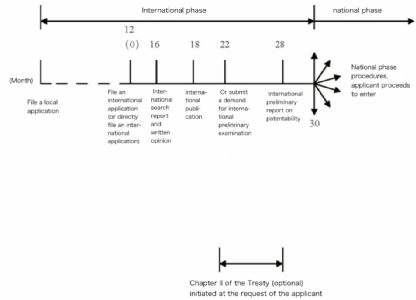
A. International Phase
1.Filing the Application
Eligible applicants may file a PCT international application directly or by entrusting a patent agency designated by the CNIPA. The application documents should be submitted to the "PCT Division of the Patent Affairs Administration Department of CNIPA." Local patent agencies do not accept PCT international applications. Applicants can file PCT international applications in electronic form using the CEPCT website or the CEPCT client, or in paper form via mail, personal delivery, or fax. The Receiving Office will establish the application date as the date on which it receives the application documents that meet all the requirements of Article 11(1) of the Treaty.
Applicants must use a prescribed language for the application documents; currently, the CNIPA accepts both Chinese and English. The application documents include essential components such as the request, description, and claims. Although documents like drawings, an abstract, and a power of attorney are not necessary to establish an application date, applicants should still submit them in a timely manner.
The applicant must pay the search fee and the international filing fee (and an additional fee for the international application, if applicable) within one month from the date the CNIPA receives the purported PCT international application. The CNIPA, acting as the Receiving Office, will conduct a national security review of the filed PCT international application.
2.International Search
After the application fees are paid as required, every PCT international application undergoes an international search. For applications received by the CNIPA, the international search is generally conducted by the CNIPA itself, which strives to discover relevant prior art. After the search, the CNIPA will issue an international search report and a non-binding written opinion on patentability. The deadline for this is three months from the receipt of the search copy or nine months from the priority date, whichever expires later.
During the international search phase, the applicant cannot amend the application documents. However, after receiving the international search report, the applicant may, within the prescribed time limit, submit amendments to the claims to the International Bureau. The time limit for amendments is two months from the date of transmittal of the international search report or sixteen months from the priority date, whichever expires later.
3.International Publication
International publication is carried out by the International Bureau of the World Intellectual Property Organization (WIPO) 18 months from the priority date. If an applicant wishes for early international publication, they can submit a request to the International Bureau and pay a special publication fee, if applicable.
4.(Optional) International Preliminary Examination
The international preliminary examination is not a mandatory procedure but is initiated at the applicant"s request. For any PCT international application received by the CNIPA, the international preliminary examination will be conducted by the CNIPA, acting as the International Preliminary Examining Authority.
The procedure is initiated after the applicant submits a valid demand for international preliminary examination within the specified time and pays the prescribed handling and preliminary examination fees. At this stage, the applicant can communicate with the examiner and amend the description, claims, and drawings under PCT Article 34. The applicant may receive a written opinion from the International Preliminary Examining Authority and will ultimately receive an international preliminary report on patentability.
B. National Phase
Approximately 30 months from the priority date, the applicant needs to select the specific countries or regions where they wish to obtain patent protection. They must then initiate the national phase procedure by submitting the required translations of the international application, paying the prescribed fees, and indicating the type of protection sought. At this stage, the laws and relevant regulations of each country differ and must be consulted separately. Generally, the procedures include submitting translations of the application documents, paying national fees, and appointing a local agent.
The patent offices of each country will conduct a substantive examination of the application according to their national patent laws and ultimately decide whether to grant a patent. It should be noted that the international search report and examination report from the international phase are not legally binding on the national patent offices, but they typically hold significant reference value.
Given the complexity of the PCT application process, if applicants are not sufficiently familiar with the relevant procedures and professional knowledge, it is advisable to entrust a professional agency to assist with the process, leveraging their expertise to improve the efficiency and success rate of the application. At the same time, applicants should strive to understand the relevant regulations as much as possible and be fully prepared before filing. To this end, the CNIPA website has a dedicated section that organizes and links to relevant information, including the latest Regulations under the PCT published by WIPO, the Applicant"s Guide, and official patent application systems. More information about PCT applications can be found through the relevant URLs listed below.
Related Websites/ Documents | Visit Address |
International Bureau of the World Intellectual Property Organization (WIPO) | |
PCT Column of the China National Intellectual Property Administration (CNIPA) | |
Patent Business Processing System | |
Patent Cooperation Treaty (PCT) | |
Regulations under the Patent Cooperation Treaty | |
Patent Law of the People"s Republic of China | |
Detailed Rules for the Implementation of the Patent Law of the People"s Republic of China | |
Guidelines for Handling Confidentiality Examination for Patent Applications Filed Abroad |
75. If choosing to file a cross-border patent application via the PCT, what are the key considerations when drafting the application documents?
Drafting high-quality PCT patent application documents is crucial to ensuring the application proceeds smoothly and achieves broad protection. From the choice of language and the structure of the claims to the format and composition of the documents, every aspect requires careful consideration in light of the PCT treaty rules and the actual requirements of the target countries to minimize application risks and increase the probability of a grant.
I. Choice of Application Language
A significant advantage of the PCT route is that applicants can file a PCT application directly with the China National Intellectual Property Administration (CNIPA) in Chinese, which is highly convenient when time is short. However, if the final target countries are non-English-speaking, the application documents will undergo two translations ("Chinese to English, then English to the local language"), which may compromise the accuracy of the technical solution. Therefore, especially for core technologies, it is advisable to prepare a high-quality English application text directly in advance to lay a solid foundation for future examination and rights enforcement.
II. Reasonable Structuring of the Claims
Although the PCT provides a unified application procedure, the final grant of a patent depends on each individual country. When drafting the application (especially the claims), the differences in the patent laws of the main target countries must be taken into account. For example, the United States grants patent protection for business methods, whereas many other countries do not. By setting up dependent claims with different scopes, one can reserve flexibility to adapt to the examination requirements of different countries in the future. This way, even if some broad claims are rejected after entering a particular country, it may still be possible to retain narrower claims that comply with that country"s laws, thereby securing a grant.
III.Attention to the Format and Composition of Application Documents
The standardized preparation of application documents is fundamental to the smooth progression of a PCT application. Details must be managed in accordance with the provisions of the Treaty and the requirements of its Regulations. The core documents must include the Request (Form PCT/RO/101), description, claims, abstract, and any drawings. The Regulations provide detailed and distinct requirements for each of these documents. In addition, the Regulations also set forth formal requirements for the international application, covering aspects such as paper size, line spacing, and margins.
In summary, the PCT offers numerous conveniences for cross-border patent applications. Its unified international application procedure greatly simplifies the process and provides applicants with more time for decision-making. However, the PCT application process is not without its hurdles; the overall procedure is rather cumbersome and highly demanding in terms of professionalism. From the initial decision of whether to use the PCT route, to the meticulous handling of language, claim structure, format, and composition when drafting the documents, and finally to determining how many and which target countries to file in, every step requires careful consideration. Any omission could affect the smooth progression of the application and the outcome of the grant.
76. How to apply for a design patent through the Hague Agreement?
The Hague Agreement concerning the International Deposit of Industrial Designs establishes a system for the cross-border application of design patents that is both convenient and cost-effective. A designer needs to file only a single application to seek registration for a design patent in multiple contracting states or regions.
Currently, there are two ways to file for the international registration of a design through the Hague System:
First, directly with WIPO. Applicants can log in to the WIPO website and file an electronic application through the eHague system. The application can be in English, French, or Spanish. The filing date is the date on which the International Bureau receives the application.
Second, via the CNIPA. Applicants can file an application with the China National Intellectual Property Administration (CNIPA), which will then forward it to the WIPO International Bureau. The application must be in English, and correspondence information in Chinese for mainland China must be provided. The filing date is the date on which the CNIPA receives the application.
Related Documents | Visit Address |
Hague System: Questions and Answers |
77. How to choose among the different routes for cross-border patent applications?
Currently, there are two main routes for cross-border patent applications: the traditional route of filing directly in each country under the Paris Convention for the Protection of Industrial Property, and the route through a PCT application. The two have significant differences and distinct advantages, as detailed in the table below:
Factors to Consider | Paris Convention Route | PCT Route |
Application Time & Deadlines | Must file an application in every country where protection is desired within 12 months of the first filing (the priority date). | Allows up to 30 months from the first filing (the priority date) before entering the "national phase" in individual countries, significantly extending the decision-making period. |
Application Documents & Language | Requires preparing a separate set of application documents that comply with the specific format requirements of each target country and translating them into the language required by that country. | Requires filing only one international application in a single language (e.g., Chinese or English), which is effective in all member states. |
Basis for Preliminary Assessment | National patent offices conduct their own searches; many do not provide a search report. It is difficult for the applicant to judge the prospects of a grant at an early stage. | An authoritative International Searching Authority provides an international search report and a written opinion, helping the applicant to make a preliminary judgment on the patentability of the invention. |
Procedure & Costs | Application fees, translation fees, and agent fees for all target countries must be paid within 12 months. Costs are incurred early and are concentrated. | Costs are paid in phases. Only a single application fee and a search fee are required during the international phase. The various fees for the national phase can be postponed until the 30-month mark. Since a search report is generated in the international phase, some national patent offices offer search fee reductions in the subsequent national phase. |
Flexibility | Once filed, the procedure follows the regulations of each country. Amendments and adjustments are relatively cumbersome. | Provides an opportunity to amend the application documents uniformly during the international phase; the amendments are effective for all designated states. Applicants can decide whether to proceed with, amend, or withdraw the application based on the search report. |
Evidently, the choice of which route to take should be based on a comprehensive consideration of various factors.
A. Number of Countries for Application
If the plan is to apply for a patent in only one or two countries, the direct filing route may be simpler and more direct. However, if protection is sought in multiple countries (e.g., three or more), the advantages of the PCT route in simplifying the procedure and distributing costs become very apparent.
B. Nature and Value of the Invention
For core inventions with high creativity and significant economic value, using the PCT route to obtain a comprehensive search report helps in adjusting the claims early, assessing the patent"s value, and providing a basis for subsequent business collaborations (such as technology transfer or seeking investment). For utility models with rapid product cycles, the longer duration of the PCT process might, conversely, reduce their value over time.
C. Urgency and Financial Situation
If time is of the essence and all documents are prepared, the direct application route through the Paris Convention can be used. However, if more time is needed to evaluate market prospects, raise funds, or further refine the technology, the 30-month "buffer period" offered by the PCT is its greatest advantage.
Second Section Technology Import and Export Compliance
78. How does China classify and manage technology imports and exports?
Technology imports and exports refer to the transfer of technology from outside China into the country, or from within China to outside the country, through trade, investment, or economic and technical cooperation. The Regulations of the People"s Republic of China on the Administration of Import and Export of Technologies enumerate the types of technology import and export activities, including patent right transfers, patent application right transfers, patent implementation licensing, technical secret transfers, technical services, and other forms of technology transfer.
Under these regulations, China"s management of technology imports and exports is categorized into three types: prohibited imports/exports, restricted imports/exports, and freely imported/exported technologies. Technologies classified as freely imported/exported undergo post-contract registration and filing. Technologies classified as restricted imports/exports are subject to licensing management. Technologies classified as prohibited imports/exports are not permitted to be imported or exported. If exported technologies are dual-use technologies simultaneously listed in the Export Control List of Dual-Use Items of the People"s Republic of China, they will also be subject to dual-use items export control management.
Detailed lists of prohibited and restricted items for import and export are provided in the Catalogue of Technologies Prohibited or Restricted by China from Export and the Catalogue of Technologies Prohibited or Restricted by China from Import.
Related Documents | Download Address | |
Regulations of the People"s Republic of China on the Administration of Import and Export of Technologies | ||
Export Control List of Dual-Use Items of the People"s Republic of China | https://www.gov.cn/zhengce/zhengceku/202411/content_6987846.htm | |
Catalogue of Technologies Prohibited or Restricted by China from Export | https://www.most.gov.cn/tztg/202312/W020231221620858841394.pdf |
|
Catalogue of Technologies Prohibited or Restricted by China from Import. | http://fms.mofcom.gov.cn/cms_files/oldfile//fms/202111/20211116131222501.pdf |
|


79. How can exporting technology to Belt and Road countries avoid violating export control regulations?
Exporting restricted or prohibited technologies to Belt and Road countries may result in penalties for violating China"s export control laws. Exporters should implement risk management throughout the entire technology export process:
1.Pre-export Review
Before exporting technology, exporters must verify against the latest Catalogue of Technologies Prohibited or Restricted by China from Export and the Export Control List of Dual-Use Items of the People"s Republic of China to confirm whether the proposed technology falls under prohibited or restricted export categories. Technologies involving sensitive fields such as artificial intelligence, encryption, nuclear power, drones, or vaccine production are highly likely to be subject to dual-use export controls.
Additionally, exporters must conduct customer due diligence to verify: the customer"s primary business scope and whether it involves sensitive activities like military operations; the customer"s type (manufacturer, distributor, or end-user); whether the customer is listed on China"s prohibited or restricted transaction lists or subject to UN sanctions; and the risk level of the customer"s country or region.
Some Belt and Road countries may carry international sanctions risks. Exporters must verify whether trading partners are listed on sanctions lists such as the EU Sanctions List or the U.S. OFAC SDN List. Particular scrutiny is required for high-risk sectors including aerospace, defense, cryptography, and communications equipment. Consult legal counsel for detailed guidance.
2.License Application
For restricted export technologies, exporters must apply for a Technology Export License from the Ministry of Commerce prior to shipment. Applicants may log into the Ministry of Commerce Business System Unified Platform (URL: https://ecomp.mofcom.gov.cn) to submit applications via the“Technology Import and Export Management Information Application.”They must also submit documents such as the Application for Export of Restricted Chinese Technologies to the provincial-level commerce authority in their jurisdiction.
If the exported technology is also dual-use technology, exporters must concurrently apply for a Dual-Use Items Export License. The dual-use items export license is also processed through the Ministry of Commerce"s Unified Business System Platform. Applicants must truthfully complete all sections of the Dual-Use Items Export License Application Form.
If the exported technology is unrestricted, the exporter must complete online filing on the Ministry of Commerce"s Unified Business System Platform within 60 days after the contract takes effect. The exporter must also present the Technical Export Contract Registration Application Form, a copy of the technical export contract, and proof of legal status for both contracting parties to the competent commerce authority to complete registration procedures.
3.Contract Risk Control
When entering into a technology export contract, the exporter should include export control compliance clauses to bind the counterparty to relevant laws and regulations, thereby reducing or eliminating export control risks. See“Question 82”for details.
Furthermore, the exporter must permanently retain the counterparty"s business license, end-user declaration, project specifications, and other relevant documents for potential customs or Ministry of Commerce inspections.
4.Dynamic Monitoring
During contract execution, the exporter must re-screen all parties involved, monitor the Ministry of Commerce"s continuously updated Unreliable Entity List, and prevent compliance risks arising from changes to prohibited or restricted transaction lists. Prior to shipment, confirm that all prior review steps are complete, verify the freight forwarder"s status, and ensure the license and shipping documents match the delivered goods. If any issues are identified, shipment should only proceed after verification by the relevant authorities. During payment processing, after-sales service provision, maintenance, or repair activities, any potential changes to the end-user, end-use, or installation location of export-controlled items must be immediately reported to the national export control administration.
Related Documents | Download Address |
Export Control List of Dual-Use Items of the People"s Republic of China | https://www.gov.cn/zhengce/zhengceku/202411/content_6987846.htm |
Internal Compliance Guide for Dual-Use Item Export Controls | http://aqygzj.mofcom.gov.cn/cms_files/oldfile//aqygzj/202104/20210428182950304.pdf |
80. What compliance procedures must be fulfilled before exporting technologies which are restricted to be exported?
Article 31 of the Regulations of the People’s Republic of China on the Administration of Import and Export of Technologies (2020 Revision) stipulates: “To export technologies which are restricted to be exported, an application shall be submitted to the Director under the State Council together with supportive documents.”
Article 33 stipulates: “If the application is approved, the Director under the State Council shall issue a Preliminary License for export of technologies. The exporter of the technologies may enter into substantive negotiation and sign contracts of export of technologies only upon obtaining the Preliminary License.”
Article 34 stipulates:“Upon signing the contract of export of technologies, the exporter shall submit the following documents to the Director of the State Council, to apply for a License of Export of Technologies. (1) The Preliminary License for Export of Technologies; (2) Copies of the contracts of export of technologies;(3) List of technological documents to accompany the export; (4) Documents evidencing the legal status of the contractual parties. The Director under the State Council shall, upon reviewing the authenticity of the contract, decide to grant or not to grant the license for export within 15 working days of receiving the above the documents.”
Article 35 stipulates: “If deciding to grant a license of export, the Director under the State Council shall issue a License of Export of Technologies. The contract of export of technologies shall be effective upon the date when the License is issued.”
Article 39 stipulates: “The exporter shall present the license or the registration certificate of export of technologies in order to go through the formalities at the authorities of foreign exchange, banking, taxation and customs.
Specific to Beijing Municipality, exporters may apply online through the Beijing Municipal Government Service Network (URL: https://banshi.beijing.
gov.cn/pubtask/bmfw.html?locationCode=110000000000&deptCode=11110000756701202G) or offline at the window of the Beijing Municipal Government Service Center (Address: Comprehensive Window, No. 1 South Xisanhuan Road, Fengtai District, Beijing). The acceptance criteria are as follows: 1. The application materials comply with the requirements of Articles 3 and 5 of the Measures for the Administration of Technologies Prohibited or Restricted from Export, the technology in question is listed as a restricted export technology in the Catalogue of Technologies Prohibited or Restricted by China from Export, and the application form conforms to the format requirements specified in the annex of the regulations; 2. The materials are complete and fully filled out; 3. The submitted certificates, documents, or approval papers are complete and intact; if copies are submitted, they shall be complete, clear, and consistent with the original documents; 4. The basic information stated in the application materials is consistent with the content contained in the submitted certificates, documents, or approval papers; 5. The signatures and seals on the application materials must comply with the requirements, and the content of the signatures must be consistent with that stated in the application materials, as well as the content stated in the submitted certificates, documents or approval documents. For more information in details such as the full list of application materials, processing procedures, and fee standards, please refer to the URL: https://banshi.beijing.
Related Documents | Download Address | |
Regulations of the People’s Republic of China on the Administration of Import and Export of Technologies (2020 Revision) | ||
Measures for the Administration of Technologies Prohibited or Restricted from Export (2009 Revision) | ||
Catalogue of Technologies Prohibited or Restricted by China from Export & Adjustments on July 15, 2025 | https://www.mofcom.gov.cn/zcfb/fwmy/art/2023/art_aedad4751d0343178777dea8552902ca.html https://fms.mofcom.gov.cn/zcfg/jsjckzcfg/art/2025/art_ba35a101c22c4f6e844f749cb0a98552.html | |
81. How to obtain an import/export contract registration certificate for technologies subject to free import/export?
Even for freely exported technologies, the exporter must still complete technical contract filing registration. Otherwise, customs clearance, foreign exchange, tax, and other procedures cannot be processed. According to relevant laws and regulations, the process and requirements for the exporter to obtain an import/export contract registration certificate from the competent commerce authority are as follows:
1.Registration Authority
Pursuant to the Administrative Measures for the Registration of Technology Import and Export Contracts, the competent commerce authority serves as the registration management department for technology import and export contracts. The commerce authorities of provinces, autonomous regions, municipalities directly under the central government, and cities with independent planning status are responsible for registering and managing contracts for freely exported technologies. These provincial-level commerce authorities may delegate registration management of freely imported and exported technology contracts to lower-level commerce authorities.
2.Registration Timeline
Per the aforementioned regulations, technology import/export operators must complete contract registration within 60 days after the contract takes effect. For contracts with royalty-based payment terms, operators must complete initial registration within 60 days after the first royalty base amount is established and subsequently file contract amendment procedures each time a new royalty base amount is formed. When processing registration or amendments, operators must provide supporting documentation verifying the royalty base amount.
3.Registration Method
Pursuant to the aforementioned Measures, the state implements online registration management for freely exported technology contracts. Technology export operators shall log into the Technology Import and Export Contract Information Management System on the Ministry of Commerce government website (URL: jsjckqy.fwmys.mofcom.gov.cn, now integrated into the Ministry of Commerce"s Unified Business System Platform, or directly access https://ecomp.mofcom.gov.cn) to register contracts. They must then submit the following documents to the competent commerce authority for registration: the Application for Registration of Technology Export Contract, a copy of the technology export contract (including a Chinese translation), and proof of legal status for both contracting parties.
For initial contract registration, the following materials are required: (1) System-generated Technical Export Contract Application Form and Data Sheet (signed by the responsible person of the entity and affixed with the official seal). (2) Copy of the technical export contract (translated into Chinese if in a foreign language). For contracts introduced through an agent, a copy of the agency agreement (affixed with the official seal) must be provided. (3) Proof of legal status for both contracting parties: Copy of the domestic enterprise"s business license and copy of the foreign enterprise"s registration documents in its home country, along with translations (bearing the official seal). (4)Domestic enterprise"s import-export qualification documents. (5) Enterprise application commitment letter and resolution. (6) For commission-based payment methods, also provide a statement of the commission base amount, commission calculation table, relevant financial statements, and other supporting documents (bearing the official seal).
4.Verification and Registration
Pursuant to the Regulations of the People"s Republic of China on the Administration of Import and Export of Technologies, the competent commerce authority shall verify and register the contract details within three working days of receiving the application documents.
First, if the application documents meet the prescribed requirements, the technology export contract shall be registered, and a Technology Export Contract Registration Certificate shall be issued. Second, if the application documents fail to meet the prescribed requirements or the registration records are inconsistent with the contract content, the competent commerce authority shall notify the technology import-export operator to supplement or amend the documents within 3 working days of receiving the application. Upon receiving the supplemented application documents, the authority shall verify the contract registration content within 3 working days and issue either a“Technology Import Contract Registration Certificate”or a “Technology Export Contract Registration Certificate.”
Related Documents | Download Address |
Administrative Measures for the Registration of Technology Import and Export Contracts |
82. What essential clauses should a technology export contract include?
A technology export contract involves the transfer and licensing of technology. Referencing the provisions for technology contracts in the Civil Code of the People"s Republic of China, such contracts should also include standard clauses covering: the contracting parties; the subject matter and scope of the contract; the obligations and performance of both parties; confidentiality of technical materials; allocation of risk liability; ownership of technological achievements and methods for profit sharing; price and payment terms; liability for breach of contract; and contract termination.
Additionally, given their cross-border nature, such contracts must address issues like international transactions, foreign exchange settlements, and export controls. Therefore, special clauses are necessary to ensure compliance and enforceability in foreign-related business. The following contract terms may serve as references, though detailed advice should be sought from legal counsel.
1.Export Approval and Filing Clause
To comply with the mandatory requirements of the Regulations of the People"s Republic of China on the Administration of Import and Export of Technologies, the contract may include an export approval and filing clause. This clause may stipulate the exporter"s obligation to handle export approval, licensing, or filing procedures. Additionally, it should address contract termination or cancellation and respective liabilities should the export license application be denied.
2.Export Control Compliance Clauses
To prevent the exporter from violating export control regulations, technology export contracts should include specific export control compliance clauses. These should explicitly prohibit the use of technology for military, nuclear, weapons, or prohibited purposes, and restrict the importer from re-exporting or transferring the technology to third parties. Should the importer breach these obligations, the contract should grant the exporter the right to terminate the contract or seek compensation.
3.Foreign Exchange Settlement and Payment Clauses
To comply with China"s foreign exchange regulations and mitigate exchange rate risks, the contract should specify the payment currency, payment method (e.g., letter of credit, collection, wire transfer), and exchange rate (based on the official exchange rate quoted by the Bank of China on the contract signing date or payment date).
4.Tax and Customs Clauses
Technology export contracts should clearly define tax burden allocation. Therefore, the contract should ideally stipulate how tariffs, value-added tax, corporate income tax, and other taxes related to technology exports are borne. It should also specify whether payment amounts are pre-tax or post-tax, outline avoidance measures for tax increases caused by the licensee"s fault, and clarify eligibility for tax incentives or relevant tax treaties.
5.Intellectual Property Clauses
To control the overseas scope of technology use and prevent improper dissemination, the contract should clearly stipulate geographical, temporal, and industry restrictions on the use of intellectual property rights related to the technology. It should prohibit the importer from exceeding the permitted scope of use or sublicensing, and determine the ownership of any resulting technological improvements.
6.Governing Law and Dispute Resolution Clauses
Given the multi-jurisdictional nature of technology export contracts, specific governing law and dispute resolution clauses should be established to avoid jurisdictional uncertainty. These clauses should address the applicable law governing the contract and the method of dispute resolution. Generally, arbitration is more common than litigation for international commercial disputes, with parties often selecting internationally recognized arbitration institutions such as CIETAC, HKIAC, ICC, or SIAC. If arbitration is stipulated as the dispute resolution method, the clause should specify the arbitration venue, language, and other details. Arbitration clause templates can be referenced from the official websites of respective arbitration institutions.
83. How to identify and avoid "unreasonable restrictive clauses" set by foreign technology licensors in contracts that exceed the scope of intellectual property protection?
To align with international rules and optimize the business environment, China"s latest Regulations of the People"s Republic of China on the Administration of Technology Import and Export has repealed a series of clauses from the original regulations that provided mandatory protection for domestic technology importers(e.g.,the previous rule that the results of improved technology belonged to the improving party). This also means that more of the risks and responsibilities of technology importation have been shifted to the negotiating table. Therefore, it is now imperative for research institutes to possess the ability to proactively identify and avoid these risks.
I. How to Identify "Unreasonable Restrictive Clauses"?
A. Macroscopic Identification
First, determine whether the clause exceeds the "exhaustion of rights" boundary of intellectual property. The core of intellectual property is to grant the rights holder an "exclusive right," which is the right to prohibit others from practicing their technology without permission. Once the rights holder has received consideration (a license fee) through a license agreement, their rights should, to a large extent, be considered "exhausted." Any clause that attempts to control the licensee"s business activities unrelated to the intellectual property after the technology has been acquired is highly likely to be "unreasonable."
Second, assess whether the clause constitutes a monopolistic act prohibited by the Anti-Monopoly Law of the People"s Republic of China. The Anti-Monopoly Law is an important tool for regulating unfair practices in technology transfer, and many typical monopolistic behaviors fall under the category of unreasonable restrictive clauses.
Finally, consider whether the clause violates the principles of fairness and good faith. Even if certain clauses do not directly constitute a monopoly, they can be deemed "unreasonable" if they seriously contravene the principle of equity and reciprocity in business cooperation.
B. Typical Examples
Tying / Tie-in Arrangement: Forcing our side to purchase other technologies, services, or equipment that are not essential. This goes beyond the scope of the exclusive rights of the core licensed technology and is suspected of being an abuse of a dominant market position.
Restricting the Source of Raw Materials or Equipment: Requiring our side to purchase raw materials or equipment for implementing the technology only from the licensor or a designated third party, even when better and more affordable alternatives are available on the market.
Restricting the Sales Channels or Prices of Products: Imposing unreasonable, rigid restrictions on the sales price, channels, or customers for products manufactured using the licensed technology after our side has already paid the license fee.
Unreasonable Market Division: Completely prohibiting our side from selling products in specific countries or regions, especially when there is no direct competition with the licensor in that region. Such horizontal market division agreements are typical monopolistic acts.
Restricting Technological Improvement and R&D Freedom: Prohibiting our side from making any form of improvement or developing new technology based on the imported technology.
Unfair Technology Grant-Back Clauses: Requiring our side to grant back any improvements made based on the imported technology (regardless of their significance) to the foreign party on a royalty-free and exclusive basis, which effectively seizes our subsequent innovative achievements.
No-Challenge Clause: Stipulating in the contract that our side may not challenge the validity of the patent for the imported technology or may only do so under certain conditions. This deprives our side of its legal rights and may result in our paying high fees for a patent that should be invalid.
Unilateral, Asymmetrical Rights and Obligations: For example, the contract only specifies the confidentiality obligations of our side but makes no requirements for the licensor"s confidentiality obligations; or it only stipulates our side"s liability for breach of contract but is lax in defining the licensor"s responsibilities.
II. How to Effectively Avoid "Unreasonable Restrictive Clauses"?
Precise identification is the foundation, and proactive avoidance is the core. Research institutes need to build a full-process avoidance strategy covering" pre-negotiation preparation,in-negotiation bargaining, and post-agreement safeguards," using the law as a shield and professional expertise as a spear to protect their bottom line.
A. Before Negotiation: Solidify Preparations and Seize the Initiative
Engage a professional intellectual property legal team at the very beginning of the technology import project, rather than waiting until the contract is drafted for review. The lawyers should conduct a comprehensive evaluation of the imported technology in advance, including patent stability (e.g., risk of invalidation), clarity of technology ownership (e.g., existence of ownership disputes), and the availability of alternative technologies in the market. This information directly determines the research institute"s bargaining power. For instance, if a technology"s patent stability is weak, reliance on the licensor can be reduced, making it easier to reject unreasonable clauses.
B. During Negotiation: Uphold the Bottom Line and Balance Rights and Obligations
Article 850 of the Civil Code of the People"s Republic of China clearly states: "A technology contract that illegally monopolizes technology or infringes upon the technological achievements of others is void A technology contract that illegally monopolies technologies or infringes upon others technological work product is invalid." Article 10 of the Interpretation of the Supreme People"s Court concerning Some Issues on Application of Law for the Trial of Cases on Disputes over Technology Contracts lists six situations of "illegally monopolizing technology" that lead to a contract being void, all of which are, in fact, typical unreasonable restrictive clauses. When faced with such clauses, one should insist on using domestic law as the basis for negotiation, employing relevant laws and regulations as "hard support" for rejecting them.
For other unreasonable restrictive clauses that are not explicitly stipulated by law as leading to a void contract, the correct negotiation approach should be adopted. Avoid simple rejection; instead, propose alternative solutions that accommodate the interests of both parties. At the same time, refine the reciprocal clauses on rights and obligations. When "asymmetrical clauses" are identified during negotiations, propose amendments promptly to ensure that rights and obligations are "reciprocal and equivalent."
In the era following the amendment of the Regulations of the People"s Republic of China on the Administration of Technology Import and Export, research institutes can no longer rely on "mandatory clauses" to avoid risks. They must complete the role transformation from a "passively protected party" to an "active negotiator." The core strategy is using domestic laws such as the Civil Code as a "defensive shield" to reject unreasonable restrictions and relying on a professional legal team as a "think tank" to accurately identify risks and formulate negotiation strategies. Only in this way can unreasonable clauses be dismantled one by one in technology import negotiations, and core rights and interests be fought for with sound reasoning, ultimately achieving a fair contract that balances rights and obligations, complies with legal provisions, and secures space for innovation, thereby building a strong safety barrier for the research institute"s R&D and commercialization of results.
Related Documents | Download Address | |
Civil Code of the People"s Republic of China | https://flk.npc.gov.cn/detail?id=ff808081729d1efe01729d50b5c500bf&fileId=&type=&title=中华人民共和国民法典 |
|
Interpretation of the Supreme People"s Court concerning Some Issues on Application of Law for the Trial of Cases on Disputes over Technology Contracts |
| |
Regulations of the People"s Republic of China on the Administration of Technology Import and Export |
| |



84. How to design "clauses on the results of technological improvements (grant-back)" in technology import contracts to maximize the protection of our rights and interests and comply with legal provisions?
I. Core Principles for Designing "Clauses on the Results of Technological Improvements (Grant-Back)"
A. "Ownership by the Improving Party" is an Unbreachable Legal Cornerstone
According to Article 875 of the Civil Code of the People"s Republic of China: " Where there is no agreement on such method or the agreement is unclear, if it cannot be determined according to the provisions of Article 510 of this Code, the subsequently improved technological product made by one party may not be shared by any other party." This article establishes the statutory rule that "in the absence of an agreement, the improving party has exclusive ownership." Research institutes must treat this as their "fundamental position" in negotiations to fundamentally preclude unreasonable claims by the foreign party for default sharing. It must be clear that any form of grant-back is a concession of our rights, not a statutory obligation.
B. "Reciprocity and Equivalence" is the Legal Red Line to Avoid Invalid Clauses
Article 850 of the Civil Code of the People"s Republic of China clearly states: " A technology contract that illegally monopolies technologies or infringes upon others technological work product is invalid." Article 10 of the Interpretation of the Supreme People"s Court concerning Some Issues on Application of Law for the Trial of Cases on Disputes over Technology Contracts provides that the following circumstances fall under "illegally monopolizing technology and hindering technological progress" as referred to in Article 850 of the Civil Code: "(1) Restricting one party from conducting new research and development on the basis of the technology as the subject matter of the contract, or restricting the party from using the improved technology, or the conditions for both parties to exchange the improved technologies are not reciprocal, including such circumstances as requiring one party to provide the improved technology to the other party free of charge, transferring the improved technology to the other party non-reciprocally, or solely occupying or sharing intellectual property rights of the improved technology free of charge. " The above provisions provide a direct basis for our side to reject unfair demands. In practice, there are three main types of "inequality traps": first, the foreign party demands a royalty-free grant-back from our side but refuses to share its own improvements with us; second, the foreign party demands an "exclusive license" grant-back from our side but only provides its improved technology to us on a "non-exclusive license" basis; third, the foreign party sets an "indefinite term" for our grant-back but limits its license to us to a "short term." When designing clauses, it must be clear that any grant-back obligation is premised on the other party undertaking an equivalent obligation. No reciprocity, no grant-back.
C. "Restricting Exclusive Grant-Backs" is Key to Preventing Strategic Risks
If a foreign party requests an "exclusive grant-back" using "payment" as a lure, it may still constitute "exclusion or restriction of competition" even if a license fee is paid. Such clauses also carry the risk of the foreign party locking down the future innovative value of our side for a small consideration. Especially in key fields like chips and biopharmaceuticals, this could lead to our core technology being controlled by others. Therefore, when designing the clause, it can be specified that "as a principle, no form of exclusive grant-back will be accepted. If special arrangements are truly necessary, they must be jointly evaluated by our research, legal, and strategic departments and be limited to non-core technology areas and a short period (e.g., not exceeding 2 years)."
II. Specific Design of "Clauses on the Results of Technological Improvements (Grant-Back)"
A. Precisely Define the Scope of "Results of Technological Improvements"
Defining the scope is the first line of defense for protecting rights and interests. The boundaries of the grant-back obligation must be narrowed through definitions.
1.Distinguish between "Improvements" and "New Inventions"
The clause should specify that ""results of technological improvements" refer to results that partially optimize the function or performance of the imported technology (e.g.,adjustments to algorithm parameters, simplification of process steps), and do not include new technical solutions independently developed by our side inspired by the imported technology (e.g., a new testing device developed based on an imported testing technology)." This prevents the foreign party from including our original achievements within the scope of the grant-back.
2.Limit the "Form of Grant-Back Results"
It can be stipulated that "the grant-back obligation only applies to improved results for which a patent has been applied or a copyright has been registered. Trade secrets that have not become intellectual property (e.g.,experimental data, undisclosed processes) are not subject to grant-back." This prevents the foreign party from acquiring our undisclosed core R&D information through the grant-back.
3.Exclude "Unrelated Improvements"
Clearly state that "improvements that have no direct technical connection to the imported technology (e.g.,our side using the imported software technology to improve its own management system) do not fall within the scope of the grant-back stipulated in this clause." This prevents the foreign party from interfering in our innovation activities that are not technically related.
B. Clarify the Ownership and Grant-Back Conditions for "Results of Technological Improvements"
Based on negotiating power, design the clauses in a tiered order of "optimal—suboptimal—concessionary" to ensure that core interests are protected in different scenarios.
1.First Priority (Optimal Strategy): No Grant-Back Agreement
The clause states: "The intellectual property rights for technological improvements independently completed by each party shall be owned by that party, and neither party shall have a grant-back obligation to the other. If one party needs to use the other party"s improved results, a separate license agreement shall be signed, and a reasonable fee shall be paid." This approach is suitable for scenarios where our side has a strong negotiating position (e.g., there are alternative options for the imported technology) and can maximize our autonomy in innovation.
2.Second Priority (Suboptimal Strategy): Paid, Non-Exclusive, Reciprocal Grant-Back
If the foreign party insists on a grant-back, it can be agreed that "our side agrees to grant the improved results to the foreign party on a non-exclusive license basis, and at the same time, the foreign party shall grant its improved results to our side under the same conditions. The foreign party shall pay a license fee for using our improved results according to the following standards: ① a one-time payment of XXX thousand yuan, or ② a royalty fee of X% of the sales revenue generated by the foreign party"s use of the results (choose one). The license fee shall be settled annually. If the foreign party is late in payment, it shall pay a penalty for breach of contract at a daily rate of 0.05%." It is also necessary to clarify the meaning of "non-exclusive license": our side retains the right to use the results itself and to license them to third parties, and the foreign party may not restrict our cooperation with third parties.
3.Third Priority (Concessionary Strategy): Royalty-Free, Non-Exclusive, Strictly Reciprocal Grant-Back
If, in exchange for commercial benefits such as a "reduction in the technology import fee," a royalty-free grant-back is acceptable, it must meet two rigid conditions: ① The foreign party must also license its improved results to our side on a royalty-free, non-exclusive basis, and the scope of its license must be consistent with the scope of our grant-back; ② The term of the royalty-free grant-back shall not exceed the validity period of the original technology import contract, and the grant-back obligation shall automatically terminate upon the expiration of the contract. The clause can state: "If the foreign party fails to provide its improved results to our side free of charge as agreed, our side has the right to immediately terminate the royalty-free grant-back obligation and demand compensation for losses from the foreign party (the amount of compensation shall not be less than 20% of our technology import fee)."
C. Set Restrictions on the "Grant-Back License"
Even if a grant-back is agreed upon, the foreign party"s abuse of the license rights must be prevented through a "threefold restriction" of territory, field of use, and term.
First, territorial restriction. The agreement can stipulate that "the grant-back license granted by our side to the foreign party shall only be effective in XX country/region (the foreign party"s core market, such as North America, Europe) and shall not be exercised in mainland China or in markets where our side has a key strategic presence (e.g., Southeast Asia)." This prevents the foreign party from competing in our core markets using our improved results.
Second, field of use restriction. For example, specify that "the grant-back license is limited to use in the XX field (e.g., the foreign party"s automotive manufacturing business) and shall not be used in fields related to our core business (e.g., aerospace)." This prevents the foreign party from using our technology across different industries.
Third, sublicensing restriction. Restrict the foreign party by strictly prohibiting sublicensing. The clause can state: "The foreign party shall not assign or sublicense the grant-back license granted by our side to any third party (including its affiliated companies). Otherwise, our side has the right to unilaterally terminate the grant-back license and demand payment of a penalty for breach of contract from the foreign party (the amount being 3 times the total license fee)."
Related Documents | Download Address | |
Civil Code of the People"s Republic of China | https://flk.npc.gov.cn/detail?id=ff808081729d1efe01729d50b5c500bf&fileId=&type=&title=中华人民共和国民法典 |
|
Interpretation of the Supreme People"s Court concerning Some Issues on Application of Law for the Trial of Cases on Disputes over Technology Contracts |
| |


85. How to handle cross-border royalty payments blocked by banks?
Cross-border royalty payments are subject to three regulatory frameworks: foreign exchange management, technology import/export control, and tax administration. Incomplete documentation or inaccurate information in any of these areas may cause banks to block such payments. Therefore, when encountering blocked royalty payments, each case requires individual analysis, and legal counsel should be consulted when necessary. Generally, the following approaches may be considered:
1.Confirm the reason for the block
As banks may follow different internal operational rules when executing foreign exchange transactions, it is best to inquire with the handling bank about the specific reason for the block. Common causes include incorrect transaction codes, incomplete contract details, discrepancies between the payment amount and the contract, unregistered contracts, or missing tax documentation.
2.Supplement Review Materials
Request a list of supplementary materials from the bank and provide the required documents as specified.
Technology imports/exports must undergo legal filing or licensing. For unrestricted technologies, import/export contract registration is required; restricted technologies necessitate a license. Sensitive technologies (e.g., encryption, dual-use) require a Dual-Use Items Export License from the Ministry of Commerce beforehand. Otherwise, banks may reject payments due to export control risks.
According to the Supplementary Announcement of the State Taxation Administration and the State Administration of Foreign Exchange on Issues Concerning the Tax Recordation for Foreign Payments under Trade in Services and Other Items, domestic institutions and individuals making single overseas payments exceeding the equivalent of USD 50,000 (excluding USD 50,000) must file a tax report with the competent state tax authority at their location. Where the competent tax authority is solely the local tax authority, filing should be made with the state tax authority at the same level. Additionally, cross-border royalty payments must comply with tax regulations. After tax payment, relevant documentation must be provided, such as corporate income tax withholding certificates.
3.Foreign Exchange Administration Consultation
For inquiries regarding foreign exchange administration, visit the consultation sections on the official websites of the State Administration of Foreign Exchange (SAFE) or the Beijing Municipal SAFE Branch (URLs: https://www.safe.gov.cn/safe/ywzx/index.html, https://www.safe.gov.cn/beijing/ywzx/index.html). For inquiries regarding foreign exchange matters in Beijing, you may also call the business consultation hotline at 010-68559550.
Related Documents | Download Address |
Foreign Exchange Operations for Current Account Transactions (2020 Edition) | https://www.safe.gov.cn/tianjin/file/file/20240428/aaf6a0aef34b432cb8c9ddfd597d147f.pdf |
Announcement of the State Taxation Administration and the State Administration of Foreign Exchange on Issues Concerning the Tax Recordation for Foreign Payments under Trade in Services and Other Items | |
Supplementary Announcement of the State Taxation Administration and the State Administration of Foreign Exchange on Issues Concerning the Tax Recordation for Foreign Payments under Trade in Services and Other Items | https://www.gov.cn/zhengce/zhengceku/2021-07/06/content_5622681.htm |
Third Section Data Security Compliance
86. In scientific research activities, how to determine whether a data processor’s working behaviors or scenarios constitute “Outbound Data Transfer”?
Paragraph 2 of Article 1 of the Guide to the Application for Security Assessment of Outbound Data Transfer (Third Edition) stipulates: “The following circumstances constitute outbound data transfers: (1) A data processor transmits to overseas recipients the data collected and generated during its operations in China. (2) The data collected and generated by a data processor, notwithstanding stored in China, are allowed to be inquired, retrieved, downloaded, or exported by overseas institutions, organizations, or individuals. (3) Other data processing activities, including overseas processing of personal information of natural persons located within the territory of the People’s Republic of China, as specified in paragraph 2 of Article 3 of the Personal Information Protection Law.”
Paragraph 2 of Article 3 of the Personal Information Protection Law of the People’s Republic of China stipulates: “This Law shall also apply to the processing outside the territory of the People’s Republic of China of the personal information of natural persons located within the territory of the People’s Republic of China if the information is processed: (1) for the purpose of providing products or services to natural persons located within China; (2) to analyze or assess the conduct of natural persons located within China; or (3) under any other circumstance as provided by any law or administrative regulation.”
In scientific research activities, data processors shall verify whether specific scientific research behaviors constitute "outbound data transfer" in accordance with the above laws and regulations, and then further confirm whether an application for the security assessment of outbound data transfer is required.
Related Documents | Download Address |
Guide to the Application for Security Assessment of Outbound Data Transfer (Third Edition) | |
Personal Information Protection Law of the People’s Republic of China | http://www.npc.gov.cn/npc/c2/c30834/202108/t20210820_313088.html |
87. Which scientific research data provided to overseas parties fall within the scope of control?
I. Scientific Research Data that Are Controlled Items
Article 25 of the Data Security Law of the People’s Republic of China stipulates: “The state shall impose export control in accordance with the law on data as controlled items related to safeguarding national security and interest and performing international obligations.”
Article 2 of the Export Control Law of the People’s Republic of China stipulates: “This Law shall apply to the state’s control over the export of dual-use items, military products, nuclear, and other items such as goods, technologies, and services related to maintaining the national security and interest and performing nonproliferation and other international obligations (hereinafter collectively referred to as the ‘controlled items’).
For the purposes of the preceding paragraph,‘controlled items’ includes the technical materials and other data relating to the items.
For the purposes of this Law, ‘export control’ means the prohibitive or restrictive measures imposed by the state on the outward movement of controlled items from the territory of the People’s Republic of China and the provision of controlled items by a citizen, legal person, or unincorporated organization of the People’s Republic of China to a foreign organization or individual.
For the purposes of this Law, ‘dual-use items’ means goods, technologies, and services that are for both civil and military purposes or contribute to an increase in military potential, especially those that may be applied to design, develop, produce, or use weapons of mass destruction and their means of delivery.
For the purposes of this Law, ‘military products’ means the equipment, specialized production machinery, and other relevant goods, technologies, and services used for military purposes.
For the purposes of this Law, ‘nuclear’ means nuclear materials, nuclear equipment, non-nuclear materials for reactor use, and relevant technologies and services.”
The state implements a unified export control system, and administer it by means such as formulating control lists, directories, or catalogues (hereinafter collectively referred to as the “control lists”) and implementing export licensure. For specific control lists, please refer to the Catalogue for the Administration of Import and Export Licenses for Dual-Use Items and Technologies issued by the Ministry of Commerce of the People’s Republic of China; the Export Control List of Dual-Use Items of the People’s Republic of China jointly issued by the Ministry of Commerce of the People’s Republic of China, the Ministry of Industry and Information Technology of the People’s Republic of China, the General Administration of Customs of the People’s Republic of China, and the State Cryptography Administration; and the Catalogue of Technologies Prohibited or Restricted by China from Export issued by the Ministry of Commerce of the People’s Republic of China and the Ministry of Science and Technology of the People’s Republic of China.
II. Scientific Research Data that Are Important Data or Personal Information as Prescribed by law
Article 2 of the Provisions on Promoting and Regulating Cross-border Data Flow stipulates: “A data processor shall identify and report important data in accordance with the applicable provisions. If data has not been informed by relevant departments or regions or publicly announced as important data, data processors are not required to apply for a security assessment of outbound data transfer.”
Article 7 stipulates: “A data processor that provides data to an overseas recipient and meets any of the following conditions shall apply to the national cyberspace administration for a security assessment of outbound data transfer through the provincial cyberspace administration at the place where it is located: (1) It is a critical information infrastructure operator that provides any personal information or important data to an overseas recipient. (2) It is a data processor, other than a critical information infrastructure operator, that provides any important data to an overseas recipient, or that has cumulatively provided the personal information (excluding sensitive personal information) of not less than 1 million individuals or the sensitive personal information of not less than 10,000 individuals to overseas recipients as of January 1 of the current year.
Under any of the circumstances specified in Articles 3, 4, 5, and 6 of these Provisions, such provisions shall apply.”
Therefore, when providing scientific research data to overseas parties, it is necessary to not only examine whether the data belong to controlled items but also determine whether they are important data or personal information as prescribed by law, so as to confirm whether it is demanded to apply for the security assessment of outbound data transfer.
Related Documents | Download Address |
Data Security Law of the People’s Republic of China | http://www.npc.gov.cn/c2/c30834/202106/t20210610_311888.html |
Export Control Law of the People’s Republic of China | https://dltb.mofcom.gov.cn/zcfg/art/2023/art_909d9f5e7f024b9ab158b71fba2f06cb.html |
Catalogue for the Administration of Import and Export Licenses for Dual-Use Items and Technologies | https://www.mofcom.gov.cn/zwgk/zcfb/art/2024/art_636ab584a448477d906e54f63719b27f.html |
Export Control List of Dual-Use Items of the People’s Republic of China | https://www.gov.cn/zhengce/zhengceku/202411/content_6987846.htm |
Catalogue of Technologies Prohibited or Restricted by China from Export & Adjustments on July 15, 2025 | https://images.mofcom.gov.cn/fms/202312/20231221153855374.pdf https://fms.mofcom.gov.cn/zcfg/jsjckzcfg/art/2025/art_ba35a101c22c4f6e844f749cb0a98552.html |
Provisions on Promoting and Regulating Cross-border Data Flow | https://www.gov.cn/gongbao/2024/issue_11366/202405/content_6954192.html |
88.Which outbound data transfer activities are exempt from applying for a security assessment of outbound data transfer, concluding a standard contract for the outbound transfer of personal information, or obtaining a personal information protection certification?
Article 2 of the Provisions on Promoting and Regulating Cross-Border Data Flow stipulates: “A data processor shall identify and report important data in accordance with the applicable provisions. If data has not been informed by relevant departments or regions or publicly announced as important data, data processors are not required to apply for a security assessment of outbound data transfer.”
Meanwhile, the Provisions on Promoting and Regulating Cross-Border Data Flow specify six exemption scenarios where entities are exempt from applying for a security assessment of outbound data transfer, concluding a standard contract for the outbound transfer of personal information, or obtaining a personal information protection certification. Article 3 of the Provisions on Promoting and Regulating Cross-Border Data Flow stipulates: “Where the data collected and generated in the course of international trade, cross-border transportation, academic cooperation, multinational production, manufacturing and marketing, and other activities is provided to an overseas recipient and does not contain any personal information or important data, a data processor shall be exempt from applying for a security assessment of outbound data transfer, concluding a standard contract for the outbound transfer of personal information, or obtaining a personal information protection certification.” Article 4 of the Provisions on Promoting and Regulating Cross-Border Data Flow stipulates: “Where a data processor transmits any personal information collected and generated abroad into China for processing and then provides it to an overseas recipient, and does not introduce any personal information or important data generated in China during the processing, the data processor shall be exempt from applying for a security assessment of outbound data transfer, concluding a standard contract for the outbound transfer of personal information, or obtaining a personal information protection.” Article 5 of the Provisions on Promoting and Regulating Cross-Border Data Flow stipulates: “Under any of the following circumstances, a data processor that provides personal information to an overseas recipient shall be exempt from applying for a security assessment of outbound data transfer, concluding a standard contract for the outbound transfer of personal information, or obtaining a personal information protection certification: (1) Any personal information must be provided to an overseas recipient as needed for the conclusion or performance of a contract to which the individual is a contracting party, such as cross-border shopping, delivery, remittance, payment, and account opening, booking of air tickets and hotels, visa application, and exam services. (2) The personal information of any internal employee must be provided to an overseas recipient as needed for human resource management under the labor rules and regulations developed in accordance with the law and a collective contract signed in accordance with the law. (3) Any personal information must be provided to an overseas recipient to protect the life, health, or property safety of natural persons under emergency circumstances. (4) It is a data processor, other than a critical information infrastructure operator, that has cumulatively provided the personal information (excluding sensitive personal information) of less than 100,000 individuals to an overseas recipient as of January 1 of the current year.
For the purpose of the preceding paragraph, ‘personal information provided to an overseas recipient’ does not include important data.”
Accordingly, outbound data transfer activities that meet the above circumstances are exempt from applying for a security assessment of outbound data transfer, concluding a standard contract for the outbound transfer of personal information, or obtaining a personal information protection certification.
Related Documents | Download Address |
Provisions on Promoting and Regulating Cross-Border Data Flow |
89. In Beijing Municipality, which types of data provided to overseas parties constitute important data requiring security assessments of outbound data transfer?
Article 19 of the Measures for the Security Assessment of Outbound Data Transfer stipulates: “for the purposes of these Measures, ‘important data’ means any data that, if it is tampered with, destroyed, divulged, illegally obtained, or illegally used, among others, may endanger national security, economic operation, social stability, public health and security, among others.”
The Policy Q&A on Outbound Data Transfer Security Management (April 2025) issued by the Cyberspace Administration of China provides explanations on how to identify important data: “According to Article 62 of the Regulation on Network Data Security Management, important data refers to data in specific fields, specific groups, or specific regions, or data that reaches a certain level of accuracy and scale, which may directly endanger national security, economic operation, social stability, public health, and public safety if tampered with, damaged, leaked, illegally obtained, or illegally used. Appendix G Guidelines for Identifying Important Data of the Data Security Technology - Rules for Data Classification and Grading (GB/T 43697-2024) proposes methods for identifying important data. Data processors may identify and declare important data in accordance with relevant laws, regulations, and technical standards.”
Paragraph 2 of Article 7 of the Measures of the China (Beijing) Pilot Free Trade Zone for the Administration of the Negative List for Outbound Data Transfer (for Trial Implementation) stipulates: “Identification of important data: Under the overall coordination of the city’s data security coordination mechanism, the municipal administration authorities specify the important data identification standards in accordance with the Data Security Law and relevant laws, regulations, and provisions, classify and grade the data, form an important data list of the BPFTZ, and file it for recordation with the Office of the National Data Security Coordination Mechanism in accordance with procedures. If industry authorities have issued the standards and specifications for data classification and grading for an industry or field to the public or within the industry, priority shall be given to identifying important data in accordance with their provisions; if the industry authorities have not clearly defined such standards, important data shall be identified in accordance with the Reference Rules of the China (Beijing) Pilot Free Trade Zone for Data Classification and Grading.”
Item (2) of Paragraph 1 of Article 3 of the Implementation Plan for the Comprehensive Supporting Reforms to Facilitate Cross-Border Data Flows in Beijing Municipality stipulates: “Exploring a Mechanism for the Application of the Negative List Outside the Pilot Free Trade Zone. On the condition that security is ensured, Chaoyang, Haidian, Tongzhou, Shunyi, Changping, Daxing, and Yizhuang—districts where the FTZ is located—shall serve as pilot areas for testing the application of the negative list for outbound data transfer outside the FTZ. Enterprises that have urgent needs for the application of the negative list, demonstrate high compatibility with the scenarios it covers, and possess strong compliance capabilities may be selected for the ‘one enterprise, one policy’ pilot program on the negative list for outbound data transfer. The program aims to explore mechanisms for facilitating compliant outbound data transfer, progressively expand the applicable scope of the negative list, and fully leverage the demonstration and spillover effects of the innovative policies adopted in the FTZ.”
Therefore, when research institutions in Huairou District determine whether important data is involved in outbound data transfer, they may give priority to referring to the standards and norms for data classification and grading in their respective industries or fields that have been publicly issued or internally issued by the competent authorities of each industry, as well as the Administrative List (Negative List) of the China (Beijing) Pilot Free Trade Zone for Outbound Data Transfer (2024 Edition). They shall also continuously pay attention to the issuance of documents and catalogs related to the identification of important data by the Beijing Municipal Government, and make preparations for the identification of important data, including data classification and grading, regular verification so as to perform and update the corresponding outbound data transfer procedures according to the specific circumstances.
Related Documents | Download Address |
Measures for the Security Assessment of Outbound Data Transfer | https://www.gov.cn/zhengce/zhengceku/2022-07/08/content_5699851.htm |
The Policy Q&A on Outbound Data Transfer Security Management (April 2025) | |
Regulation on Network Data Security Management | https://www.gov.cn/zhengce/zhengceku/202409/content_6977767.htm |
Data Security Technology - Rules for Data Classification and Grading (GB/T 43697-2024) | https://openstd.samr.gov.cn/bzgk/gb/newGbInfo?hcno=F0C385EDC38CBF277AEC021F23126ADE |
Notice by Three Departments Including the Office of the Cyberspace Affairs Commission of Beijing Municipality of Issuing the Implementation Plan for the Comprehensive Supporting Reforms to Facilitate Cross-Border Data Flows in Beijing Municipality | https://www.beijing.gov.cn/zhengce/zhengcefagui/202409/t20240902_3787646.html |
90. How to meet compliance requirements for cross-border transmission of experimental data generated in international cooperation on major scientific installations?
In accordance with laws and regulations such as the Measures for the Security Assessment of Outbound Data Transfer, the cross-border transmission of experimental data generated in international cooperation on major scientific installations requires a comprehensive consideration of the laws and regulations of China and the cooperating countries, so as to ensure data security and compliance. The specific reference items are as follows:
1.Data Identification
Experimental data generated in international cooperation on major scientific installations shall be identified in accordance with China’s relevant laws and regulations to confirm whether the data to be transmitted falls into the category of controlled data prohibited or restricted from export by China, or important data that requires declaration for security assessment.
2.Compliance of Outbound Data Transfer Process
On the basis of legally identifying the data, in accordance with the requirements of corresponding laws and regulations, an export license shall be applied for if the data is a controlled item, and a security assessment for outbound data transfer shall be declared if the data is important data.
3.Examination of Overseas Recipients
Conduct due diligence on the data security capabilities of overseas cooperative parties to ensure they have adequate technical protection measures (such as encryption and access control) and a compliant management system. Evaluate the impact of the data security protection policies, laws, regulations, and cybersecurity environment of the country or region where the overseas recipient is located on the security of outbound data; and assess whether the data protection level of the overseas recipient meets the requirements specified in the laws, administrative regulations, and mandatory national standards of the People’s Republic of China.
4.Technical Safeguard Measures
Adopt technical means such as encryption and desensitization to protect the security of data transmission and storage, and ensure that data is not leaked or tampered with during cross-border transmission.
5.Continuous Monitoring and Update
Regularly assess the compliance of cross-border data transmission, pay attention to changes in domestic and foreign laws and regulations, and adjust compliance strategies in a timely manner.
91. How to apply for a security assessment of outbound data transfer?
Article 2 of the Guide to the Application for Security Assessment of Outbound Data Transfer (Third Edition) issued by the Cyberspace Administration of China stipulates: “A data processor applying for a security assessment of outbound data transfer shall submit the application materials online. A critical information infrastructure operator, or any other data processor that is not suitable for applying for a security assessment through the Outbound Data Transfer Application System, shall apply to the Cyberspace Administration of China for a security assessment offline through the provincial cyberspace administration where it is located.” “The Outbound Data Transfer Application System may be accessed at https://sjcj.cac.
gov.cn.”
For the declaration materials and material requirements, please refer to the Guide to the Application for Security Assessment of Outbound Data Transfer (Third Edition). Data processors in Beijing can obtain detailed information about a security assessment of outbound data transfer through the Beijing Cross-Border Data Flow Public Service Platform, with the website as follows: https://sjcj.bjcert.org.cn/homePage.
Related Documents | Download Address |
Guide to the Application for Security Assessment of Outbound Data Transfer (Third Edition) |
92.What matters should be noted when concluding legal documents with overseas data recipients?
Article 9 of the Measures for the Security Assessment of Outbound Data Transfer stipulates: “A data processor shall expressly agree on the data security protection responsibilities and obligations in the legal documents concluded with the overseas recipient, which shall at least cover: (1) the purpose and method of the outbound data transfer and the scope of data, and the purpose and method, among others, of data processing by the overseas recipient; (2) the place and period for the storage of data abroad, and the measures to handle the data transferred abroad upon the expiration of the storage period, the completion of the agreed purpose, or the termination of the legal documents; (3) restrictive requirements on the overseas recipient’s re-transfer of the data transferred abroad to any other organization or individual; (4) the security measures to be taken when there is any material change in the actual control or business scope of the overseas recipient or change in the data security protection policies and regulations, or cybersecurity environment, or any other force majeure event occurs in the country or region where the overseas recipient is located, which makes it difficult to ensure data security; (5) the remedial measures, liability for breach, and dispute resolution methods for the violation of any data security protection obligation agreed upon in legal documents; and (6) the requirements for proper emergency disposal and for ensuring the channels and ways for individuals to safeguard their personal information rights and interests when the data transferred abroad is at risk of being tampered with, destroyed, divulged, lost, transferred, illegally obtained, or illegally used, among others.”
Related Documents | Download Address |
Measures for the Security Assessment of Outbound Data Transfer | https://www.gov.cn/zhengce/zhengceku/2022-07/08/content_5699851.htm |
93.What is the validity period of the result of the security assessment of outbound data transfer? Under what circumstances is it required to re-apply for the assessment?
Article 9 of the Provisions on Promoting and Regulating Cross-Border Data Flow stipulates: “The result of having passed the security assessment of outbound data transfer shall be valid for three years commencing from the date of issuance of the assessment result. If it is necessary to continue outbound data transfer activities after the expiration of the validity period and there is no need to reapply for a security assessment of outbound data transfer, a data processor may, within 60 working days before the expiration of the validity period, apply to the national cyberspace administration for an extension of the validity period of the assessment result through the provincial cyberspace administration at the place where it is located. With the approval of the national cyberspace administration, the validity period of the assessment result may be extended by three years.”
Article 14 of the Measures for the Security Assessment of Outbound Data Transfer stipulates: “The result of the security assessment of outbound data transfer shall be valid for two years commencing from the date of issuance of the assessment result. The data processor shall reapply for assessment under any of the following circumstances within the validity period: (1) There is any change in the purpose, method, or scope of the outbound data transfer or the type of data, or the purpose or method of data processing by the overseas recipient, which affects the security of the data transferred abroad, or the period for the storage of personal information and important data abroad is extended. (2) There is any change in the data security protection policies or regulations or the cybersecurity environment or any other force majeure event occurs in the country or region where the overseas recipient is located, any change in the actual control of the data processor or overseas recipient, or any change in the legal documents concluded between the data processor and overseas recipient, among others, which may affect the security of the data transferred abroad. (3) Any other circumstance that may affect the security of the data transferred abroad. If it is necessary to continue outbound data transfer activities after the expiration of the validity period, the data processor shall reapply for assessment 60 working days before the expiration of the validity period.”
Related Documents | Download Address |
Provisions on Promoting and Regulating Cross-Border Data Flow | |
Measures for the Security Assessment of Outbound Data Transfer | https://www.gov.cn/zhengce/zhengceku/2022-07/08/content_5699851.htm |
Fourth Section Talent Management
94. Can a foreign researcher continue to use his or her unpublished achievements after resignation?
Regarding whether a foreign researcher may continue to use unpublished research achievements produced during employment after leaving the post, the ownership of the intellectual property rights in such achievements must first be clarified. If the intellectual property rights belong to the former employer, the individual may not use them independently and must obtain the employer’s authorization or conclude an agreement specifying the use of such results. If the use of the results has already been stipulated in a contract between the parties, the contract shall prevail. If the ownership of the rights belongs to the researcher personally, he or she may continue to use them. It should be noted that researchers remain obligated to maintain the confidentiality of job-related scientific and technological achievements even after departure. If they disclose the employer’s trade secrets or transfer, or in disguised form transfer, job-related scientific and technological achievements without authorization, they may bear civil or criminal liability.
I. Ownership of Service and Non-Service Technical Achievements
According to current laws and regulations, inventions or creations made by utilizing an employer’s material and technical conditions shall be determined first by the contractual agreement between the entity and the inventor or designer. If there is such an agreement, it shall prevail. If no agreement exists, the ownership shall be determined by distinguishing between service inventions and non-service inventions. Ownership of service inventions belongs to the entity, while ownership of non-service inventions belongs to the inventor or designer.
Article 847 of the Civil Code of the People’s Republic of China stipulates: “Where a right to use or transfer a work for hire belongs to a legal person or an unincorporated organization, the legal person or unincorporated organization may conclude a technology contract on the work for hire. Where the legal person or unincorporated organization concludes a technology contract to transfer the work for hire, the creator of the work for hire has right in priority to acquire it on equivalent conditions.
A work for hire is a technological achievement that is accomplished as a result of performing the tasks assigned by a legal person or unincorporated organization or that is accomplished mainly by using the material and technological resources of the said legal person or unincorporated organization.”
Article 6 of the Patent Law of the People’s Republic of China further provides: “An invention or innovation made by a person in the execution of tasks of the employer of the person or mainly by taking advantage of the employer’s material and technical conditions is a service invention or innovation. The right to apply for a patent for a service invention or innovation belongs to the employer; and after the application is granted, the employer is the patent owner. The employer may, in accordance with the law, dispose of its right to apply for the patent for the service invention or innovation and the patent right, and promote the exploitation and application of the invention or innovation.
For any non-service invention or innovation, the right to apply for a patent shall remain with the inventor or designer. After the application is approved, the inventor or designer shall be the patent owner.
For an invention or innovation made by a person by taking advantage of the material and technical means of the employer of the person, if there is a contract between the employer and the inventor or designer regarding the right to apply for patent and the ownership of the patent, the contractual stipulations shall prevail.”
Regarding the definition of service inventions or creations, Article 13 of the Detailed Rules for the Implementation of the Patent Law of the People’s Republic of China provides: “Service invention-creation made by a person in execution of the tasks of the entity to which he belongs” mentioned in Article 6 of the Patent Law means any invention-creation made:
(1)in the course of performing his own duty;
(2)in execution of any task, other than his own duty, which was delivered to him by the entity to which he belongs;
(3)within 1 year of his retirement, removal from office, or termination of the employee or personnel relationship, provided that the invention-creation relates to his own duty in the entity where he worked or relates to a task assigned to him by the entity.”
II. Confidentiality Obligations of Researchers
Under the current legal framework, researchers are obligated to maintain the confidentiality of service scientific and technological achievements both during and after employment, and are prohibited from transferring or indirectly transferring such achievements without authorization.
Article 42 of the Law of the People’s Republic of China on Promoting the Transformation of Scientific and Technological Achievements provides: “Enterprises and public institutions may enter into an agreement with relevant employees who participate in the transformation of scientific and technological achievements, specifying that they should keep confidential the technical know-how of the entities during the period when they are on job or within a specified period of time after they leave office or retire; and the said employees may not violate the agreement, disclose the technical know-how of their employers, or engage in transformation of the scientific and technological achievements same as those of their employers.
No employees may transfer job-related scientific and technological achievements without authorization or in disguise.”
Article 51 of the same law further provides: “If, in violation of the provisions of this Law, an employee discloses the technical know-how of his or her employer without permission of the employer, or transfers a job-related scientific and technological achievement without authorization or in disguise, or if a person who took part in the transformation of a scientific and technological achievement violates the agreement reached with his or her employer by engaging in the transformation of the scientific or technological achievement same as that of the employer during the agreed period of time after leaving office or retiring, he or she shall assume civil liability for compensation according to the law if economic losses are caused to the employer; and if a crime is constituted, he or she shall be subject to criminal liability according to the law.”
For higher education institutions and government-established research institutions, Article 15 of the Regulations of Beijing Municipality on Promoting the Transformation of Scientific and Technological Achievements provides: “Government-established research and development institutions and universities shall establish management systems for the transformation of scientific and technological achievements that suit their own characteristics, specifying the registration, transformation procedures, distribution of benefits, organizational support, and procedures for handling objections.”
Therefore, after a foreign researcher’s resignation, the use, disposal, and transfer of unpublished service scientific and technological achievements shall first depend on whether a contract exists between the researcher and the former entity. If a contract exists, it shall be followed; if not, it is necessary to determine whether the achievement constitutes a service scientific and technological achievement and who holds the rights. If the rights belong to the former entity, the researcher shall not use, dispose of, or transfer the results without authorization, and must negotiate with the entity to determine subsequent use. Otherwise, corresponding legal liability may arise.
Related Documents | Download Address |
Civil Code of the People’s Republic of China | |
Patent Law of the People’s Republic of China | |
Detailed Rules for the Implementation of the Patent Law of the People’s Republic of China | |
Law of the People’s Republic of China on Promoting the Transformation of Scientific and Technological Achievements | https://www.most.gov.cn/ztzl/gjkxjsjldh/jldh2019/jldh19xgwj/202001/t20200106_150944.html |
Regulations of Beijing Municipality on Promoting the Transformation of Scientific and Technological Achievements | https://fgw.beijing.gov.cn/fgwzwgk/2024zcwj/sjbmgfxwj/bjszfwj/202203/t20220322_3713593.htm |
95. How should the ownership of inventions created by international visiting scholars in China be determined?
The ownership of inventions and creations generated by international visiting scholars during their stay in China shall follow the principle of “contractual agreement takes precedence; absent an agreement, ownership is determined by law.” This standard is consistent with the legal provisions applicable to domestic researchers. The specific ownership shall be determined based on the written agreement between the parties and the conditions under which the achievement was made.
Article 6 of the Patent Law of the People’s Republic of China provides: “For an invention or innovation made by a person by taking advantage of the material and technical means of the employer of the person, if there is a contract between the employer and the inventor or designer regarding the right to apply for patent and the ownership of the patent, the contractual stipulations shall prevail.”
Therefore, if the visiting scholar and the host institution have executed a written contract explicitly specifying the ownership of the results, the contractual provisions shall prevail. The parties may agree that the results belong to the institution, be jointly owned, or belong to the scholar individually, subject to the specific terms of the contract.
If no such agreement exists, ownership shall be determined according to the statutory distinction between service inventions and non-service inventions. Article 13 of the Detailed Rules for the Implementation of the Patent Law of the People’s Republic of China stipulates: “Service invention-creation made by a person in execution of the tasks of the entity to which he belongs” mentioned in Article 6 of the Patent Law means any invention-creation made:
(1)in the course of performing his own duty;
(2)in execution of any task, other than his own duty, which was delivered to him by the entity to which he belongs;
(3)within 1 year of his retirement, removal from office, or termination of the employee or personnel relationship, provided that the invention-creation relates to his own duty in the entity where he worked or relates to a task assigned to him by the entity.
‘The entity to which he belongs’ mentioned in Article 6 of the Patent Law may also be a temporary entity for which the person works; ‘material resources of the entity’ mentioned in Article 6 of the Patent Law shall include the entity’s money, equipment, spare parts, raw materials, or technical information and materials which are not to be disclosed to the public.”
If the invention or creation constitutes a service invention, the right to apply for a patent and the patent right shall belong to the host institution, which may independently dispose of such rights. Non-service inventions, however, shall belong to the visiting scholar personally.
With respect to the transformation of research results, the creators and participants of service inventions may, in accordance with an agreement with their institution, transform the related scientific and technological achievements, provided that the institution’s lawful rights and interests are not harmed. Institutions may also, in accordance with the law, transfer all or part of the rights to the creators and stipulate the distribution of benefits through an agreement.
Article 19 of the Law of the People’s Republic of China on Promoting the Transformation of Scientific and Technological Achievements provides: “For job-related scientific and technological achievements obtained in state-maintained research and development institutions and institutions of higher education, the accomplishers and participants may, without changing the ownership of the job-related scientific and technological achievements, transform the scientific and technological achievements according to the agreements reached with their employers and enjoy the rights and interests as stipulated in the agreements. Their employers shall provide support for the transformation of the aforesaid scientific and technological achievements.
The accomplishers of scientific and technological achievements or persons in charge of research projects may not obstruct transformation of the job-related scientific and technological achievements, take into their own possession the job-related scientific and technological achievements and the relevant technical materials and data, or infringe upon the lawful rights and interests of their employers.”
For host institutions located in Beijing, Article 9 of the Regulations of Beijing Municipality on Promoting the Transformation of Scientific and Technological Achievements stipulates: “Government-established research and development institutions and universities may, in accordance with the law, grant all or part of the intellectual property rights of service scientific and technological achievements, as well as rights to use, transfer, or invest in other service scientific and technological achievements that have not yet formed intellectual property rights, to the creators of such achievements. They shall also stipulate the method for distributing the income from such transformation.”
In conclusion, the ownership of inventions and creations produced by international visiting scholars in China shall primarily be determined based on written agreements, supplemented by statutory standards. Where a written contract exists, its provisions shall be followed. In the absence of such agreement, ownership of service inventions shall belong to the host institution, and ownership of non-service inventions shall belong to the inventor or designer. Institutions may also lawfully transfer all or part of the rights in service scientific and technological achievements to the creators and define benefit-sharing arrangements through an agreement.
Related Documents | Download Address |
Patent Law of the People’s Republic of China | |
Law of the People’s Republic of China on Promoting the Transformation of Scientific and Technological Achievements | https://www.most.gov.cn/ztzl/gjkxjsjldh/jldh2019/jldh19xgwj/202001/t20200106_150944.html |
Detailed Rules for the Implementation of the Patent Law of the People’s Republic of China | |
Regulations of Beijing Municipality on Promoting the Transformation of Scientific and Technological Achievements | https://fgw.beijing.gov.cn/fgwzwgk/2024zcwj/sjbmgfxwj/bjszfwj/202203/t20220322_3713593.htm |
96. How should conflicts between foreign employees’ social insurance contributions in China and their home country benefits be resolved?
Conflicts between foreign employees’ participation in China’s social insurance system and their home country’s social welfare obligations arise when a foreign employee legally employed in China is required by law to participate in the Chinese social insurance system while being simultaneously subject to social insurance obligations or benefit eligibility requirements in their country of origin or nationality. This can result in double contributions, inconsistencies between the two countries’ benefit systems, and legal conflicts. Employers in China are required by law to enroll foreign employees in China’s social insurance programs. For nationals of countries that have concluded bilateral or multilateral social insurance agreements with China, participation shall be handled in accordance with the relevant international agreement.
I. Employer’s Obligation to Contribute to Social Insurance in China
Foreigners employed in China enjoy the same social insurance rights and obligations as domestic employees. Article 97 of the Social Insurance Law of the People’s Republic of China provides: “Foreigners employed within the territory of the People’s Republic of China shall participate in social insurance analogically in accordance with this Law.”
Article 2 of the Interim Measures for the Participation in Social Insurance of Foreigners Employed in China (hereinafter referred to as the “Interim Measures”) further specifies: “The term ‘foreigners employed in China’ means the persons without Chinese nationality who have legally obtained employment certificates such as the Work Permit for Foreigners of the People’s Republic of China and the Certificate of Resident Foreign Correspondents, and resident certificates for foreigners or hold foreign permanent resident certificates and are lawfully employed within the territory of China.”
Article 3 of the Interim Measures provides: “Foreigners legally employed by enterprises, public institutions, social organizations, private non-enterprise entities, foundations, law firms, accounting firms and other organizations which are legally registered in China (hereinafter the “employers”) shall participate in the basic endowment insurance for employees, basic medical insurance for employees, work-related injury insurance, unemployment insurance and maternity insurance according to law, and the social insurance premiums shall be paid by the employers and foreigners according to the relevant provisions.”
Article 4 of the Interim Measures further provides: “Where a foreigner is employed, the employer shall, within 30 days from the date on which the employment certificate is handled, handle the social insurance registration for the foreigner.
For a foreigner who is dispatched by an overseas employer to a domestic entity, the domestic entity shall handle the social insurance registration for the foreigner according to the provision of the preceding paragraph.
Institutions issuing employment certificates to foreigners according to law shall timely notify the local social insurance agencies of information about foreigners employed in China. Social insurance agencies shall check information about issuance of employment certificates to foreigners with the relevant institutions on a regular basis.”
In conclusion, employers must ensure that foreign employees possess valid work and residence permits and enroll them in China’s social insurance system in accordance with the law. Employers must complete social insurance registration within 30 days after the issuance of the foreign employee’s employment permit and promptly update all relevant documentation and registration status.
II. Special Provisions Under Bilateral or Multilateral Social Insurance Agreements
If China and the foreign employee’s home country have concluded a bilateral or multilateral social insurance agreement, Article 9 of the Interim Measures stipulates: “Where a person of the nationality of a country which has signed a bilateral or multilateral agreement on social insurance with China is employed in China, his or her participation in social insurance shall be governed by the agreement.”
Article 2 of the Notice of the Ministry of Human Resources and Social Security on the Relevant Issues Concerning the Participation in Social Insurance by Foreigners Employed in China provides: “Where an employed person of the nationality of a country which has signed a bilateral or multilateral agreement (or treaty, hereinafter referred to as the “agreement”) with China on social insurance premium payment provides the insurance participation certificate issued by the country that has signed the agreement with China within three months after the said person has legally obtained the permit to work in China, the person’s obligation to pay insurance premium for certain insurance types within the prescribed time limit shall be exempted in accordance with the provisions of the agreement. Where the said person fails to provide the insurance participation certificate issued by the country that has signed the agreement with China within three months after he or she has legally obtained the permit to work in China, social insurance premium shall be collected and the corresponding overdue fees shall be charged as required. Where the insurance type is not covered in the agreement or no payment is made for the insurance type prescribed in the agreement within the prescribed time limit, the said person shall be required to pay social insurance premium in accordance with the relevant provisions.”
Additionally, Article 8 of the Interim Measures provides: “Where any dispute over social insurance occurs between a foreigner participating in social insurance in accordance with law and his or her employer or domestic entity, they may apply for mediation or arbitration or institute a lawsuit in accordance with law. Where the employer or domestic entity infringes upon the foreigner’s social insurance rights and interests, the foreigner may request the social insurance administrative department or the institution collecting social insurance premiums to handle it according to law.”
In practice, employers must ensure that all foreign employees are lawfully enrolled in China’s social insurance programs. For nationals of countries with which China has concluded bilateral or multilateral social insurance agreements, employers should verify the agreement’s content in advance, confirm exempted insurance types, procedures, and time limits, and remind employees to provide proof of social insurance participation issued by their home country within three months after obtaining employment documents in China.
Related Documents | Download Address |
Social Insurance Law of the People’s Republic of China | https://www.mohrss.gov.cn/xxgk2020/fdzdgknr/zcfg/fl/202011/t20201102_394629.html |
Interim Measures for the Participation in Social Insurance of Foreigners Employed in China | https://www.beijing.gov.cn/zhengce/zhengcefagui/qtwj/202509/t20250908_4194428.html |
Notice of the Ministry of Human Resources and Social Security on the Relevant Issues Concerning the Participation in Social Insurance by Foreigners Employed in China | https://www.mohrss.gov.cn/xxgk2020/fdzdgknr/zcfg/gfxwj/shbx/202312/t20231211_510341.html |
97. What is the grace period for residence permits after foreign researchers resign, and what deregistration obligations must employers fulfill?
Chinese law does not provide a unified grace period for foreign researchers’ residence permits after resignation, but it does set clear procedural requirements and timelines for handling matters following the termination of employment.
I. Stay and Residence of Foreign Researchers
Currently, Chinese law does not explicitly specify a grace period for foreigners’ residence permits. Regarding foreigners’ stay and residence in China, if a foreign researcher needs to extend their stay, the application must be submitted at least seven days before the expiration of the stay period indicated on the visa. Article 29 of the Exit and Entry Administration Law of the People’s Republic of China provides: “Where the period of stay as stated on a visa held by a foreign national is not more than 180 days, the visa holder shall stay in China on the basis of the visa and according to the period of stay as stated on the visa.
Where the period of stay on the visa needs to be extended, the foreign national shall, seven days before the period of stay as stated on the visa expires, apply to the exit-entry administration division of the public security authority of the local people’s government of the place at or above the county level where the foreign national stays and submit documentation on cause of application as required. After examination, if the grounds for extension are reasonable and sufficient, extension of the period of stay shall be granted; or if extension of the period of stay is not granted, the foreign national shall exit China on schedule.
Extensions of the period of stay on a visa shall not exceed cumulatively the period of stay as originally stated on the visa.”
If a foreign researcher needs to extend residence, Article 32 of the Exit and Entry Administration Law provides: “Where a foreign national residing in China applies for extension of his or her period of residence, the foreign national shall, 30 days before the term of validity of his or her residence permit expires, apply to the exit-entry administration division of the public security authority of the local people’s government of the place at or above the county level where the foreign national resides and submit documentation on cause of application as required. After examination, if the grounds for extension are reasonable and sufficient, extension of the period of residence shall be granted; or if extension of the period of residence is not granted, the foreign national shall exit China on schedule.”
Furthermore, Article 33 of the Exit and Entry Administration Law stipulates: “Where any of the registration items on the residence permit of a foreign national changes, the holder of the permit shall, within ten days after the change occurs, apply for modification of the registration item to the exit-entry administration division of the public security authority of the local people’s government of the place at or above the county level where the foreign national resides.”
Accordingly, once an employment relationship terminates, if the change or departure procedures are not handled in a timely manner, the original work-type residence permit may be cancelled or declared invalid.
II. Work Permits for Foreign Researchers
A foreigner’s employment permit becomes invalid upon the expiration of the employment contract. If the employer intends to renew the employment, it must apply for an extension 30 days before the contract expires. Article 18 of the Provisions on the Administration of the Employment of Foreigners in China provides: “Once the employment contract concluded between a foreigner and an employer expires, the Employment Permit of the foreigner becomes invalid. To renew the Employment Permit, the employer shall, within 30 days before the original contract expires, file an application for extending the employment period with the labor administrative department and undergo the formalities for the renewal of the employment permit upon approval.”
When an employment relationship ends, the employer must promptly report to the labor and public security authorities, return the foreigner’s employment permit and residence permit, and assist in handling exit procedures. Article 20 of the same Regulations provides: “After the employment contract concluded between a foreigner and his or her employer is rescinded, the employer shall report it to the labor and public security departments without delay, surrender the Employment Permit and residence permit of the foreigner, and undergo the exit formalities with the public security organ.”
In addition, the Service Guide to the Foreigner’s Work Permit in China (for Trial Implementation) provides more detailed requirements for cancellation procedures. According to Section 7 of the Guide: “A work permit for foreigners in China that has expired and not been renewed shall be automatically cancelled. Where the permit has been revoked, withdrawn, or annulled according to law, it shall be cancelled by the issuing authority. In cases of the applicant’s death, loss of civil capacity, early termination of contract, or dissolution of employment, the employer shall apply for cancellation within 10 working days from the date the event occurs. Where the employer has been terminated, the applicant may apply for cancellation of the work permit directly.”
Required Materials for Work Permit Cancellation are as follows:
No. | List of Required Documents | Original / Copy | Quantity | Format | Requirements | Remarks |
1 | Application Form for Cancellation of Work Permit for Foreigners in China | Original | 1 | Paper/Electronic | Fill in and print online, affix the employer’s official seal, and upload to the system. | |
2 | Proof of termination of employment, expiration of contract, or other documents relevant to the reason for cancellation | Original | 1 | Paper/Electronic | Termination or contract expiration documents must be signed by both parties. If the applicant leaves on their own or the employer cannot contact the applicant, the employer must provide a written statement explaining the circumstances of cancellation. | Note: If the employer has been legally terminated, the applicant may submit the cancellation form without the employer’s seal but must provide supporting documents proving the termination, a personal statement on the cancellation, and the original Work Permit for Foreigners in China. |
Notes: 1. If the employer has been legally terminated, the applicant may submit the Application Form for Cancellation of Work Permit for Foreigners in China without affixing the employer’s official seal, but must provide relevant proof materials that the employer has been legally terminated, a personal statement explaining the circumstances of cancellation, and the Work Permit for Foreigners in China that is to be cancelled. 2. After the work permit for foreigners in China has been cancelled, the applicant may apply for a Certificate of Cancellation of Work Permit for Foreigners in China from the permit-issuing authority. | ||||||
In conclusion, after a foreign researcher’s resignation, it is recommended that the employer strictly comply with reporting and deregistration procedures, ensuring that the cancellation of the work permit is completed within ten working days. Employers should remind and assist the foreign employee in handling residence permit changes or exit formalities within the validity period of their current residence permit to avoid illegal overstay risks. Meanwhile, the employee should ensure timely completion of relevant procedures and properly retain all employment and residence documents for future reference, including re-entry or re-employment in China.
Related Documents | Download Address |
Exit and Entry Administration Law of the People’s Republic of China | https://www.nia.gov.cn/n741440/n741547/c1013311/content.html |
Provisions on the Administration of the Employment of Foreigners in China | |
Service Guide to the Foreigner’s Work Permit in China (for Trial Implementation) | https://fuwu.most.gov.cn/r/cms/zwpt/web/pdf/wgrlhzq/20170418182639_469.pdf |
98. How do foreign experts file their personal income tax returns while working in China, and what are the special regulations?
Foreign experts working in China are subject to individual income tax (“IIT”) declarations based on their place of residence and duration of stay. The general principle is that taxes are primarily withheld and paid by the employer, with self-declaration required under special circumstances. In addition, experts may determine their eligibility for treaty benefits under a tax agreement between their home country and China and must complete self-declaration procedures in a timely manner to enjoy such preferential treatment.
I. Calculation of Individual Income Tax for Foreign Experts
Article 1 of the Individual Income Tax Law of the People’s Republic of China provides: “A resident individual is an individual who is domiciled in China or who is not domiciled in China but has stayed in the aggregate for 183 days or more of a tax year in China. A resident individual shall, in accordance with the provisions of this Law, pay individual income tax on his or her income obtained inside and outside China.
A nonresident individual is an individual who neither is domiciled in China nor stays in China or who is not domiciled in China but has stayed in the aggregate for less than 183 days of a tax year in China. A nonresident individual shall, in accordance with the provisions of this Law, pay individual income tax on his or her income obtained inside China.”
Thus, China classifies taxpayers as resident or non-resident based on residence location and duration of stay. Article 2 of the Regulation on the Implementation of the Individual Income Tax Law of the People’s Republic of China further clarifies: “For the purpose of the Individual Income Tax Law, ‘is domiciled in China’ means habitually residing inside China due to household registration, family or economic ties; and ‘income obtained inside and outside China’ means income derived from inside and outside China respectively.”
Article 4 of the Regulation on the Implementation of the Individual Income Tax Law further provides: “Where the number of years in each of which an individual who does not have a residence in China has stayed for a total of 183 days or more in China is less than 6 years consecutively, he or she may, after filing a report with the tax authority having jurisdiction, be exempt from individual income tax on his or her income derived from outside China paid by overseas entities or individuals; and where the taxpayer had left China for 30 days or more in a single trip in any of the years in each of which he or she has stayed for a total of 183 days or more in China, the starting time of the specified consecutive years in each of which he or she has stayed for a total of 183 days or more in China shall be recounted.”
II. Declaration of Individual Income Tax for Foreign Experts
Regarding declaration methods, Article 9 of the Individual Income Tax Law of the People’s Republic of China provides: “Individuals having income are the taxpayers of individual income tax, and the entities or individuals making payments from which the income is derived are the withholding agents.
Where a taxpayer has a Chinese citizen identity number, the taxpayer’s identification number shall be his or her Chinese citizen identity number; otherwise, the taxpayer shall be assigned a taxpayer’s identification number by the tax authority. When a withholding agent withholds taxes, the taxpayers shall provide their taxpayer’s identification numbers to the withholding agent.”
Article 13 of the same Law provides: “Where a resident individual obtains any income from outside China, the individual shall file a tax return from March 1 to June 30 of the next year after obtaining the income.
Where a nonresident individual obtains any income from wages and salaries from two or more places inside China, the individual shall file a tax return with the tax authority within the first 15 days of the next month after obtaining the income.”
Accordingly, foreign experts who receive salaries or wages from multiple sources in China, who have not had taxes withheld, or who earn income from abroad, must file their own tax declarations.
Article 6 of the Announcement of the State Administration of Taxation on Issues Concerning Taxpayers’ Self-Filing of Individual Income Tax Returns provides:
“Where a nonresident individual obtains income from wages and salaries from two or more sources inside China, the individual shall, within the first 15 days of the next month after obtaining the income, file a tax return with the tax authority of the place where either of his or her employers is located, and submit a Self-Filed Individual Income Tax Return (Table A).”
III. Tax Incentives for Foreign Experts
Regarding tax preferences, Article 7 of the Notice of the Ministry of Finance and the State Administration of Taxation on Issues Concerning the Connection of Preferential Policies after the Individual Income Tax Law Is Amended provides:
(1)From January 1, 2019 to December 31, 2021, the foreign individuals who are eligible as resident individuals may choose to enjoy special additional deductibles of individual income tax, or, in accordance with the provisions of the Notice of the Ministry of Finance and the State Administration of Taxation on Several Policies Concerning Individual Income Tax (No. 20 [1994], MOF), the Notice of the State Administration of Taxation on the Implementation of the Collection and Exemption of Individual Income Tax on the Relevant Subsidies Received by Foreign Individuals (No. 54 [1997], SAT), and the Notice of the Ministry of Finance and the State Administration of Taxation on Exempting the Hong Kong or Macao Housing Subsidies and Other Subsidies Received by Foreign Individuals from Individual Income Tax (No. 29 [2004], MOF), enjoy the preferential policy of exemption of tax on housing allowances, language training fees, children’s education fees and other allowances and subsidies, but shall not enjoy both concurrently. Once selected, the tax preference selected by a foreign individual shall not be changed within one tax year.
(2)Beginning on January 1, 2022, foreign individuals will no longer enjoy the preferential policy of exemption of tax on housing allowances, language training fees, children’s education fees and other allowances and subsidies, and shall enjoy special additional deductibles as required.”
The Circular on Some Policy Questions Concerning Individual Income Tax also provides: “The wage and salary incomes gained by foreign experts who conform with one of the following conditions may be exempt from individual income tax:
1.Foreign experts directly sent by the World Bank to work in China in accordance with a special loan agreement;
2.Experts directly sent by the United Nations’ Organizations to work in China;
3.Experts coming to work in China for the UN aid projects;
4.Experts sent by an aid-granting country to China to work specially for the project granted gratis by the country;
5.Cultural and educational experts coming to China to work for two years on the cultural exchange project under an agreement signed between two governments, with their wages and salaries being borne by the country;
6.Cultural and educational exerts coming to China to work for two years on the international exchange projects of China’s universities and colleges, with their wages and salaries being borne by the country concerned;
7.Experts coming to work in China through a non-government scientific research agreement, with their wages and salaries being borne by the government organization of the country concerned.”
Additionally, Article 3 of the Announcement of the State Taxation Administration on Issuing the Measures for Non-resident Taxpayers’ Enjoyment of Treaty Benefits (hereinafter referred to as the “Measures”) provides:
“Non-resident taxpayers’ enjoyment of treaty benefits shall be handled in the manner of ‘self-assessment, claim for and enjoyment of treaty benefits, and retention of relevant materials for review.’ If a non-resident taxpayer determines through self-assessment that he or she is eligible for treaty benefits, he or she may, when filing tax returns, or when a withholding agent files withholding returns, enjoy tax treaty benefits, and collect and retain relevant materials for review in accordance with these Measures and accept the follow-up administration of tax authorities.”
Article 5 of the Measures provides: “Where non-resident taxpayers file tax returns on their own initiatives, they shall independently judge whether they are eligible for and need to enjoy treaty benefits, submit the Information Reporting Form for Non-resident Taxpayers Claiming Treaty Benefits (see Annex), and collect and retain relevant materials for review in accordance with Article 7 of these Measures.”
Article 6 of the Measures further provides: “If a non-resident taxpayer fails to submit an Information Reporting Form for Non-resident Taxpayers Claiming Treaty Benefits to the withholding agent or the information entered is incomplete, the withholding agent shall withhold taxes in accordance with the provisions of domestic tax laws.”
Regarding documentation, Article 14 of the Measures provides: “If the originals of the materials as prescribed in these Measures are in a foreign language, the non-resident taxpayers shall attach a Chinese translation to such materials when they are provided according to the requirements of the tax authorities, and be responsible for the accuracy and completeness of the Chinese translations.
Non-resident taxpayers and withholding agents may submit a photocopy of the relevant materials to the tax authorities, but shall indicate the depositories of the originals on the photocopies, and affix the seals or signatures of the persons responsible for the reports. Originals shall be submitted for verification if it is required by tax authorities.”
In conclusion, enterprises must strictly fulfill their obligations to withhold and remit individual income tax for foreign experts and should guide them to review relevant tax treaty provisions and timely apply for treaty benefits through proper declaration.
Related Documents | Download Address |
Individual Income Tax Law of the People’s Republic of China | |
Regulation on the Implementation of the Individual Income Tax Law of the People’s Republic of China | https://www.chinatax.gov.cn/n810219/n810744/n3752930/n3752974/c3963364/content.html |
Notice of the Ministry of Finance and the State Administration of Taxation on Issues Concerning the Connection of Preferential Policies after the Individual Income Tax Law Is Amended | https://www.chinatax.gov.cn/chinatax/n810219/n810744/n3752930/n3752974/c3979016/content.html |
Circular on Some Policy Questions Concerning Individual Income Tax | https://fgk.chinatax.gov.cn/zcfgk/c102416/c5202580/content.html |
Announcement of the State Taxation Administration on Issuing the Measures for Non-resident Taxpayers’ Enjoyment of Treaty Benefits (including Information Reporting Form for Non-resident Taxpayers Claiming Treaty Benefits) | https://www.chinatax.gov.cn/chinatax/n810341/n810765/n4182981/201910/c5141954/content.html |
Announcement of the State Administration of Taxation on Issues Concerning Taxpayers’ Self-Filing of Individual Income Tax Returns | https://www.chinatax.gov.cn/n810219/n810744/n3752930/n3752974/c3963385/content.html |
Self-Filed Individual Income Tax Return (Table A) |
Fifth Section Cross-border Procurement and Assets
99. How to appeal when imported research equipment components are classified as “complete machines”?
Whether imported goods should be classified as equipment components or complete machines is a typical customs classification dispute. If a research institute or enterprise believes that the customs classification is erroneous, it may seek relief through the following channels:
I. Application for Reassessment by Customs
According to Article 43 of the Customs Law of the People’s Republic of China, Customs may, upon written application by a foreign trade operator, make an advance ruling on commodity classification, among other matters, for goods intended for import or export. And Article 66 of the Law of the People’s Republic of China on Import and Export Duties, Where a taxpayer, withholding agent, or guarantor has an objection to matters such as the taxpayer determination, commodity classification, origin of goods, place of taxation, mode of levy, taxable value, applicable tax rate or exchange rate, decisions on tax reduction or exemption, confirmation of tax payable, collection of back taxes, refund of taxes, or late payment surcharges, they shall first apply for administrative reconsideration to the next higher customs authority; if they disagree with the administrative reconsideration decision, they may bring an administrative lawsuit before a People’s Court in accordance with the law. In practice, research institutes or enterprises may exercise the right to apply for reassessment immediately upon receiving the Tax Payment Notice or Classification Determination, without any waiting period. The competent authority is generally the tariff division of the local customs directly in charge of the importation; if the case has been referred to the General Administration of Customs (GAC) for approval, the application may be submitted directly to the GAC’s Department of Tariff Collection and Administration. Customs shall issue a reassessment decision within 20 days of receiving the application; where technical appraisal is required, the period may be extended by 30 days. During the review, enterprises may submit additional evidence, while Customs may initiate supplementary testing, price inquiries, or expert evaluations. If Customs upholds its original classification, the enterprise may proceed to the next stage of relief with the Reassessment Decision. If Customs accepts the enterprise’s position, a Correction Notice will be issued, and any overpaid duties will be refunded, thereby closing the procedure.
II. Administrative Reconsideration
Pursuant to Article 2 of the Administrative Reconsideration Law of the People’s Republic of China, where a citizen, legal person, or other organization believes that an administrative act of an administrative organ has infringed upon its lawful rights and interests, it may apply for administrative reconsideration, and the administrative reconsideration authority shall handle the case in accordance with the law. Article 7 of the Provisions of the General Administration of Customs on the Procedures for Handling Administrative Reconsideration Cases further provides that an application for administrative reconsideration shall be filed within sixty days from the date the applicant knew or should have known of the administrative act, unless otherwise provided by law. Within sixty days from the day following receipt of the Reassessment Decision, the enterprise may file an administrative reconsideration application with the higher-level customs authority, usually the directly subordinate Customs or the GAC. In this process, the enterprise may submit new technical appraisal reports, precedents of foreign customs classifications, or explanatory notes issued by the World Customs Organization (WCO). It may also point out procedural defects such as Customs’ failure to notify, hold a hearing, or consider key evidence, and may invoke the general principles and rules of the Administrative Litigation Law of the PRC. Customs administrative reconsideration bodies generally conduct written reviews but may hold hearings when necessary. Enterprises may request a hearing to confront the evidence in person. Customs shall issue a reconsideration decision within sixty days from the date of acceptance, extendable by thirty days in complex cases.
III. Administrative Litigation
According to Article 46 of the Administrative Litigation Law of the People’s Republic of China, where a citizen, legal person, or other organization directly brings a lawsuit to a People’s Court, it shall do so within six months from the date it knows or should have known of the administrative act, unless otherwise provided by law. If the administrative reconsideration upholds the original decision, or if the reconsideration authority fails to issue a decision within the statutory period, the enterprise may, within fifteen days from receipt of the reconsideration decision or from the expiration of the reconsideration period, bring a lawsuit before the intermediate people’s court at the location of the customs authority. If no reconsideration has been sought, the enterprise may directly bring a lawsuit within six months from the date it knew or should have known of the administrative act. In such litigation, Customs bears the primary burden of proof regarding the legality of its administrative act, while the enterprise bears the supplementary burden of proof to demonstrate that the imported goods constitute “components” rather than “complete machines.”
Related Documents | Download Address |
Customs Law of the People’s Republic of China | |
Law of the People’s Republic of China on Import and Export Duties (Tariff Law) | https://www.gov.cn/yaowen/liebiao/202404/content_6947843.htm |
Administrative Reconsideration Law of the People’s Republic of China | https://www.gov.cn/yaowen/liebiao/202309/content_6901584.htm |
Administrative Litigation Law of the People’s Republic of China | http://www.npc.gov.cn/zgrdw/npc/xinwen/2017-06/29/content_2024894.htm |
Provisions of the Customs of the People’s Republic of China on the Procedures for Handling Administrative Reconsideration Cases | https://www.moj.gov.cn/pub/sfbgw/flfggz/flfggzbmgz/202411/t20241104_508953.html |
100. How to counter discriminatory clauses in international bidding projects?
The Bidding Law of the People’s Republic of China explicitly stipulates that the tenderer shall not impose unreasonable conditions to restrict or exclude potential bidders, nor shall it apply discriminatory treatment to any potential bidder. When an enterprise encounters discriminatory clauses in the bidding process, it may seek remedies through the following approaches.
I. Raise an Objection to the Tenderer
According to Article 65 of the Bidding Law of the People’s Republic of China, bidders and other interested parties who believe that bidding activities violate the provisions of the law have the right to raise objections to the tenderer or file complaints with the relevant administrative supervision departments in accordance with the law. From the date the enterprise obtains the bidding documents or pre-qualification documents until the bidding deadline, it may submit a written objection at any time upon discovering any discriminatory terms. If such terms are discovered during the bid opening or evaluation stage, supplementary objections may be filed during the public announcement period of the results. When submitting an objection, the enterprise must demonstrate that the disputed requirements constitute discriminatory clauses rather than lawful tender conditions. The enterprise may cite relevant legal provisions such as the Foreign Investment Law of the People’s Republic of China, the Anti-Monopoly Law of the People’s Republic of China, and the Negative List for Market Access to prove the existence of discrimination, for example, by showing that the tender limits participation to specific brands, imposes excessively high performance thresholds, unlawfully excludes overseas project experience, or requires a domestic registration location in violation of law.
II. Administrative Complaint
Pursuant to Article 65 of the Bidding Law of the People’s Republic of China and Articles 60 and 61 of Regulations for the Implementation of the Bidding Law of the People’s Republic of China, bidders or other interested parties who believe that bidding activities violate laws or administrative regulations may file a complaint with the relevant administrative supervision department within ten days from the date they know or should have known of such violations. A complaint must contain a clear request and necessary supporting evidence. If multiple competent authorities exist for the same matter, the department that first receives the complaint shall be responsible for handling it. The supervising authority shall decide within three working days of receiving the complaint whether to accept it, and shall issue a written decision within thirty working days from acceptance, excluding any additional time required for inspection, testing, appraisal, or expert evaluation. The competent supervisory authority varies depending on the field of the bidding project: for foreign investment-related matters, the Ministry of Commerce may be the proper authority; for construction projects, the competent departments may include the Ministry of Housing and Urban-Rural Development, the Ministry of Transport, or the Ministry of Water Resources; for goods and service procurement under government projects, complaints may be filed with the financial authorities. Upon investigation, the supervisory department may order the tenderer to amend the bidding documents, suspend, or terminate the bidding process. If the tenderer refuses to make corrections, the department may impose fines, discipline responsible personnel, and record the violation in the credit information system.
III. Litigation.
If the administrative supervision department fails to issue a decision within the prescribed time limit or upholds the discriminatory clauses, the enterprise may, within six months from the date it knows or should have known of the administrative act, file a lawsuit with the intermediate people’s court in the jurisdiction of the defendant, requesting the revocation of the administrative decision and an order for re-adjudication. In cases where the enterprise has already won the bid but is disqualified or excluded due to discriminatory clauses, it may seek compensation under Article 500 of the Civil Code of the People’s Republic of China on pre-contractual liability, or Article 53 of the Bidding Law of the People’s Republic of China concerning liability for unlawful tendering conduct.
Related Documents | Download Address |
Bidding Law of the People’s Republic of China | http://www.npc.gov.cn/npc/c2/c30834/201905/t20190521_279157.html |
Regulations for the Implementation of the Bidding Law of the People’s Republic of China |
101. How to claim compensation when overseas procurement of laboratory reagents or equipment cannot be delivered due to trade sanctions?
When research institutions purchase laboratory reagents, instruments, or equipment from abroad, and the supplier refuses or fails to deliver due to trade sanctions, the institution should consider the following factors when seeking compensation.
I. Whether the Sanctions Constitute Force Majeure
Article 180 of the Civil Code of the People’s Republic of China provides that a party shall not bear civil liability if it cannot perform its obligations due to force majeure, unless otherwise provided by law, and defines force majeure as an objective circumstance that is unforeseeable, unavoidable, and insurmountable. Article 590 further stipulates that if one party cannot perform the contract due to force majeure, it may be partially or fully exempted from liability according to the impact of the event, unless otherwise provided by law. The party shall promptly notify the other party to mitigate potential losses and provide proof of the event within a reasonable time. Under the Civil Code, force majeure requires meeting three conditions: unforeseeability, unavoidability, and insurmountability. If the sanctions had not yet been issued or did not target the research institution at the time the contract was signed, the condition of “unforeseeability” is met; since the sanctions are mandatorily imposed by a foreign government and cannot be avoided by either party, the “unavoidability” condition is satisfied; and if the supplier has attempted to perform through re-exporting, applying for exemptions, or changing payment methods but still cannot fulfill the contract, “insurmountability” is met. In this case, the supplier may claim force majeure and request partial or full exemption from liability. However, the research institution may present two counterarguments: first, if the contract explicitly states that “risks arising from any government sanctions shall be borne by the seller,” this contractual clause prevails over the statutory exemption for force majeure; second, if the supplier had already delayed performance before the sanctions occurred, Article 590(2) of the Civil Code provides that the supplier cannot be exempted from liability. Upon receiving a force majeure notice from the supplier, the research institution should promptly raise a written objection and preserve relevant evidence such as correspondence, shipping documents, and customs seizure notices to support future dispute resolution.
II. Whether the Sanctions Constitute Discriminatory Restrictive Measures
Article 12 of the Anti-Foreign Sanctions Law of the People’s Republic of China stipulates that no organization or individual may implement or assist in implementing discriminatory restrictive measures taken by foreign states against Chinese citizens or organizations. If any organization or individual violates this provision and infringes upon the lawful rights and interests of Chinese citizens or organizations, the latter may bring a lawsuit before a people’s court to request cessation of the infringement and compensation for damages. If a foreign sanction qualifies as a “discriminatory restrictive measure,” then regardless of whether it constitutes force majeure, Chinese courts will not recognize the supplier’s exemption of liability based on such sanctions. The research institution may directly file a lawsuit under Article 12 to demand cessation of the infringement and compensation for losses. The institution may consider submitting the following evidence: (1) proof that it has been listed under a foreign sanctions regime or that the subject of the transaction falls within controlled items; (2) evidence that the supplier refused to deliver or provide after-sales service citing compliance with foreign sanctions; and (3) evidence that the sanction measures have been explicitly opposed by China’s Ministry of Foreign Affairs or Ministry of Commerce.
III. The Calculation of Losses
Direct losses include contract price, paid deposits, and bank handling fees. The research institution may also claim the price difference from substitute procurement, provided it demonstrates that it made reasonable efforts to find an alternative supplier and that the substitute price exceeded the original contract price. Indirect losses, such as administrative penalties due to project delays, liquidated damages under downstream contracts, and idle labor costs, may also be claimed with supporting evidence such as project task documents and third-party audit reports.
Related Documents | Download Address |
Civil Code of the People’s Republic of China | |
Anti-Foreign Sanctions Law of the People’s Republic of China | http://www.npc.gov.cn/npc/c2/c30834/202106/t20210610_311892.html |