

DOI:10.1016/j.cell.2026.05.045
Deciphering Core Developmental Mysteries and Building a Novel In Vitro Research Platform
About three weeks after fertilization, the human embryo initiates gastrulation—a process that establishes the head-to-tail and dorsal-ventral body axes, and gives rise to precursor cells for every organ, from the heart and liver to the nervous system. It is the most pivotal stage of human development. Yet because ethical guidelines restrict access to embryos beyond 14 days post-fertilization, how the primitive streak initiates and how organs form in an orderly fashion has long remained a “black box” in developmental biology—one that has also limited progress in understanding congenital diseases and advancing regenerative medicine.
Previous artificial embryo models could not distinguish among the three types of extra-embryonic cells—amnion, trophoblast, and extra-embryonic mesoderm—making it impossible to faithfully recreate the embryonic microenvironment. The team has now, for the first time, mapped out the distinct roles of these three cell types: amnion-like cells trigger gastrulation differentiation; trophoblast stem cells prevent chaotic differentiation; and extra-embryonic mesoderm stem cells steer newly formed organ cells along their proper migratory paths.
Building on these interaction principles, the researchers developed the human disc-Gastruloid model, which faithfully replicates the spatial architecture of the natural embryonic disc. Within 72 hours, the model developed groove-like primitive streak-like structures, vividly reproducing the key events of cell migration and fate transition that define gastrulation in natural embryos. With extended culture, over 80% of the models spontaneously assembled three-dimensional embryo-like structures with clear anterior-posterior and dorsal-ventral axes, sprouting rudimentary organ primordia including the neural tube, primitive gut tube, and primitive heart chamber. Their cell expression profiles closely matched those of natural embryos at roughly 21 days post-fertilization.
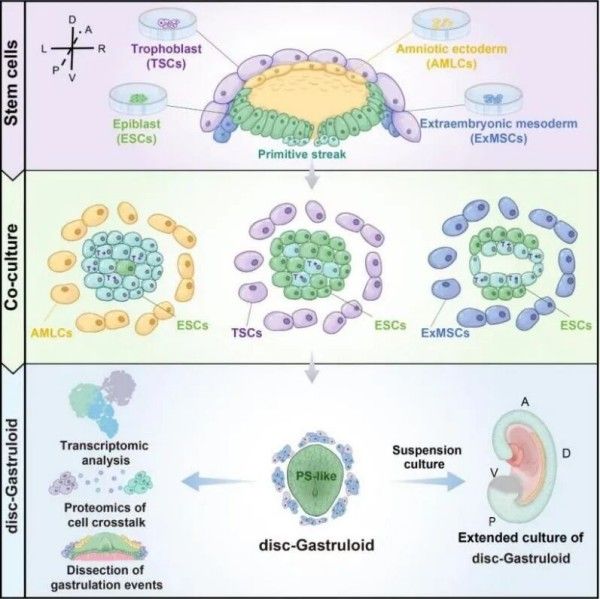
Schematic Diagram of the Disc-Gastruloid Model
Broad Impact: Opening New Avenues for Translational Life Sciences
This breakthrough does more than establish an in vitro embryo research platform free from ethical constraints, allowing scientists to directly observe and dissect the spatiotemporal control of gastrulation and reveal the fundamental logic behind early human body plan formation; it also holds vast promise for clinical medicine and regenerative medicine. The model can help trace the origins of congenital defects such as fetal malformations and early miscarriage, and serve as a human-specific alternative to animal models for studying disease mechanisms and testing new drug safety; moreover, it can generate seed cells for the heart, nervous system, liver, and other organs at scale, providing a stable and reliable cell source for building artificial organs in vitro and for cell-based therapies—bridging the gap between cutting-edge life science discoveries and real-world clinical applications.
Huairou Science City: A Launchpad for Cutting-Edge Science
Guided by the philosophy of “building components, assembling systems, and emulating function,” the Human Organ Physiopathology Emulation System (HOPE) will simulate diverse genetic backgrounds, complex multi-organ interactions, and multi-functional states, serving as an open, scenario-based research platform for life sciences, drug evaluation, regenerative medicine, and specialized applications. It is poised to drive transformative advances across the biomedical landscape. Construction began in January 2024, with full operation targeted for the end of 2028. By steadily delivering world-class original research, HOPE will help establish Huairou Science City as a globally leading innovation hub for stem cell science and life health.

Human Organ Physiopathology Emulation System (HOPE)