

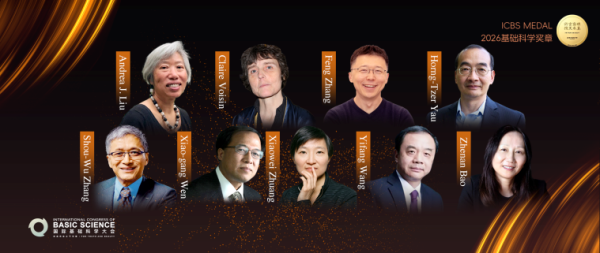
On the afternoon of May 18, the press conference for the 2026 International Congress of Basic Science (ICBS 2026) was held at Tsinghua University, officially announcing the 2026 ICBS Medal and Frontiers of Science Award winners. Nine world-class scientists were honored with the ICBS Medal. Among them, Claire Voisin, Horng-Tzer Yau, and Shou-Wu Zhang received the ICBS Medal in Mathematics; Andrea J. Liu, Yifang Wang, and Xiao-gang Wen received the ICBS Medal in Physics; and Zhenan Bao, Xiaowei Zhuang, and Feng Zhang received the ICBS Medal in Engineering.
As the inaugural award established in 2026, the ICBS Medal aims to honor scientists worldwide who have achieved revolutionary, breakthrough results in basic science, paying tribute to their outstanding contributions to scientific progress. The obverse of the medal features the portrait of a scientific giant, while the reverse is engraved with the motto “For Truth and Beauty” (钩玄穷理,搜美求真), symbolizing scientists’ unwavering commitment to the persistent pursuit of truth and the relentless exploration of ultimate beauty in their quest to uncover the profound laws of the universe. The award covers three fields—mathematics, physics, and engineering—with three medals in each field. The medals are named after nine towering figures in science: Emmy Noether, Shiing-Shen Chern, and Andrew Wiles (mathematics); Marie Curie, Samuel C.C. Ting, and David Gross (physics); and Chien-Shiung Wu, Steven Chu, and Charles K. Kao (engineering). Notably, each field features one medal named after a distinguished woman scientist. This year, four women scientists—Claire Voisin, Andrea J. Liu, Zhenan Bao, and Xiaowei Zhuang—were honored, fully demonstrating the scientific community’s high respect for women researchers and showcasing the outstanding power of women in basic science.
2026 ICBS Medal in Mathematics
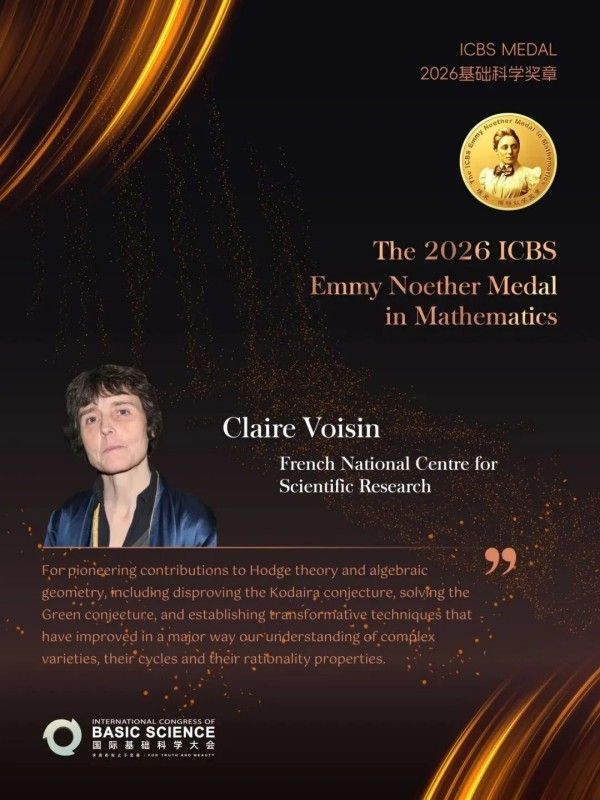
“The 2026 ICBS Emmy Noether Medal in Mathematics is awarded to Claire Voisin for pioneering contributions to Hodge theory and algebraic geometry, including disproving the Kodaira conjecture, solving the Green conjecture, and establishing transformative techniques that have improved in a major way our understanding of complex varieties, their cycles and their rationality properties.”
Claire Voisin is an eminent mathematician whose research has fundamentally advanced the development of modern algebraic geometry and Hodge theory. Her most important academic contributions include: disproving the Kodaira conjecture on higher-dimensional Kähler manifolds, constructing key counterexamples to the Hodge conjecture, and successfully proving the Green conjecture for general curves—a landmark achievement in the field of modern algebraic geometry.
Voisin has done much foundational work across numerous branches of algebraic geometry. She pioneered research on diagonal decompositions and, within this framework, introduced specialization methods, providing powerful tools for the study of rationality problems of Fano manifolds. Currently, she continues to focus on the geometry and arithmetic of algebraic cycles—a core research topic in algebraic geometry.
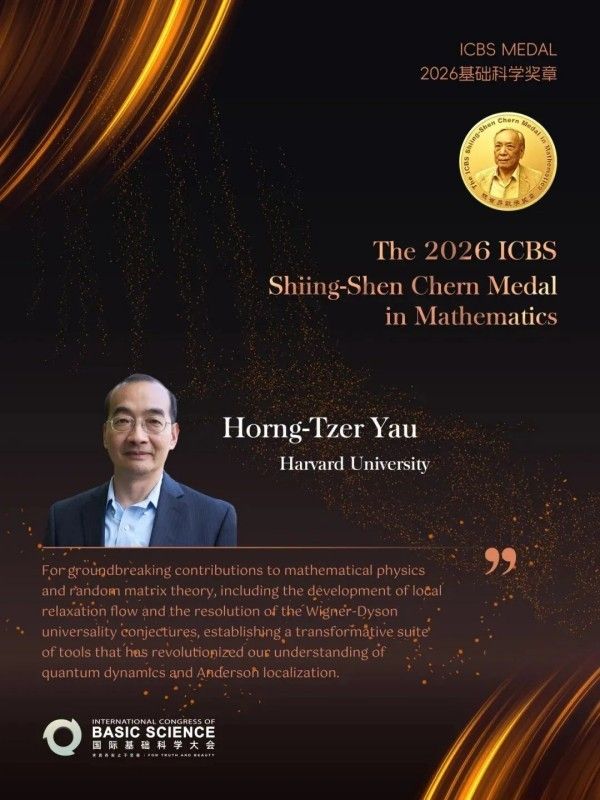
“The 2026 ICBS Shiing-Shen Chern Medal in Mathematics is awarded to Horng-Tzer Yau for groundbreaking contributions to mathematical physics and random matrix theory, including the development of local relaxation flow and the resolution of the Wigner-Dyson universality conjectures, establishing a transformative suite of tools that has revolutionized our understanding of quantum dynamics and Anderson localization.”
Horng-Tzer Yau is an eminent mathematical physicist whose academic work has fundamentally restructured contemporary research in probability theory and quantum many-body dynamics. His most important contributions include: jointly proposing the local relaxation flow method with collaborators, which—through its proof of universality for Wigner matrices—drove a paradigm shift in random matrix theory research. Subsequently, he launched a series of pioneering works in the field of quantum unique ergodicity, fortifying the theoretical cornerstone for our understanding of disordered quantum systems.
In the development of spectral analysis for random band matrices, Yau also made multiple critical contributions. He adapted thermal flow techniques and applied them to eigenvector analysis, expanding the analytical research framework and clarifying the transition mechanism between localization and delocalization. He continues to integrate physical intuition with sophisticated analytical methods, constructing core theoretical frameworks and recalibrating our understanding of complex random systems across multidisciplinary contexts.
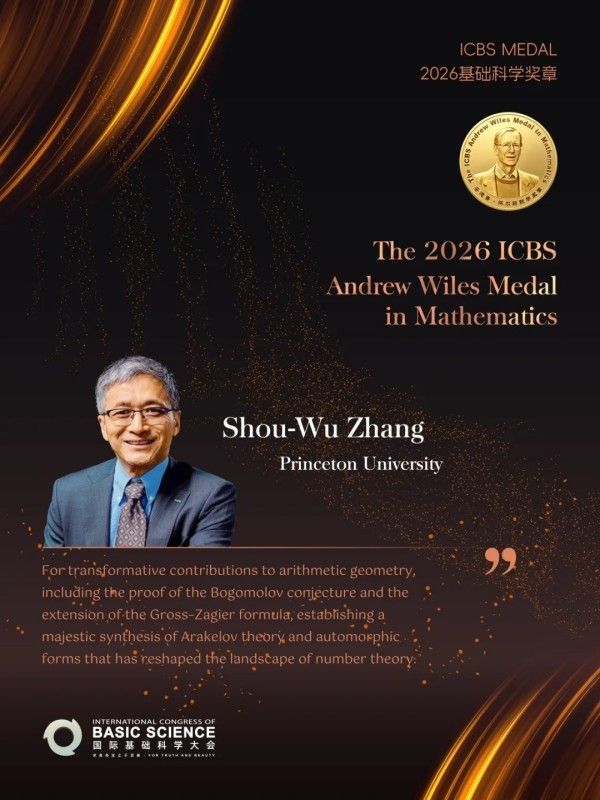
“The 2026 ICBS Andrew Wiles Medal in Mathematics is awarded to Shou-Wu Zhang for transformative contributions to arithmetic geometry, including the proof of the Bogomolov conjecture and the extension of the Gross-Zagier formula, establishing a majestic synthesis of Arakelov theory and automorphic forms that has reshaped the landscape of number theory.”
Shou-Wu Zhang is an eminent mathematician whose academic work has fundamentally reshaped research in modern arithmetic geometry and number theory. His most important contributions include: pioneering work on the equidistribution theorem of small points, and the rigorous proof of the Bogomolov conjecture over number fields. Subsequently, he generalized the Gross–Zagier formula to Shimura curves over totally real fields, laying the cornerstone of modern Arakelov theory.
Zhang has also made numerous critical contributions to the development of the Kudla program and the Gan–Gross–Prasad conjecture. He pioneered a highly transformative research approach that unifies dynamical systems with automorphic forms, providing profound and elegant insights into the study of arithmetic cycles. He continually strives to integrate natural geometric phenomena with sophisticated analytical tools, offering important theoretical frameworks for understanding contemporary arithmetic geometry and problems at the intersection of multiple mathematical disciplines.
2026 ICBS Medal in Physics
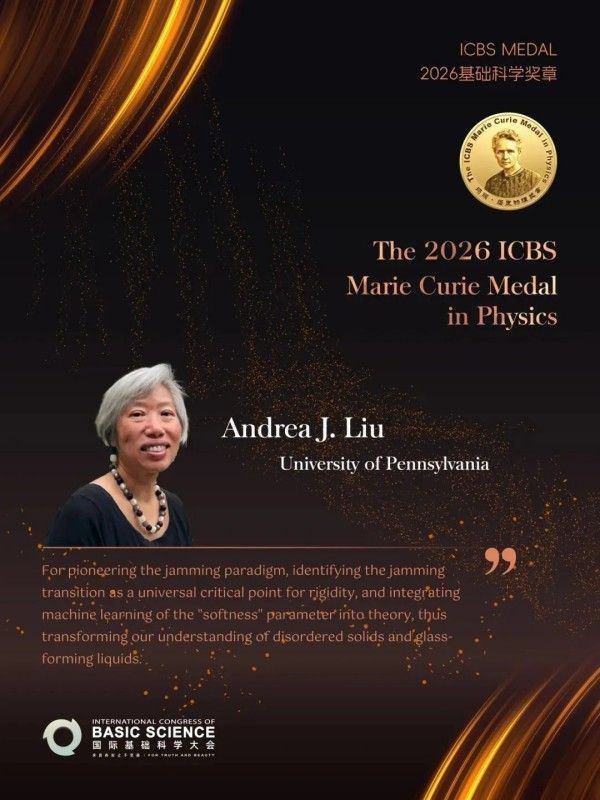
“The 2026 ICBS Marie Curie Medal in Physics is awarded to Andrea J. Liu for pioneering the jamming paradigm, identifying the jamming transition as a universal critical point for rigidity, and integrating machine learning of the “softness” parameter into theory, thus transforming our understanding of disordered solids and glass-forming liquids.”
Andrea J. Liu is an eminent theoretical physicist whose academic achievements have profoundly influenced contemporary research in both soft matter and statistical physics. Her most influential academic contributions include: proposing the “jamming phase diagram,” unifying the study of foams, glasses, and granular media within a single theoretical framework, and driving a major paradigm shift in the discipline. Subsequently, she launched frontier research on the jamming transition, laying the core theoretical cornerstone for understanding how amorphous materials transform into rigid states.
Liu has also expanded the application scope of analytical theory by introducing the machine learning-based softness parameter to elucidate the properties of glass-forming liquids and disordered solids, deepening our understanding of such materials. She combines biological phenomena with sophisticated physical engineering techniques, providing an interdisciplinary research paradigm for the emergence of collective function in tunable matter.
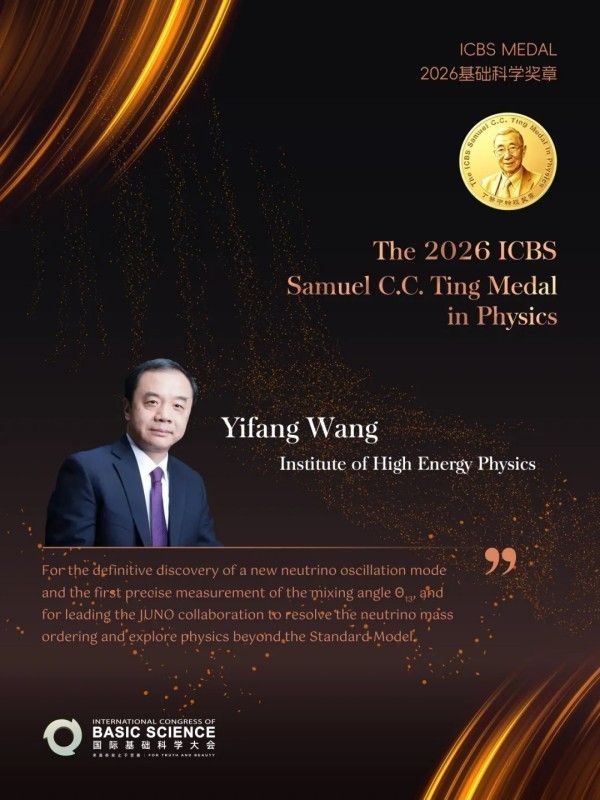
“The 2026 ICBS Samuel C.C. Ting Medal in Physics is awarded to Yifang Wang for the definitive discovery of a new neutrino oscillation mode and the first precise measurement of the mixing angle Θ₁₃, and for leading the JUNO collaboration to resolve the neutrino mass ordering and explore physics beyond the Standard Model.”
Yifang Wang is an eminent physicist whose academic achievements have profoundly reshaped contemporary research in high-energy physics and neutrino physics. His most significant contribution was the joint discovery of the neutrino mixing angle Θ₁₃ through the Daya Bay experiment—a result that overturned the academic community’s established understanding of neutrino oscillation modes and propelled the field into an entirely new paradigm. Subsequently, he took the lead in directing the Jiangmen Underground Neutrino Observatory (JUNO) project, fortifying the foundation for the global effort to tackle the challenge of measuring neutrino mass ordering.
Wang has also built distinguished accomplishments in large-scale detector technology development and international scientific collaboration. Through designing ultra-sensitive liquid scintillator systems, he significantly enhanced the precision and discrimination level of reactor antineutrino detection, broadening the research boundaries of experimental physics. He has long been dedicated to frontier fields, integrating profound physical theoretical insight with complex engineering technology to build key theoretical frameworks and lay an important foundation for re-understanding contemporary particle physics from an interdisciplinary perspective.
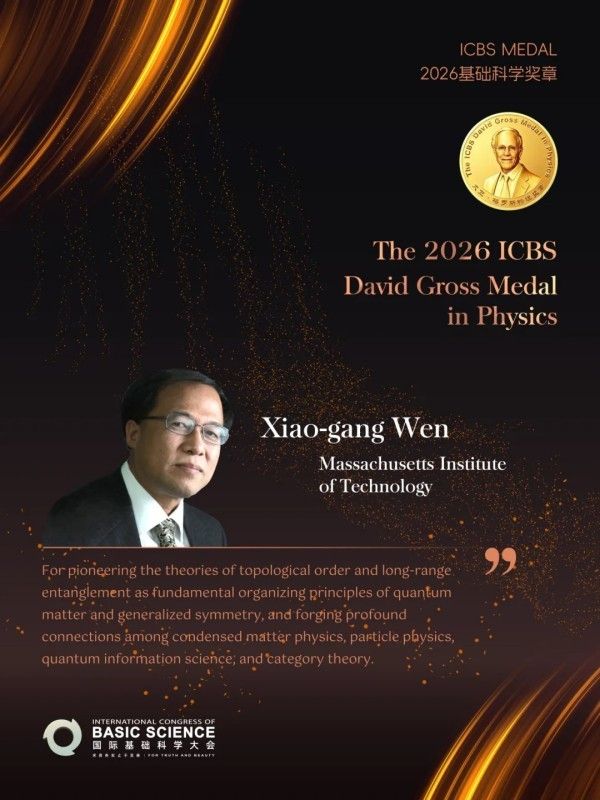
“The 2026 ICBS David Gross Medal in Physics is awarded to Xiao-gang Wen for pioneering the theories of topological order and long-range entanglement as fundamental organizing principles of quantum matter and generalized symmetry, and forging profound connections among condensed matter physics, particle physics, quantum information science, and category theory.”
Xiao-gang Wen is an internationally renowned eminent physicist whose academic work has reshaped the theoretical system of modern condensed matter physics. His most influential contributions include proposing the concept of topological order and clarifying long-range entanglement as the microscopic origin of topological order. These achievements broke through Landau’s symmetry-breaking theory of matter phases and transcended symmetry cognition based on group theory, establishing a new paradigm for condensed matter physics research. He proposed the string-net condensation theory, constructing a profound theoretical framework that elucidates how gauge interactions and Fermi statistics emerge from local quantum bits and can be unified through local quantum bits.
Wen has been a driving force in introducing fusion categories and higher category theory into condensed matter physics, establishing this theoretical framework (rather than group theory) as the core mathematical architecture for describing topological quantum states of matter, many-body entanglement, and symmetry-protected topological theories. He continues to dedicate himself to frontier research, deeply integrating condensed matter physical phenomena with sophisticated quantum information theory and mathematical category theory, constructing key theoretical frameworks that have recalibrated our understanding of the nature of topological quantum phases, many-body entanglement, and symmetry-protected topological theories. His research achievements span multiple disciplines.
ICBS Medal in Engineering
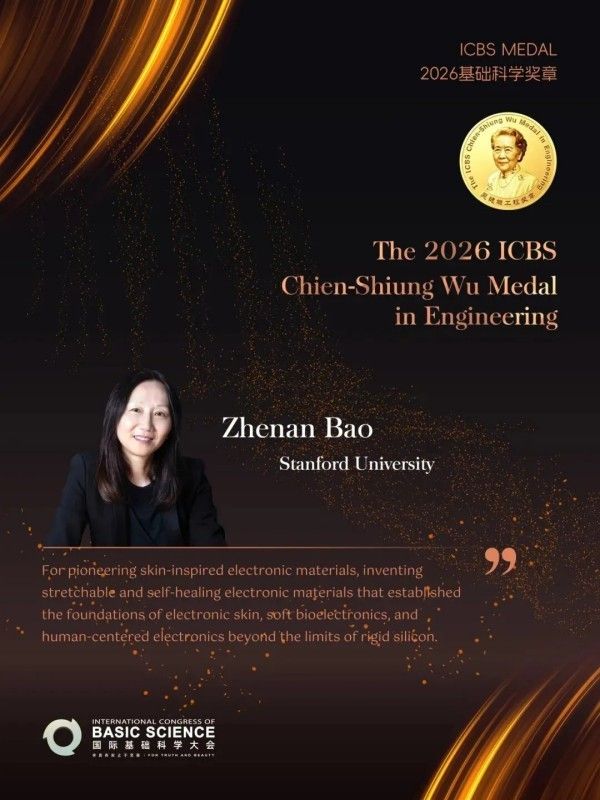
“The 2026 ICBS Chien-Shiung Wu Medal in Engineering is awarded to Zhenan Bao for pioneering skin-inspired electronic materials, inventing stretchable and self-healing electronic materials that established the foundations of electronic skin, soft bioelectronics, and human-centered electronics beyond the limits of rigid silicon.”
Zhenan Bao is an internationally top-tier materials scientist whose pioneering research has profoundly shaped the fields of organic electronics, flexible bioelectronics, and human-centered electronics. Her most influential research achievements include: developing high-performance organic semiconductors, the first all-printed plastic transistor, and high-speed stretchable polymer integrated circuits—these breakthroughs shattered the restrictions that rigid, fragile silicon-based materials had imposed on electronic technology. The above scientific advances laid the core foundation for the material research and fabrication processes of “electronic skin,” validating that synthetic materials can combine the softness, stretchability, self-healing capability, and durability of biological tissues with sophisticated electronic functions.
Bao’s foundational research in polymer electronic materials has fortified the foundation for the development of wearable and implantable systems that can intimately interface with the human body, with broad applications in healthcare, intelligent robotics, prosthetic devices, and human-machine interaction. Guided by the same research philosophy, she developed NeuroString—a hair-thin electronic sensing fiber for application in neural engineering technology, enabling the fabrication of minimally invasive implantable devices for use in cardiac, gastrointestinal, and urinary systems, as well as long-term precise monitoring of physiological signs, among others. She continues to dedicate herself to frontier research, deeply integrating chemical engineering with advanced electronic technology, proposing a series of fundamental material design concepts and fabrication methods in the new research field at the intersection of synthetic materials, electronic technology, and living systems.
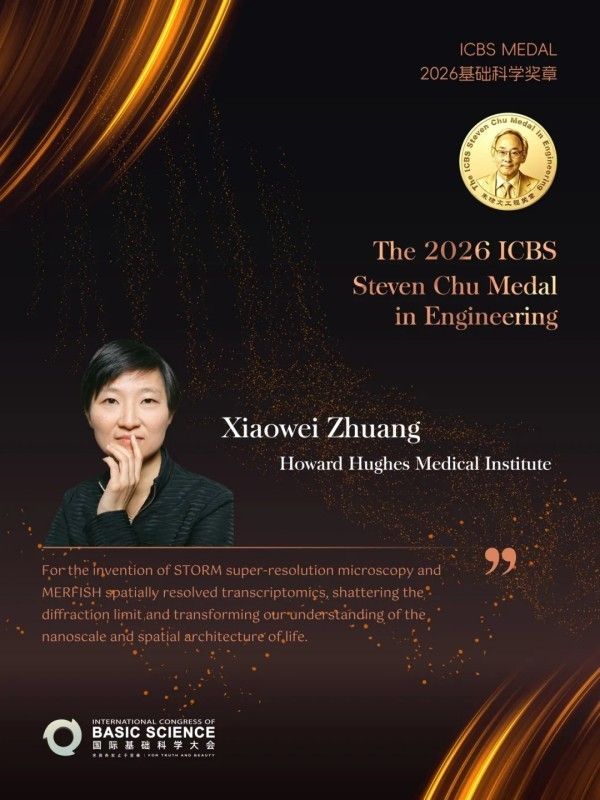
“The 2026 ICBS Steven Chu Engineering Medal is awarded to Xiaowei Zhuang for the invention of STORM super-resolution microscopy and MERFISH spatially resolved transcriptomics, shattering the diffraction limit and transforming our understanding of the nanoscale and spatial architecture of life.”
Xiaowei Zhuang is an internationally top-tier biophysicist whose work has profoundly shaped the development landscape of modern biological imaging and spatial genomics. Her most influential achievement was the invention of stochastic optical reconstruction microscopy (STORM), a super-resolution imaging technology that successfully broke through the optical diffraction limit. This major breakthrough provided critical support for resolving cellular nanoscale structures, revealing the arrangement patterns of molecular components within cells at a precision level previously considered unattainable by the academic community.
In the field of high-resolution biological analysis, Zhuang has also made multiple critical contributions. She pioneered the development of spatially resolved transcriptomics technology MERFISH (multiplexed error-robust fluorescence in situ hybridization), capable of simultaneously localizing thousands of distinct RNA molecules within a single cell. This technology established a research framework integrating molecular biology with spatial context, providing important insights for resolving the functional architecture of tissues. She remains committed to combining physical principles with advanced imaging technologies, developing a series of fundamental tools that have reshaped our understanding of cellular organization and gene expression from a multidisciplinary perspective.
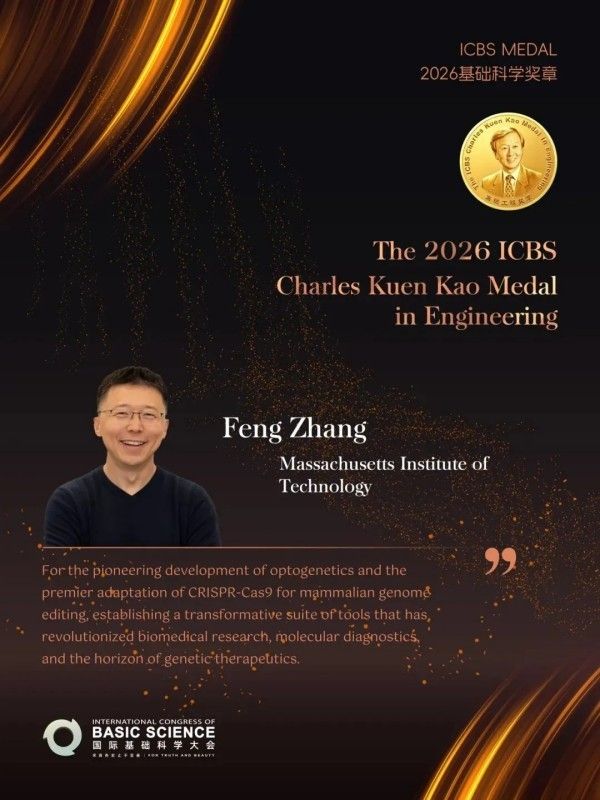
“The 2026 ICBS Charles Kuen Kao Medal in Engineering is awarded to Feng Zhang for the pioneering development of optogenetics and the premier adaptation of CRISPR-Cas9 for mammalian genome editing, establishing a transformative suite of tools that has revolutionized biomedical research, molecular diagnostics, and the horizon of genetic therapeutics.”
Zhang is an internationally eminent molecular biologist and bioengineer whose academic achievements have fundamentally shaped contemporary research in neuroscience and genome architecture. His most iconic contributions include co-pioneering optogenetics technology, which—through achieving light-driven control of brain cells—fundamentally transformed the paradigm of neural network research. Subsequently, he was the first to demonstrate that CRISPR-Cas9 technology could be used for eukaryotic genome editing, laying the core cornerstone for modern biotechnology.
In the development of programmable biomolecular technologies, Zhang has also made multiple critical contributions. Through optimizing Cas12 and Cas13 enzymes and applying them to multidimensional DNA/RNA manipulation, he expanded the “nuclease application scope,” and—together with collaborators—developed SHERLOCK, an ultra-high-sensitivity diagnostic technology that significantly enhanced the precision and resolution capability of molecular detection. He dedicates himself to frontier fields, long committed to integrating natural biological phenomena with cutting-edge engineering technology, constructing key theoretical frameworks, redefining our understanding of cellular dynamic mechanisms, and opening up entirely new directions for gene therapy in interdisciplinary fields.