

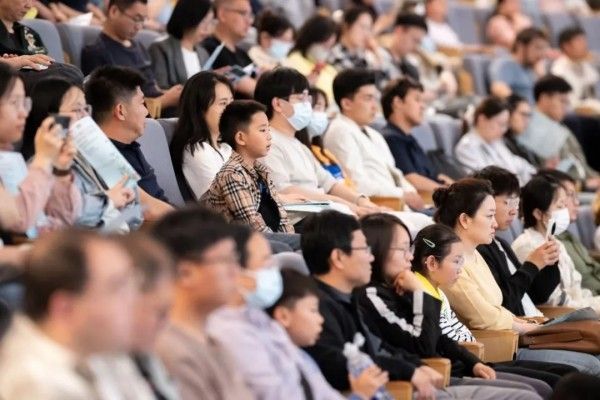
With surging melodies, science and art met beautifully on an early summer evening. On the evening of May 8, the lecture hall of Block A, Urban Living Room, Huairou Science City, was filled with the sound of strings and waves of applause. The first event of the 2026 National Centre for the Performing Arts (NCPA) May Festival Benefit Performance opened here. Titled “Rhythm Shaping the Future,” this performance featured May Festival Artistic Director and renowned violinist Lyu Siqing, together with young pianist Wang Chao, presenting a splendid immersive concert to over 400 audience members, including scientific researchers and their families, as well as students from the University of Chinese Academy of Sciences.
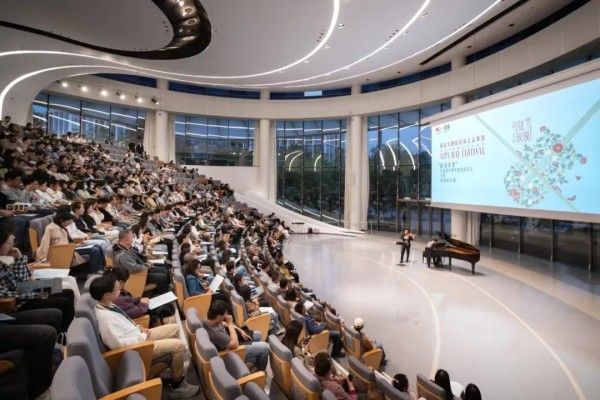
As the first Asian violinist to win the gold medal at the International Violin Competition “Premio Paganini,” Lyu Siqing is a globally celebrated Chinese performer, acclaimed as the “Oriental Paganini” and the “finest interpreter of ‘The Butterfly Lovers’.” Young pianist Wang Chao has been praised by France Musique as “a pianist with a palette of colors.”
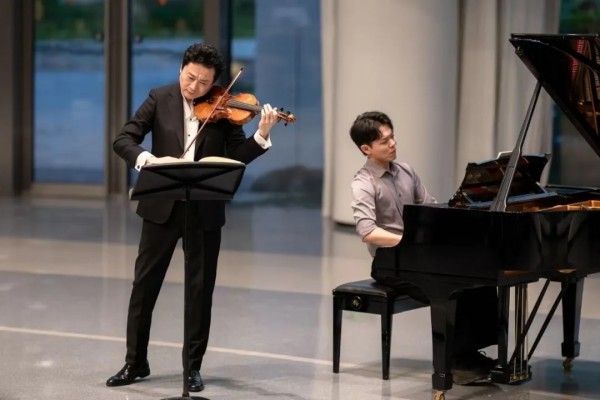
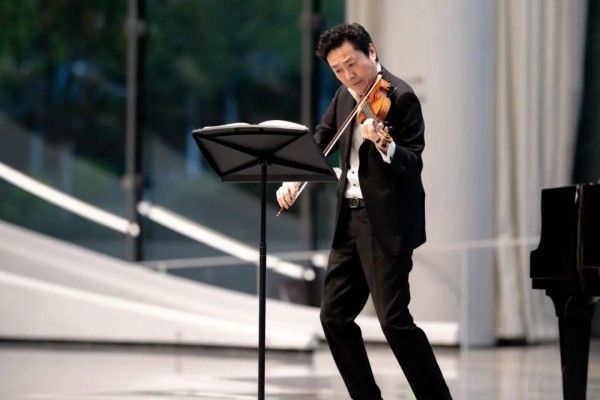
“Huairou Science City has created scientific miracles on this land, and continues to develop and reach new heights. Coming here today to pay tribute and extend greetings to our nation’s outstanding scientists through music—I find this deeply meaningful,” said Lyu.
Lyu and Wang opened with Mozart’s Violin Sonata No. 10—the Andante flowing with lyrical grace, the Allegro bright and spirited, fully displaying classical charm. They then performed Beethoven’s Violin Sonata No. 5 in F Major, “Spring,” overflowing with vitality and hope, complementing the innovative atmosphere of Huairou Science City. The program gradually transitioned from Western classics to national sentiment: Lei Zhenbang’s “Why Are the Flowers So Red” was tender yet fervent, He Zhanhao and Chen Gang’s Violin Concerto “The Butterfly Lovers” (excerpt) was tragically moving, and Paganini’s Violin Sonata in A Major blazed with brilliant melody.
Amid enthusiastic applause from the audience, Lyu returned to the stage to perform Kreisler’s “Liebesfreud”—its melody light, warm, and overflowing with affection, bringing the concert to a touching close. The consummate artistry of both musicians earned sustained, thunderous applause.
“My work demands extremely high precision, so my nerves are always on edge.” For Sun Yumeng, assistant engineer at the Meridian Project Operation and Research Center, this concert was a rare opportunity to relax. “Hearing that melody from ‘The Butterfly Lovers’ today, I just melted into relaxation. Science pursues precision; music moves the heart—both demand complete focus, yet the feeling is entirely different.”
“Before, if I wanted to see a performance at the NCPA, the round trip alone would take two or three hours. Today, I walked a few steps from work to the concert venue,” said Ma Ling of the Beijing Laser Acceleration Innovation Center, full of praise for this world-class concert right at her doorstep. “It’s quite moving that the NCPA can bring such a high-level performance directly to us.”
“The Science City is not only about laboratories and large research infrastructures—cultural events like this concert also nourish the soul, adding depth and texture to life here,” said Bai Yang, General Manager of Beijing Huairou Science City Technology Service Co., Ltd.
Since its launch in 2012, the NCPA May Festival Benefit Performance has cumulatively held 207 public benefit events, reaching nearly 37,200 audience members. In 2026, the May Festival Benefit Performance centers on Beijing’s development in the new era, focusing on the city’s vision to develop itself into “four national centers”—the national political center, cultural center, international exchange center, and science and technology innovation center—delivering 11 high-quality benefit performances to working professionals and citizens of the capital, allowing art to become part of the city’s fabric and daily life.
“Refined art has never been confined within palace walls—it should take root in the fertile soil of the city and pay tribute to those who toil and strive. Art and science have always been intertwined and mutually resonant; many researchers also harbor artistic passions. This benefit performance coming to Huairou Science City, using music as a bridge to reach the heart of scientific research, serves both to enrich the spiritual and cultural lives of scientific workers and to empower the high-quality development of science and technology innovation in China’s capital through the power of art,” said Wang Ban, Vice President of the National Centre for the Performing Arts.